
 TRIAL LESSON
Pianists, Piano Lessons
Stephen Hough in London: Virtuosity, Poetry and the Art of Serious Piano Listening
Jun
Stephen Hough in London
WKMT London listening guide
Stephen Hough in London: Virtuosity, Poetry and the Art of Serious Piano Listening
A cultured WKMT guide to Sir Stephen Hough’s London presence, recordings, composition, and the listening habits that make his playing so rewarding for serious adult pianists.
Quick overview: who Stephen Hough is
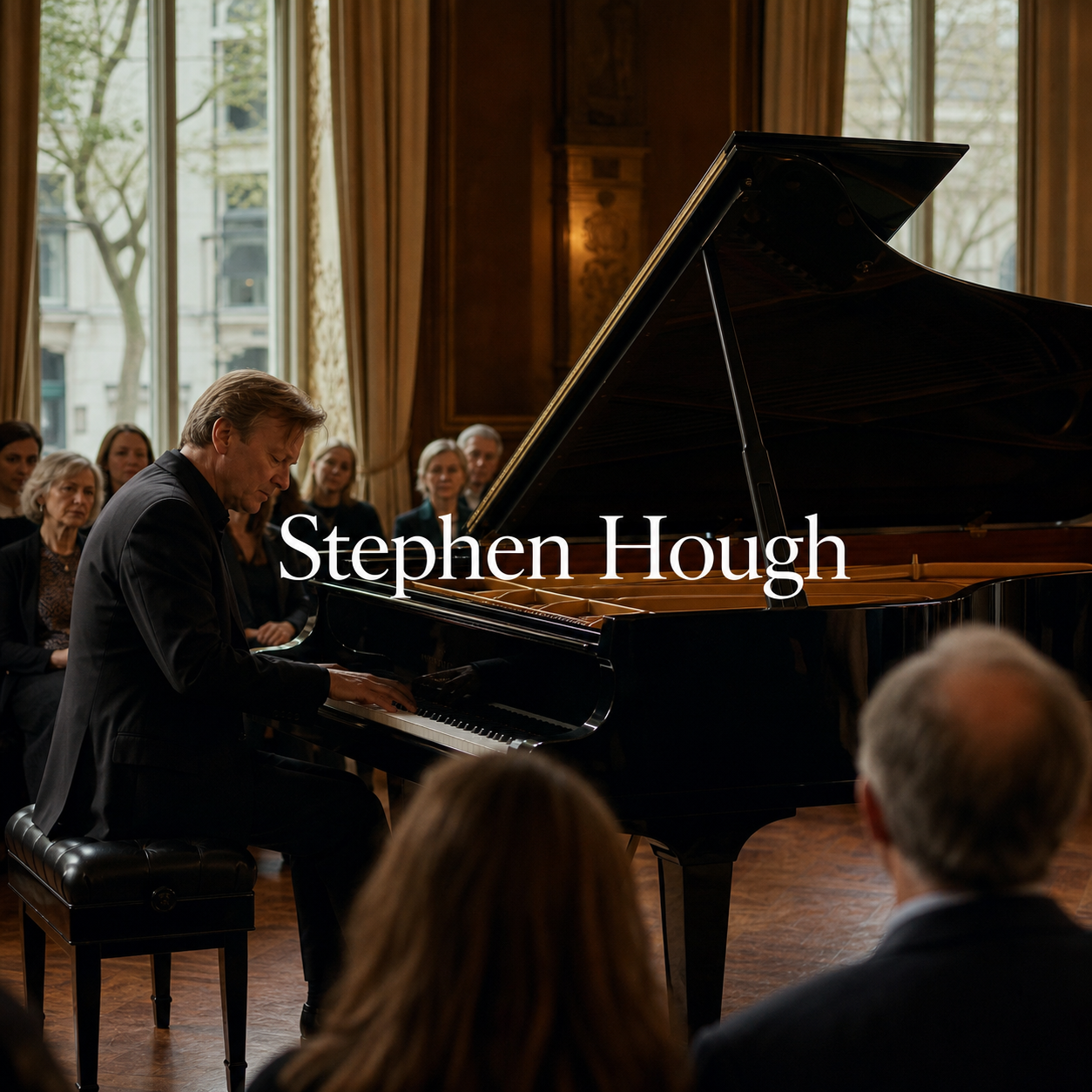
Stephen Hough is a British pianist, composer and writer whose career sits unusually comfortably between the concert platform, the recording studio and the essay. His official biography describes a musician who combines a major pianistic career with composition and writing, and records that he was knighted in the 2022 Queen’s Birthday Honours [1].
Why this matters to you in London: Hough is not a remote discographic name; he belongs to the living recital culture that shapes how London listeners hear the piano.
Why he matters to London’s musical life
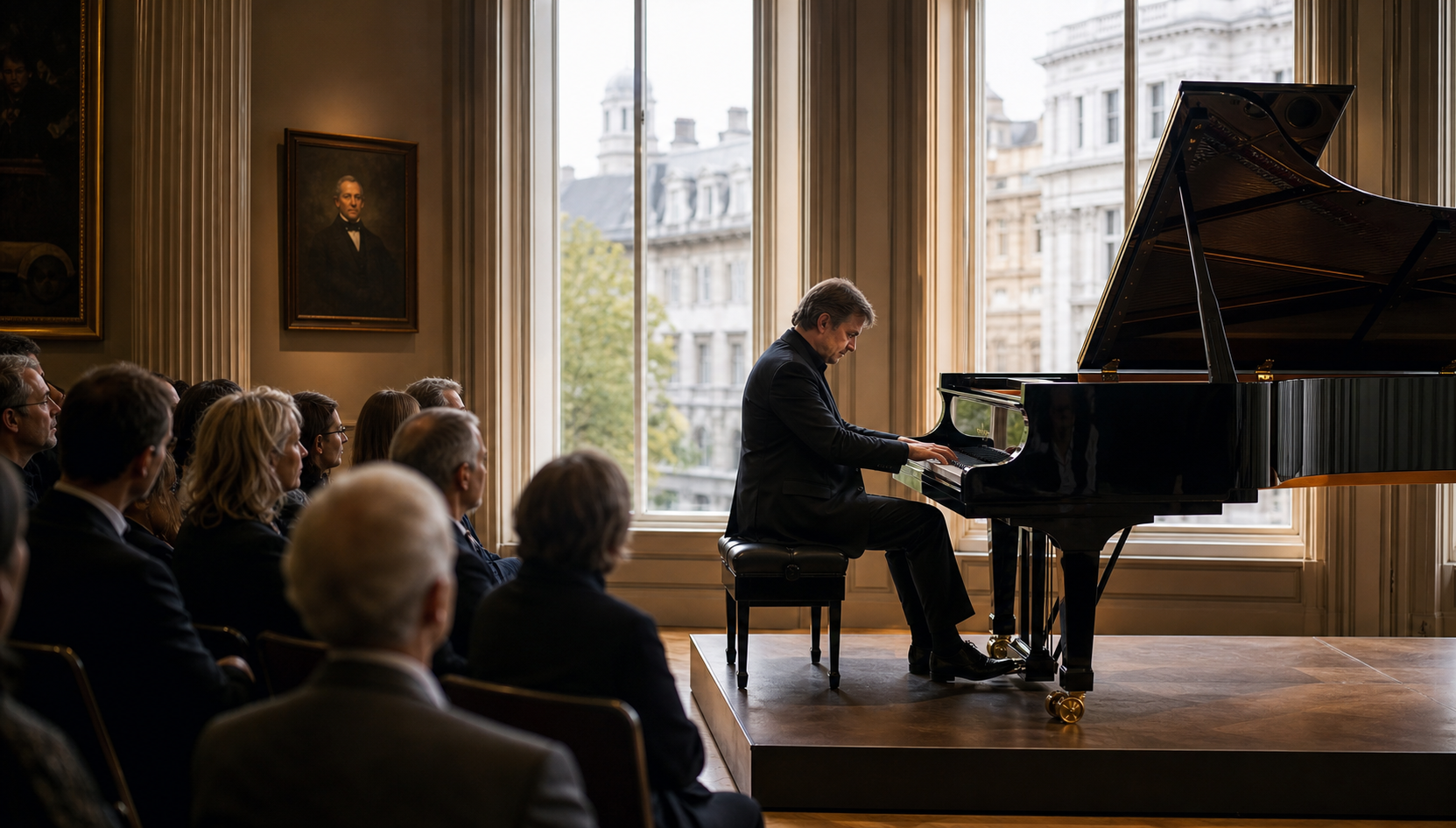
London has heard Hough in several registers: concerto soloist, recitalist, composer-performer and public musical thinker. His own performance listings showed a Wigmore Hall recital on 19 May 2026, with Schubert, Brahms, Schoenberg, Stockhausen, Beethoven, Schumann and Hough’s Mary Poppins Suite on the same programme, last checked on 15 June 2026 [2]. That kind of programming is revealing. It refuses the narrow idea that virtuosity is merely fast playing; it treats the piano as a historical, theatrical and intellectual instrument.
The same London map reaches beyond Wigmore Hall. HarrisonParrott’s current biography notes Royal Festival Hall, the BBC Proms, Aldeburgh and Edinburgh among the institutions and festivals in which Hough has been a regular presence [3]. Southbank Centre listed the UK premiere of his Piano Quintet Les noces rouges with the Viano Quartet, again showing the dual identity: pianist at the keyboard, composer in the programme [4].
For WKMT readers, this matters because a pianist such as Hough models the type of listening that develops serious musical judgement: structure before display, colour before volume, and wit without superficiality. It is the same hierarchy that should guide advanced study in classical piano study in London.
Why this matters to you in London: his programmes make the capital a practical classroom for adult listeners, not only a place to consume concerts.
Signature repertoire and recorded highlights
Hough’s catalogue is wide, but a few territories define the public image: Chopin and Liszt for brilliance and poetry; Rachmaninov and Saint-Saens for concerto glamour; Mompou, Schubert and late Brahms for intimacy; and his own music for the composer’s ear. His official recordings page lists the Chopin Waltzes on Hyperion, the 2025 Hough Piano Concerto album with the Halle and Sir Mark Elder, Mompou’s Musica callada, Schubert sonatas, Chopin Nocturnes, Brahms chamber sonatas, Beethoven concertos and many more [5].
The 2025 Hough concerto release is especially useful for understanding his present artistic profile. The official news page notes the album and the European premiere of The World of Yesterday with the Halle and Sir Mark Elder [6]. The point is not novelty for its own sake. It is that Hough’s repertoire has become a conversation between inherited style and personal invention.
Liszt, concerto repertoire and brilliant transcriptions ask for clarity under pressure.
Chopin, Mompou and Schubert reveal proportion, breath and tonal restraint.
Beethoven, Brahms and Schumann test whether the listener can follow long-range argument.
Why this matters to you in London: recordings let you prepare for the hall, so the first live hearing is already a deeper one.
A serious listener’s annotated guide
Begin with Hough’s Chopin. Listen for how a phrase can glow without becoming sentimental. In the Nocturnes and Waltzes, the surface charm is only the doorway; the real lesson is proportion. If a rubato disturbs the dance, it has gone too far. If it never breathes, it is not Chopin. Hough’s appeal lies in keeping these two dangers in tension.
Move next to Schumann, especially Fantasie and Kreisleriana. Here the listener should follow changes of character as if watching a mind move from tenderness to agitation and back again. The lesson for adult pianists is not to exaggerate each mood, but to give each one a distinct temperature. WKMT’s article on analysing musical sentences is a useful companion: expressive freedom becomes stronger when phrase grammar is clear.
For concerto listening, try Rachmaninov and Saint-Saens. The Guardian’s review of the Last Night of the Proms in 2024 described Hough as a nuanced soloist in the second movement of Saint-Saens’s Egyptian Concerto, a useful reminder that brilliance may be most persuasive when it glitters lightly [7]. In Rachmaninov, listen for the bass line and the orchestral dialogue before judging the big tune.
| Listening focus | What to notice | Practice transfer |
|---|---|---|
| Tone | How colour changes without forcing volume. | Shape a melody at three dynamic levels. |
| Time | Where flexibility serves the phrase rather than habit. | Record one phrase twice: strict pulse, then musical pulse. |
| Structure | How small contrasts belong to a larger design. | Mark cadences before practising speed. |
Why this matters to you in London: a good recital ticket becomes better value when your ear has been prepared before you arrive.
Landmark London performances and premieres
A compact London timeline shows the shape of Hough’s local relevance. He has made repeated BBC Proms appearances; his official biography counts twenty-nine concerto appearances at the Proms [1]. In September 2024 he appeared at the Last Night of the Proms at the Royal Albert Hall, with Saint-Saens and his own Mary Poppins arrangement discussed in contemporary reviews [7]. In October 2025, Southbank Centre’s listing placed the UK premiere of Les noces rouges at Queen Elizabeth Hall [4]. In May 2026, Wigmore Hall listed a recital programme joining Schubert, Brahms, Schoenberg, Stockhausen, Beethoven, Schumann and Hough’s own arrangement [2].
For students, this is a useful contrast. The same pianist must persuade in different rooms: breadth at the Proms, inwardness at Wigmore, clarity in a chamber premiere. That is why serious performance preparation at WKMT often includes not only repertoire, but the ability to understand venue, audience and programme. See also WKMT’s guidance on preparing a first music performance.
Why this matters to you in London: Hough’s career helps listeners hear how a room changes musical meaning.
Hough as composer, writer and public intellectual
Hough’s composer-writer identity is not a side note. His official biography lists commissions from the Takacs Quartet, Wigmore Hall, the National Gallery, the Louvre and other institutions, and notes his work for orchestra, choir, chamber ensemble, organ, harpsichord and solo piano [1]. His books and essays place performance inside a broader life of thought, belief, memory and culture.
This matters musically. A performer who writes and composes tends to phrase as someone who understands construction from the inside. In the Hough Piano Concerto, in Les noces rouges, and in the lighter Mary Poppins Suite, the same impulse appears in different clothes: wit, craft, sharp timing and an appetite for transformation. London is unusually receptive to this kind of musician because its audiences are used to crossing between recital halls, galleries, churches, public lectures and festivals.
Why this matters to you in London: a richer musical life begins when concerts, lessons and reading inform each other.
Develop this kind of listening at WKMT
If Hough’s playing draws you toward deeper tone, phrase and structure, WKMT can help you turn serious listening into disciplined piano study in London.
How to hear Stephen Hough in London today
First, check Hough’s own performances page and the venue box office, because dates, returns and ticket availability change quickly [2]. For Wigmore Hall recitals, choose seats that let you hear the treble without being too close to the instrument; the middle of the hall often gives a truer blend. For Royal Festival Hall or Proms contexts, read the whole programme, not just the soloist’s name. Hough’s strongest effect often comes from how he reframes familiar music among unexpected neighbours.
Before going, listen to one recording from the same family of repertoire, then stop. Over-preparation can make a live performance feel like a comparison exercise. A better habit is to carry three questions into the hall: what is the sound-world, where is the long line, and how does the performer manage surprise?
Adult pianists who want to develop this listening into practical work can use adult piano lessons at WKMT to connect tone, analysis and repertoire choices. For performance context, the WKMT London piano masterclasses page is also a natural next step.
Why this matters to you in London: the city offers enough concerts that the real task is not access, but choosing and hearing well.
Discography, selected bibliography and FAQs
Where should a new listener begin? Start with Chopin, Schumann or Mompou if you want inward playing, and Rachmaninov or Saint-Saens if you want concerto brilliance. Hough’s own recordings page gives a reliable route through labels and catalogue numbers [5].
When does Stephen Hough perform in London? Check his official performances page, Wigmore Hall, Southbank Centre and BBC Proms listings. Current and archive information changes, so use the official venue page before making plans.
What makes his playing useful for adult students? Hough demonstrates how virtuosity can remain elegant, how poetry can remain disciplined, and how serious listening can guide practice without becoming academic.
Selected listening and reading should include Hough’s Chopin Waltzes, Chopin Nocturnes, Schumann recital recordings, Mompou Musica callada, Beethoven concertos, the 2025 Hough concerto album, and his books Rough Ideas and Enough, verified through his official recordings and books pages [5].
Why this matters to you in London: good discography is not collecting; it is ear-training with better materials.
Sources on Stephen Hough
- Sir Stephen Hough, official biography, stephenhough.com/about
- Sir Stephen Hough, official performances page, stephenhough.com/performances
- HarrisonParrott artist biography, Sir Stephen Hough
- Southbank Centre listing, Stephen Hough & Viano Quartet, southbankcentre.co.uk
- Sir Stephen Hough, official recordings page, stephenhough.com/recordings
- Sir Stephen Hough, official news page, stephenhough.com/news
- The Guardian, Last Night of the Proms 2024 review, theguardian.com
- WKMT page and post sitemaps, page sitemap and post sitemap