
 TRIAL LESSON
Piano Lessons
Piano Voicing: A London Teacher’s Guide to Melody, Colour and Inner Lines

Jun
Piano voicing explained for London pianists
Piano technique and tone
Piano Voicing: A London Teacher’s Guide to Melody, Colour and Inner Lines
Piano voicing is where technique, listening and the physical instrument meet. For the pianist, it means deciding which notes speak, which recede, and how colour changes with touch. For the technician, it means shaping the hammer and action so the instrument can answer that intention.

Good voicing is not simply playing the melody louder. It is the art of proportion: the treble line singing without glare, the accompaniment breathing without heaviness, and the inner voices becoming audible at the exact moment the music needs them. In a London lesson room, we hear the issue immediately when a pupil has worked hard on notes but the musical hierarchy is still flat. The piece is correct, yet it does not yet speak.
That is why piano voicing matters to intermediate players, advanced students, accompanists and serious adult amateurs. It turns the keyboard from a row of equal buttons into a layered ensemble. It also helps a pianist judge an instrument more intelligently. A bright piano, a deep concert grand, a small practice upright and a resonant recital hall each ask for a different kind of listening.
What Is Piano Voicing? Performer and Technician Meanings

The phrase has two legitimate meanings. Performer voicing is the pianist’s control of balance between parts: melody against accompaniment, bass against treble, right hand against left, and one finger inside a chord against the others. Technician voicing, sometimes called tone regulating, concerns the piano itself: hammer shape, hammer density, string contact, action regulation and the evenness of tone from note to note.
The two meanings are connected. A pianist cannot project a soprano line gracefully if the action is uneven, the hammers are deeply grooved, or one register is markedly harder than the next. Equally, even the finest concert preparation cannot replace a pianist’s ear. The instrument supplies the possibility; the player supplies the musical grammar.
Why Piano Voicing Matters: Musical, Acoustic and Interpretive Effects
Voicing changes the listener’s sense of structure. In Bach, it clarifies counterpoint. In Mozart, it separates elegance from blandness. In Chopin, it lets a melody float above harmonic movement without forcing the hand into theatrical loudness. In Debussy, it decides whether a chord sounds like a block or a wash of colour.
Acoustically, voicing also governs how sound travels. A note played with too much vertical attack may seem brilliant under the player’s ear but harsh at a distance. A melody that is beautifully balanced in a dry practice room may disappear in a larger space unless the pianist thinks about release, resonance and projection. The ear must learn to judge both the immediate keybed sensation and the sound returning from the room.
A well-voiced performance sounds inevitable: not louder for its own sake, but clearer in its musical priorities.
Performer Piano Voicing: Touch, Melody Colour and Inner Lines

Tone sources: touch, weight and finger economy
The hand does not create tone by pressure after the key has reached the bed. Tone is shaped before and during descent: by preparation, finger contact, arm weight, speed, release and the player’s inner hearing. A singing top line usually needs economy elsewhere. If every finger tries to be important, no line becomes important. A teacher will often ask the pupil to feel the leading finger as more grounded while the supporting fingers remain alive but lighter.
Balance and managing inner voices across hands
Many voicing problems are coordination problems. A left-hand accompaniment may be rhythmically correct yet too present; an inner alto line may vanish because the hand is organised around the thumb; a bass may speak too late to support the harmony. The solution is rarely brute force. It is better to hear the desired layer first, then let the hand find a smaller, cleaner choreography.
Style notes: Classical, Romantic, Impressionist and jazz
Classical voicing often asks for transparency and proportion; Romantic voicing expands the singing line and harmonic bass; Impressionist repertoire depends on colour gradients and pedalled resonance; jazz voicing adds spacing, register and harmonic tension to the player’s palette. The common principle is hierarchy. The listener should know what to follow without feeling that the pianist is pointing at it too heavily.
Technician Voicing: Hammers, Needles, Regulation and the Player’s Response

Technician voicing begins with the condition of the instrument. The Piano Technicians Guild describes fine piano maintenance as involving tuning, action regulation and voicing, with voicing usually considered after hammer shape, alignment and regulation are in order. That sequence is musically sensible. If a hammer does not meet the strings cleanly, or the action cannot repeat evenly, tonal work alone will not solve the pianist’s problem.
Hammer felt can become compacted by use. If the sound is too bright, loud or short-lived, a technician may soften selected areas of the felt with needles so the hammer has more flexibility. If the sound is weak or over-mellow, the technician may remove soft outer felt or use a hardening treatment. These decisions should be made by a qualified technician, not by the player experimenting at home.
Regulation affects voicing because the action translates finger motion into hammer motion. The PTG notes that the action, trapwork and damper system all require precise adjustment for even response. For the pianist, this means that some apparent technical faults are partly mechanical. A note that refuses to sing may be a listening issue, a touch issue, or an instrument issue. Good teaching learns to separate the three.
This distinction is especially important in a busy teaching studio. If every piano feels radically different, the student may start blaming the instrument for every imbalance. If the teacher ignores the instrument entirely, the student may waste hours trying to compensate for an action that genuinely needs attention. The mature answer sits between those extremes: build a refined touch, but also learn when the piano itself is asking for technical care.
Repertoire and Listening Guide for Piano Voicing
Listen for independence of lines, even when articulation is crisp and dry.
Notice how singing tone remains light, never inflated.
Observe rubato and melodic priority, even where the texture is unstable.
Hear chord colour as layered sound rather than vertical attack.
Study bass depth, structural clarity and disciplined tonal weight.
Listen to spacing, register and harmonic colour in jazz piano voicing.
Do not listen passively. Choose one layer at a time: melody, bass, inner movement, pedal resonance, register spacing. Then return to your score and ask which layer your own playing makes easiest to hear. This kind of listening improves practice because it replaces vague taste with specific tonal questions.
For accompanists, the same listening discipline becomes practical diplomacy. A singer may need the piano to provide harmonic warmth without covering consonants. A violinist may need a treble texture that supports pitch without competing with the line. In chamber music, piano voicing is rarely about personal beauty alone; it is about making the ensemble intelligible. That is why the best pianists often sound generous. They know exactly when not to dominate.
Teaching, Assessment Checklist and Common Diagnostic Fixes
In lessons, voicing should be assessed before it is corrected. A useful teacher diagnosis asks: Which line should the listener follow first? Is the main voice physically easy to play? Is the accompaniment too loud, too late, too pedalled or too harmonically thick? Does the student understand the style? Is the instrument helping or resisting?
| Melody hidden | Reduce support layers before asking for more top-line sound. |
| Bass too heavy | Check attack speed, pedal timing and harmonic function. |
| Inner voice absent | Rebalance the hand around the finger that carries the line. |
| Uneven register | Consider whether the piano needs regulation or technician voicing. |
For pupils preparing recordings, auditions or recitals, this diagnostic habit is more valuable than a fixed exercise. It trains the ear to ask what the music needs before the hand chooses how to act.
One useful lesson test is to ask the pupil to describe the texture before playing it. Is the phrase a solo line with accompaniment, a dialogue, a chorale, a bass-led progression, or a colouristic sonority? The answer changes the touch. In a chorale, each finger may need a different degree of presence. In a melody-and-accompaniment passage, the supporting rhythm must still have shape, but it must not draw the listener away from the line. In a colouristic passage, the ear may care less about one note and more about the composite resonance.
Teachers should also listen for physical signs. A raised shoulder, locked wrist or over-curled finger often produces a hard sound before the student notices it. Conversely, a hand that collapses in the accompaniment may lose rhythmic definition. Voicing is therefore both musical and physical. It asks for a body organised around the sound the ear has chosen.
London Venues, Acoustics and Performance Considerations
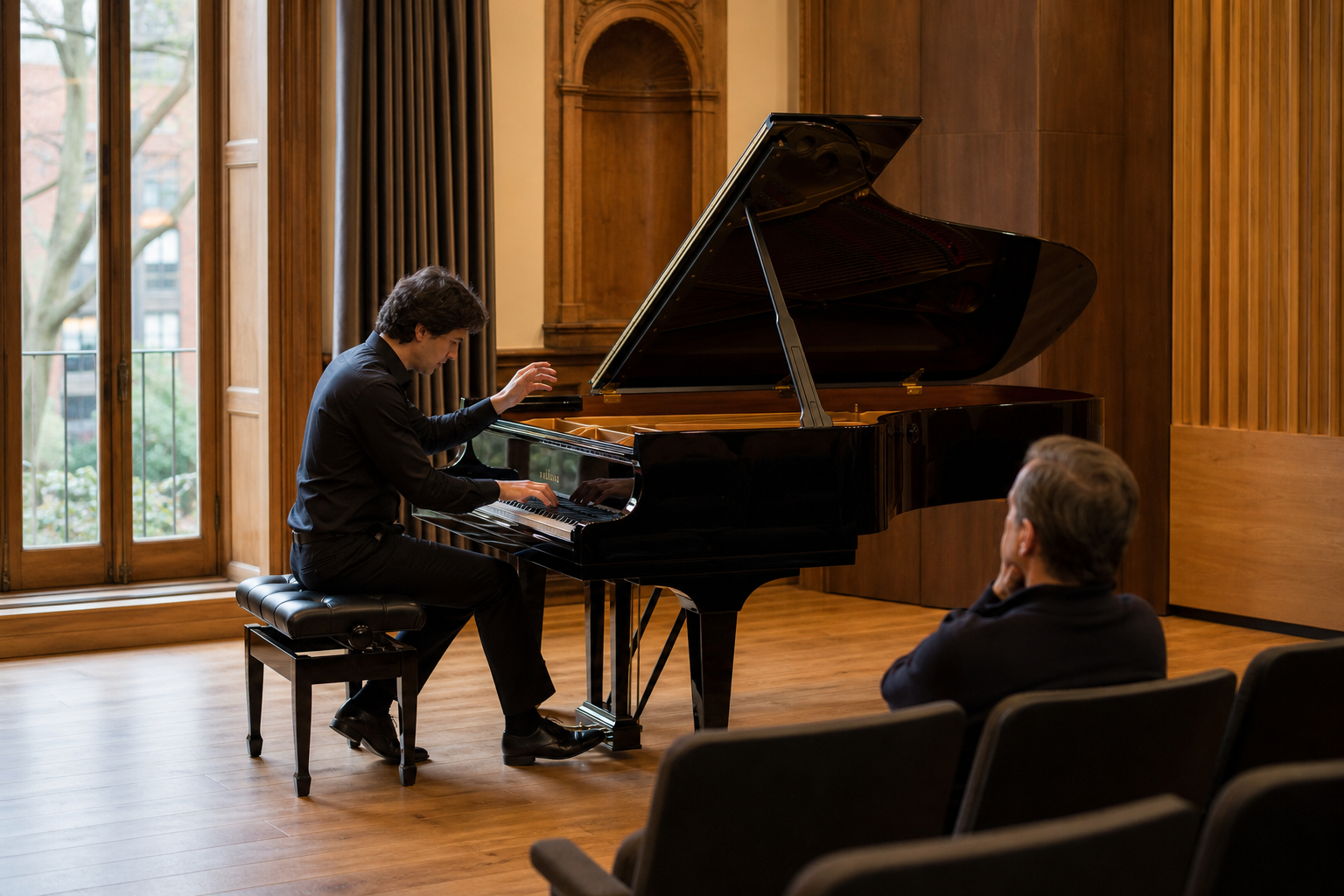
London pianists quickly learn that the room is part of the instrument. Wigmore Hall describes itself as an intimate venue with a crystalline acoustic and 552 seats, specialising in chamber and instrumental music. Southbank Centre’s Royal Festival Hall is a much larger auditorium, with a capacity of around 2,700. The same voicing choice will not travel identically through both spaces.
In a dry room, a pianist may need more legato illusion and warmer pedalling. In a resonant hall, too much pedal can blur harmonic direction. For recitals, lessons and masterclasses, WKMT teachers encourage students to test balance from the audience position whenever possible. Projection is not only volume; it is the clarity of musical intention at a distance.
Recording changes the problem again. A microphone close to the strings may exaggerate attack noise and make a balanced accompaniment seem too present. A distant microphone may reward cleaner melodic projection and punish blurred pedalling. Before an exam video, audition tape or public performance, it is worth hearing a short recording from the room itself. The pianist’s seat is the worst place to judge the whole truth of the sound.
Piano Voicing FAQ
Is piano voicing the same as tuning?
No. Tuning adjusts pitch. Technician voicing adjusts tone quality, usually through hammer and action work. Performer voicing is the pianist’s control of balance between musical layers.
How do I voice a chord on piano?
First decide which note carries the musical meaning. Then play the other notes with less weight and a quieter attack so the chosen note leads naturally rather than by force.
When should I call a piano technician?
If one register is consistently harsh, dull, uneven or resistant after careful playing checks, ask a qualified technician to assess tuning, regulation, hammer condition and voicing.
Study tone, balance and voicing with WKMT
For refined work on piano voicing, interpretation and recital preparation, explore piano lessons in London or join a WKMT London piano masterclass. A teacher can hear whether the answer is musical, technical or mechanical, and help you make the instrument speak with clearer intention.
Sources
- Piano Technicians Guild, Piano Care FAQs, https://www.ptg.org/ptgmain/piano/care/care-faqs
- Piano Technicians Guild, Action Regulation teacher resource, https://www.ptg.org/teacher-resources/caring-for-a-piano/action-regulation
- Piano Technicians Guild, Piano Care servicing overview, https://www.ptg.org/ptgmain/piano/care/servicing
- Wigmore Hall, About Us, https://www.wigmore-hall.org.uk/about-us
- Southbank Centre, Royal Festival Hall, https://www.southbankcentre.co.uk/venues/royal-festival-hall/
- WKMT, Piano Lessons London, https://www.piano-composer-teacher-london.co.uk/