
 TRIAL LESSON
Pianists, Piano Lessons
Eileen Joyce in London: The Pianist Whose Brilliant Touch Still Teaches Musical Courage

May
Eileen Joyce in London: The Pianist Whose Brilliant Touch Still Teaches Musical Courage
Eileen Joyce in London: The Pianist Whose Brilliant Touch Still Teaches Musical Courage
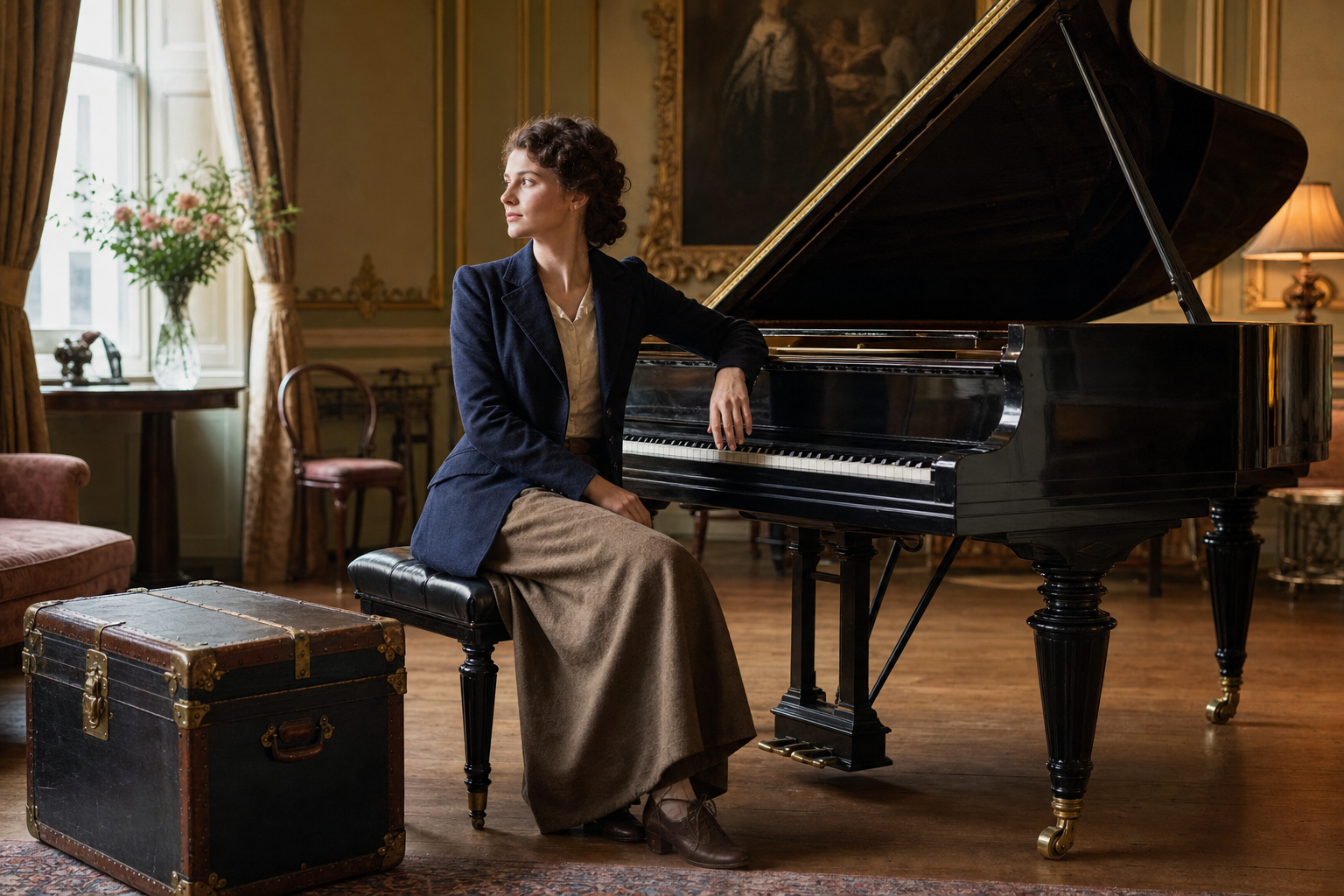
Eileen Joyce is one of those pianists whose name opens a larger question: how does a musician keep individuality alive while meeting the demands of the public concert platform, the recording studio and the serious classical tradition?
For readers searching for Eileen Joyce, the answer begins with a remarkable journey. Born in Tasmania in 1908 and raised largely in Western Australia, she was discovered through the international examination culture that linked distant mining communities with London musical standards. The Australian Dictionary of Biography records how a visiting London examiner, Charles Schilsky, recognised her ability in 1923, when she was still a teenager. That moment matters because it shows talent being noticed through a disciplined musical system rather than through accident alone.
Joyce later studied in Europe, built a London concert career, recorded widely, and became known to a wider public through film and broadcast culture. Yet her legacy is not merely glamorous. It is educational. Her story connects touch, stamina, musical memory, public confidence and the ability to make a piano sing in very different rooms. That is why her life belongs naturally beside classical piano study in London: she reminds modern students that artistry is built from daily discipline long before it becomes public brilliance.
Eileen Joyce and the Road to London
The most striking part of Joyce’s early story is not simply that she was gifted. Gifted children appear everywhere. What distinguishes her biography is the combination of community support, musical examination structure and a teacherly eye that saw a future professional. Her childhood in Boulder and Kalgoorlie placed her inside a mining culture where music-making was woven into civic life through choirs, bands and local performances. Serious pianism did not arrive as decoration; it was part of a community’s aspiration.
The London connection came early through the examiner who recognised her promise. That link is worth pausing over. For a young pianist, external standards can be either oppressive or liberating. Used badly, they reduce music to marks. Used well, they tell a student that their work belongs to a wider musical world. Joyce’s discovery belongs to the second category. It gave shape to ambition, and ambition eventually required travel.
A Brilliant Touch Without Empty Display
Joyce’s reputation often gathers around glamour: striking stage presence, commanding programmes, public visibility and the unusual breadth of her audience. Yet the musical lesson is subtler. Pianists who survive public fascination must still answer the instrument. Under the stage image sits touch, voicing, pedalling, memory and rhythmic stability. Without those foundations, the surface collapses.
Her playing is valuable to discuss with students because it invites a practical distinction between brilliance and noise. Brilliance is not merely speed or volume. It is the ability to make texture transparent, to decide where a phrase is travelling, and to let the listener feel the shape before they notice the effort. A pianist can be dazzling and still clear. That is the kind of brilliance worth studying.
When a student admires a famous pianist, the useful question is not “How can I copy that career?” It is “What technical habit made that freedom possible?” In Joyce’s case, the answer often begins with tonal control, clean projection and a reliable physical relationship with the keyboard.
Eileen Joyce in the Recording Imagination
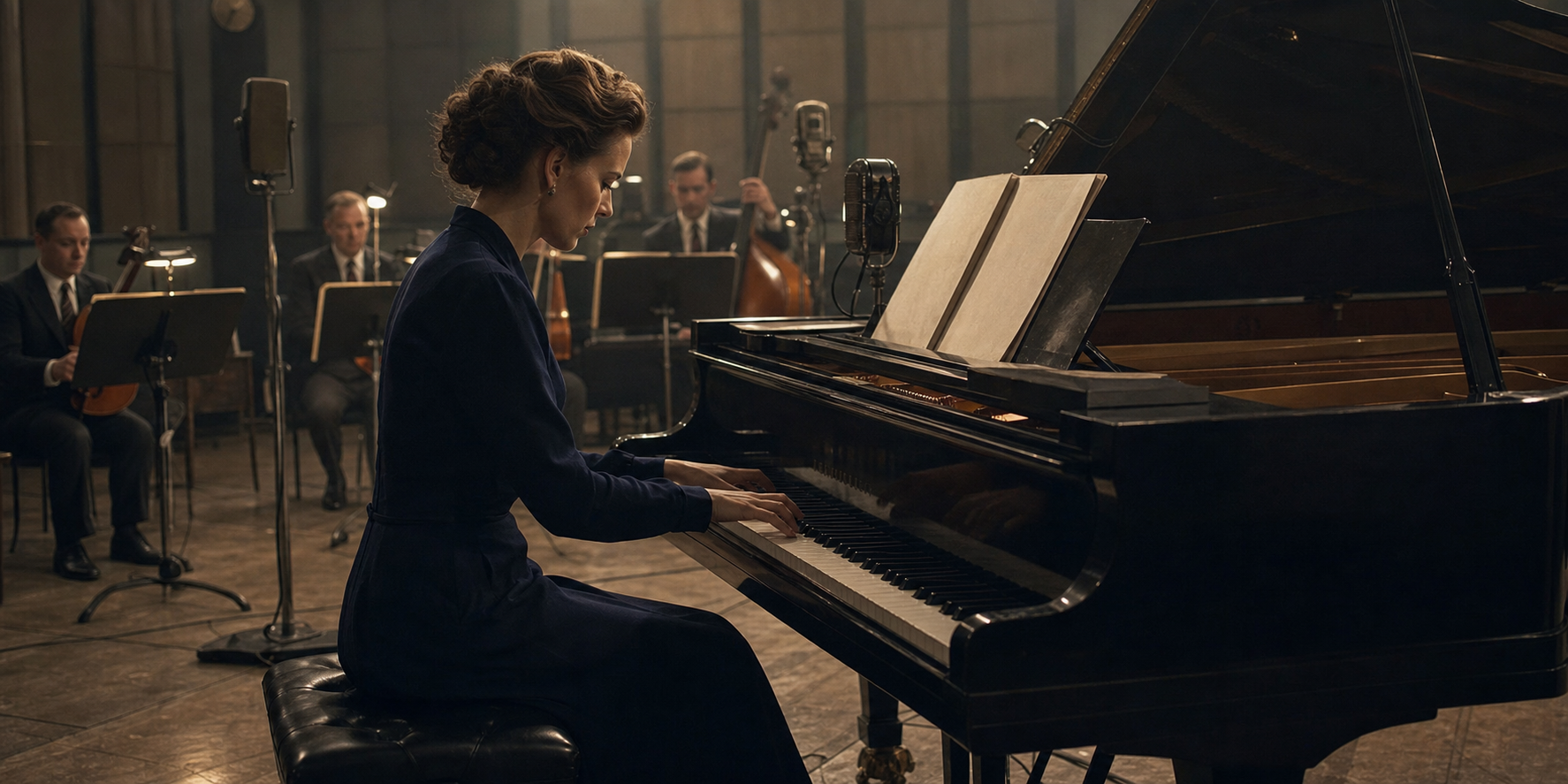
Many listeners encounter Joyce through the romantic piano sound associated with mid-century British film culture. Her connection with Rachmaninoff’s Second Piano Concerto in the era of Brief Encounter helped attach a particular kind of piano sonority to public memory: ardent, lyrical, cinematic and immediately recognisable. The point is not to turn Joyce into a film footnote. Rather, it shows how a serious pianist can enter the imagination of listeners who might never attend a recital.
That matters for today’s piano students. Recording changes the discipline of playing. The microphone notices uneven voicing, vague pedalling and a phrase that does not quite breathe. A concert hall asks the pianist to project; a recording asks the pianist to refine. Joyce’s career moved between both demands, and that movement gives students a useful model for self-listening.
Listen for whether the melody remains alive when the accompaniment becomes full. In romantic piano music, the danger is that emotion becomes thickness. A refined pianist keeps the singing line clear.
What Modern Pianists Can Learn From Joyce
| Joyce’s musical world | Lesson for today’s pianist | Practice translation |
|---|---|---|
| Public brilliance | Projection must be supported by clarity. | Practise climaxes slowly, checking that the top voice remains clean. |
| Recording culture | The ear must become more exact than the hand feels. | Record short passages and listen for balance, pedal blur and phrase direction. |
| Romantic repertoire | Intensity needs structure. | Mark harmonic arrivals and phrase peaks before increasing tempo. |
| International training | A local beginning can lead to a serious artistic life. | Use examinations, concerts and teacher feedback as gateways, not final goals. |
The most useful inheritance from Joyce is not nostalgia. It is a way of thinking about musical ambition. A pianist can be cultivated, technically serious, publicly vivid and still rooted in disciplined study. Those qualities belong together. At WKMT, this is also why technique, repertoire, interpretation and performance confidence are treated as one educational arc rather than separate boxes.
Students interested in the physical side of this work may also enjoy WKMT’s material on Scaramuzza technique, where the relationship between arm, wrist and sound is considered in detail. Readers drawn to the wider pianist tradition can continue with the great pianists of all time, while those interested in public performance culture can explore WKMT classical concerts in London.
The Public Pianist and the Private Craft
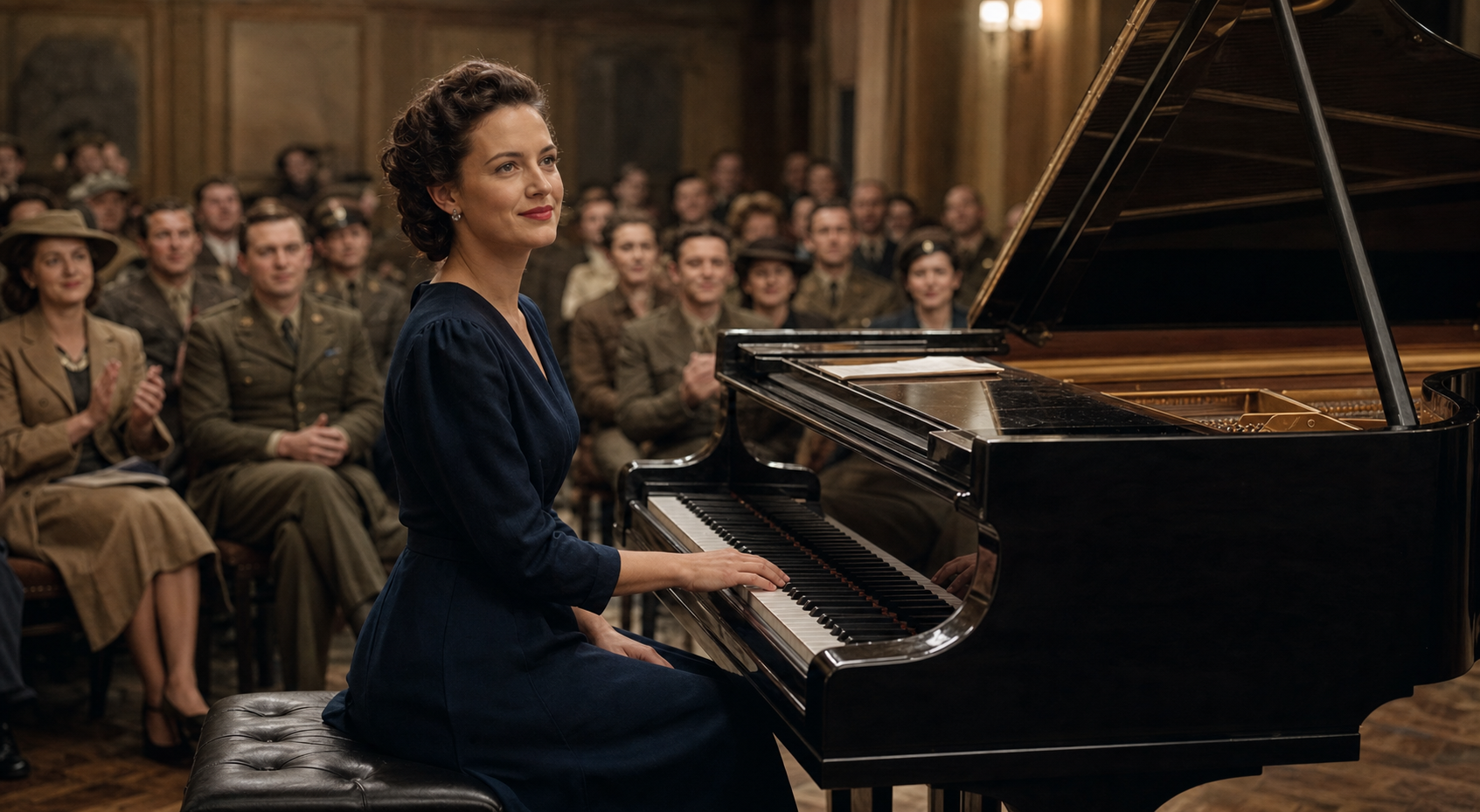
A public pianist lives between two realities. One is visible: the concert, the dress, the applause, the press photograph. The other is private: the repetition of awkward passages, the slow correction of balance, the management of nerves, the decision to stop pretending and listen honestly. Joyce’s career is interesting because the visible part never fully explains the private discipline beneath it.
This distinction is important for young pianists and adult learners alike. Many students judge themselves by the public surface of music: how fast they can play, whether they feel nervous, whether a piece sounds impressive. Joyce’s example points in the opposite direction. The better questions are practical: can the left hand support without dominating, can the right hand sing without hardening, can the body stay free under pressure, can the memory follow harmonic logic rather than panic?
Why Eileen Joyce Still Belongs in a London Piano Conversation
London has always absorbed musicians from elsewhere and tested them against a dense musical public. Joyce belongs in that story because her career shows the city as a meeting point: Australian formation, European study, British concert and recording life, and a public that knew the piano through both recital culture and cinema. That makes her a valuable figure for a London piano school to revisit.
She also helps correct a narrow view of classical success. The point of studying the piano is not simply to become famous. Fame is too unstable to be an educational aim. The point is to develop the kind of musicianship that can survive different rooms, audiences and pressures. Joyce’s life gives that idea a human shape.
Classical Piano Study in London
For students who want technique, interpretation and performance confidence to develop together, WKMT offers structured classical piano study with a serious London teaching culture.
From Legacy to Lesson
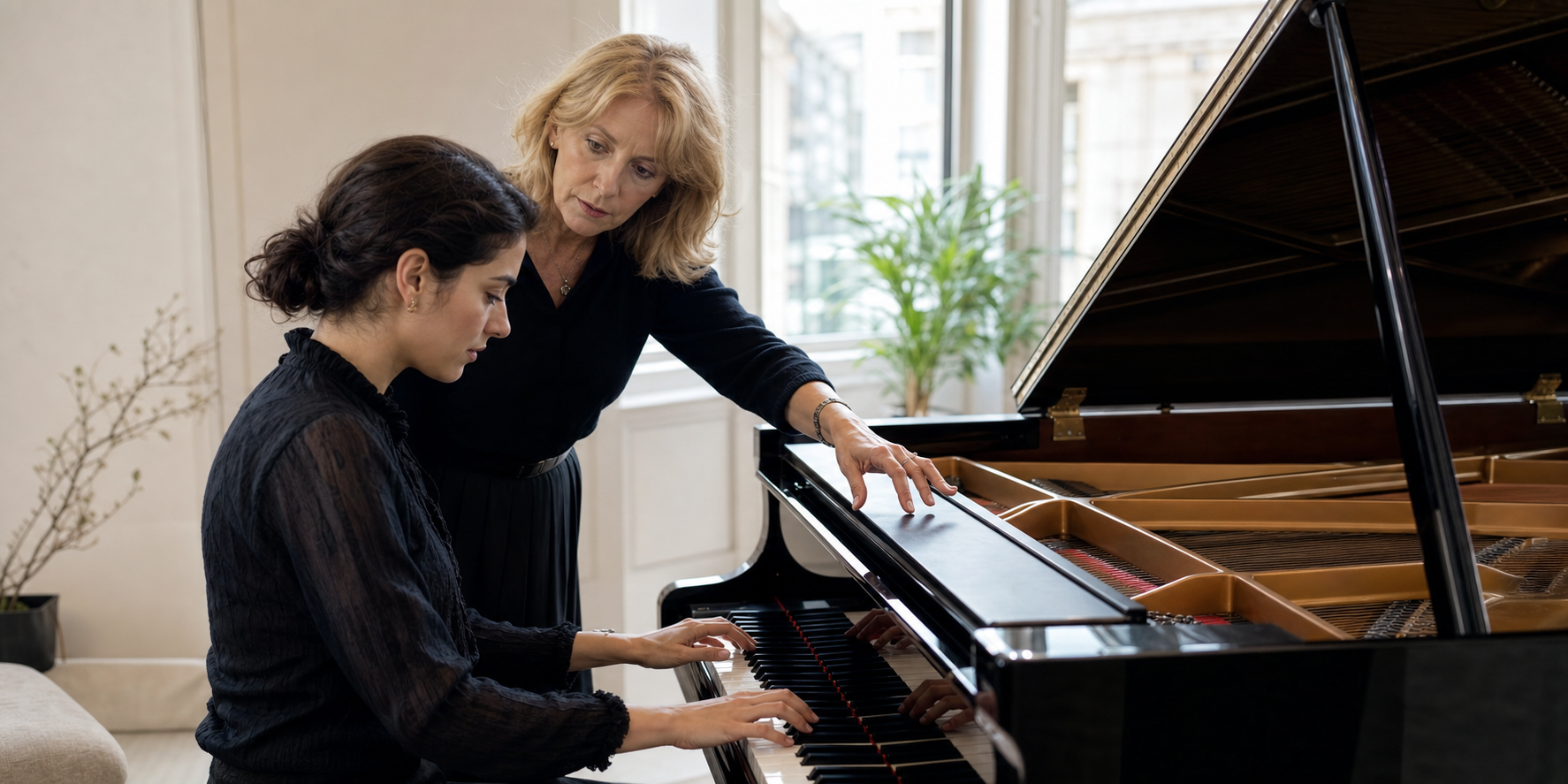
There is a final, generous detail in Joyce’s story. The University of Western Australia records that she supported the creation of the Eileen Joyce Studio, an intimate teaching and performance space that opened in 1981 and houses a historical keyboard collection. That gesture returns the public pianist to the educational world from which she first emerged. A career that began through teaching, examination and community support ended by strengthening the conditions for future keyboard study.
That is perhaps the most WKMT-relevant part of her legacy. Great pianists should not be treated only as distant icons. They should return us to better practice, clearer listening and a more demanding idea of what piano lessons can achieve. Eileen Joyce still matters because her life makes those ambitions feel concrete.
Sources
- Australian Dictionary of Biography “Eileen Alannah Joyce” by David Tunley, last checked 23 May 2026.
- The University of Western Australia, “Eileen Joyce Studio”, last checked 23 May 2026.
- National Portrait Gallery, London, Eileen Joyce collection entry, last checked 23 May 2026.
- British Film Institute, Brief Encounter collection entry, last checked 23 May 2026.
- British Pathe, Eileen Joyce archive material, last checked 23 May 2026.