
 TRIAL LESSON
Piano Lessons
Sviatoslav Richter in London: The Little-Known Story Behind His Most Talked-About UK Appearances
Mar
Sviatoslav Richter – All about his London experience
Sviatoslav Richter in London: the definitive account of his UK appearances
This article sets out a London-first account of sviatoslav richter in the capital: the key dates, the known repertoire, what contemporary writers and later commentators singled out, and where the traces now live—on disc, in broadcast catalogues, and in institutional archives. Where programmes need confirming (notably parts of 1961), that is stated plainly.
London remembered Richter as both event and evidence: scarce appearances, then the BBC turning those evenings into documents that pianists can still study.
If you are reading about Sviatoslav Richter, there is a good chance that you are a serious music enthusiast. If you have ever considered taking the next step and learning the piano yourself, we would be delighted to welcome you. Whether face-to-face at our London studios or online from anywhere in the world, our lessons are designed especially for adult learners. Do not hesitate to visit our Piano Lessons for Adults page to discover more.
At a glance — Richter’s key UK dates and venues
Major London appearances (known dates and venues):
- 10 July 1961 — Royal Festival Hall: British debut recital (part of Victor Hochhauser’s festival series). Programme highlights: Chopin, Beethoven, Debussy (programme scans needed for full detail).
- 12 July 1961 — Royal Festival Hall: second recital of the first visit.
- 16 July 1961 — Royal Albert Hall: concerto appearance with the London Symphony Orchestra under Kondrashin: Chopin Andante Spianato & Grande Polonaise, Op. 22 and Dvořák Piano Concerto in G minor, Op. 33 (single performance; no interval).
- 27 January 1963 — Royal Festival Hall: first of two recitals; Schumann and Chopin items including Papillons, Faschingsschwank, and Chopin Polonaise Op. 61.
- 2 February 1963 — Royal Festival Hall: second recital, all Beethoven/Schubert including Beethoven Op. 14 No. 3 and the Wanderer Fantasy; these concerts appear on the BBC Legends “Richter in London” set.
- 11 June 1975 — Royal Festival Hall: all-Beethoven recital: Sonata Op. 2 No. 3; Hammerklavier Op. 106; and Beethoven Op. 126 Bagatelles. Recorded and later issued; praised for the “electricity of the occasion”.
- 31 March 1979 — Royal Festival Hall: late-career recital including Schubert’s A minor Sonata D. 784, plus Schumann Fantasiestücke and Debussy Images. Broadcast by the BBC.
The historical context — Richter, the Cold War and the British concert scene
Richter’s first London concerts arrived in a particular political climate. After Stalin’s death in 1953, the London impresario Victor Hochhauser began bringing Soviet artists to Britain, shaping a distinctive strand of post-war musical life. Richter—already celebrated in the USSR and still rare in the West—reached London in July 1961 for his UK debut, aged 46. Andrew Clements later called it his “belated first appearance” in Britain, and placed him “at the height of his phenomenal powers”.
Hochhauser’s own recollection is blunt and revealing: without that organisational backing, “Richter never came here—he wouldn’t come if we weren’t organizing his concerts.” London audiences, curious and not a little suspicious of the mechanisms of cultural exchange, treated his arrivals as both musical and geopolitical events. A programme writer observed that Richter “began his three London recitals with a stunning Haydn and Prokofiev programme, only to become increasingly nebulous” in later appearances—an aside that says as much about the era’s anxieties as about the pianist’s art.
What critics and listeners repeatedly returned to, however, was Richter’s interpretive breadth: the ability to “dazzle with barnstorming power” and then, without sentimentality, find “ethereal delicacy”. In London, that contrast was amplified by the setting: the Royal Festival Hall as a national stage, and the BBC as the institution that turned one-off evenings into durable documents.
Complete chronological account of major London performances
July 1961 — the London debut at the Royal Festival Hall
Richter’s first London visit centred on two Royal Festival Hall recitals (10 and 12 July 1961), billed as his British debut. Contemporary British press coverage from 1961 tends to require archive access and can be difficult to retrieve at a glance, but the essentials are consistent: the concerts were recorded for BBC radio, and the programmes mixed Romantic and twentieth-century works.
Listings and later documentation point to Chopin and Debussy in the debut recital; live selections in circulation also include Chopin’s Andante Spianato & Grande Polonaise. While the full printed programmes are flagged here as needing scans for verification, the broader picture is clear enough: Richter arrived not as a specialist but as a player presenting range—Romantic line, French colour, and the structural seriousness for which London later prized him.
Looking back, Andrew Clements characterised Richter’s playing in this period as marked by “astonishing insight” and “startling power”. Even allowing for hindsight’s glow, those phrases match the long-standing listener memory of 1961: not simply virtuosity, but a kind of uncompromising attention that made audiences feel they were hearing familiar works at an unfamiliar depth.
16 July 1961 — Royal Albert Hall with the LSO (Kondrashin)
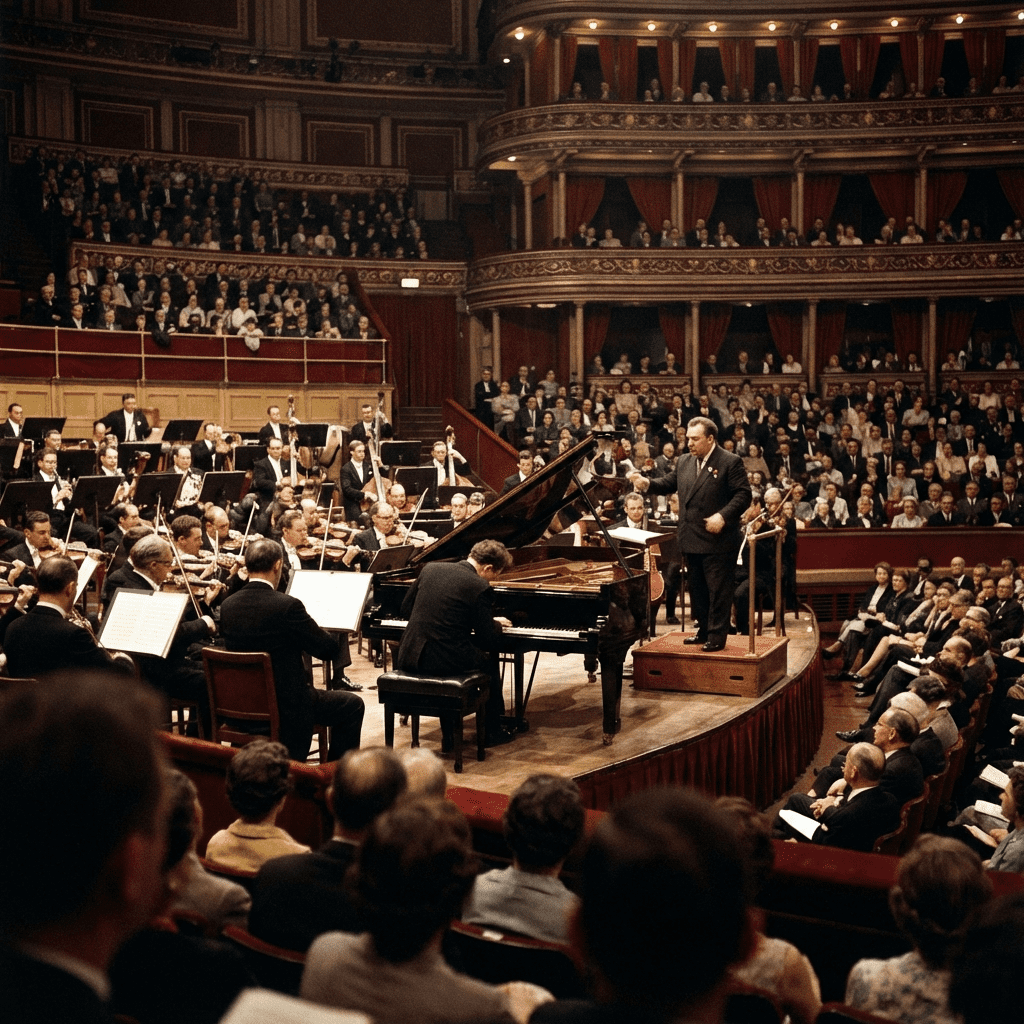
Four days after the second Festival Hall recital, Richter appeared at the Royal Albert Hall with the London Symphony Orchestra under Kondrashin. The programme was concentrated and bold: Chopin’s Andante Spianato & Grande Polonaise, Op. 22, followed by Dvořák’s Piano Concerto in G minor, Op. 33. It was given as a single performance, without an interval.
In later years, this Albert Hall evening gained a second life through a live issue released in 2020. Its value is not only musical but documentary: it places Richter in a British orchestral context under a Soviet conductor, a pairing that makes the Cold War subtext of these tours unusually visible.
January–February 1963 — two Festival Hall recitals, later issued by BBC Legends
Richter returned for two Royal Festival Hall recitals on 27 January and 2 February 1963. For London listeners, these concerts are among the best-documented because BBC broadcast tapes survive and were later commercially released, making the repertoire and the playing available for scrutiny rather than reminiscence.
The 27 January programme included Schumann and Chopin: works such as Schumann’s Papillons and Faschingsschwank, alongside Chopin—including the Polonaise Op. 61. The 2 February recital was all Beethoven and Schubert, including Beethoven’s Op. 14 No. 3 and the immense Wanderer Fantasy. Reviews of the period noted playing “full of startling insights”.
These are the performances that later appeared on the BBC Legends “Richter in London” set, a release that effectively fixed the 1963 visit as a reference point for British listeners: Richter not as rumour, but as sound.
11 June 1975 — the all-Beethoven recital (RFH) and its afterlife on disc
Richter’s first London trip back in more than a decade culminated in a Royal Festival Hall recital on 11 June 1975 devoted entirely to Beethoven: Sonata in C major Op. 2 No. 3; the Hammerklavier Sonata Op. 106; and three Bagatelles from Op. 126. BBC Radio recorded the concert, and a later CD release on ICA Classics (2012) drew major retrospective attention.
Andrew Clements, writing about that recording, pointed to “the electricity of the occasion” and described a telling moment of stagecraft and temperament: “the first chord… played almost before he was settled on the stool – and the tension of the first movement [of the Hammerklavier] is remorselessly ratcheted up”. He went further, calling it an “extraordinary 80 minutes of music-making” that still convinces sceptics why many regard Richter as “the greatest pianist of the second half of the 20th century”.
One detail has become part of the recital’s folklore precisely because it can be checked: on the recording, Richter even encores the Hammerklavier finale. In London terms, the 1975 evening functions like a monument—an event that became a document, then a touchstone.
31 March 1979 — late-career Richter at the Festival Hall (Schubert, Schumann, Debussy)
Richter’s final London recital took place at the Royal Festival Hall on 31 March 1979, again preserved by a BBC broadcast. The programme included Schubert’s A minor Sonata D. 784, Schumann’s Fantasiestücke, and Debussy’s Images.
Commentary on the surviving release has emphasised Richter’s “scale… unstoppable momentum” in Schubert, and the “depth” he could bring even to short pieces. If the 1975 Beethoven concert shows him as a public force, 1979 catches something else: concentration without display, the late style that refuses to entertain and therefore, paradoxically, holds attention more fiercely.
Signature London programmes and recordings
Repertoire patterns: breadth first, then concentration
Across Richter’s London visits, one can see a shift from breadth to focus. The 1961 recitals are described as mixing Romantic favourites and twentieth-century French repertoire—Chopin and Debussy among them—while the 1963 programmes combine Schumann and Chopin in one recital and Beethoven/Schubert in the other. By 1975, the idea becomes almost architectural: one composer, spanning youthful invention (Op. 2 No. 3) to late extremity (Op. 106), plus the concise afterthoughts of Op. 126.
This is one reason the London Richter story has remained useful for pianists: it demonstrates programming as an argument, not a playlist. Critics noted how the 1975 recital linked early and late Beethoven into a single line of thought. Max Loppert, writing in BBC Music Magazine, called the 1963 recitals “enthralling” and drew attention to Richter’s tempo choices—particularly a Beethoven slow movement taken at “roughly half” the usual speed, yielding what Loppert termed “proto-Schubertian poignancy”. A pull-quote from this strand of commentary sums up the continuity listeners hear: “Richter’s account… contained within it the germ of what developed 24 years later into the unparalleled scope of the Hammerklavier Sonata”.
Commercial issues and what they document
For those who want to hear sviatoslav richter in London rather than read about him, the key listening routes are clear in the existing documentation:
- BBC Legends: releases covering the 1961–63 London recitals and the 1975 Beethoven recital.
- ICA Classics (2012): the 11 June 1975 Royal Festival Hall Beethoven programme.
- “Richter’s First London Visit” (2013 listings): material from July 1961 recitals (as presented on streaming/catalogue listings).
- Live issue (2020): the Royal Albert Hall concert with Kondrashin, including Chopin Op. 22 and Dvořák’s G minor Concerto.
There are also the usual shadows around Richter: parts of the 1961 concerts circulating on bootlegs, and excerpts (including Schumann items such as the “Abegg Variations” and Faschingsschwank) used in the 2013 documentary Richter: The Enigma. The key point, for London researchers, is that the BBC broadcasts turn this history from hearsay into something you can date, locate, and compare.
Anecdotes, personalities and behind-the-scenes
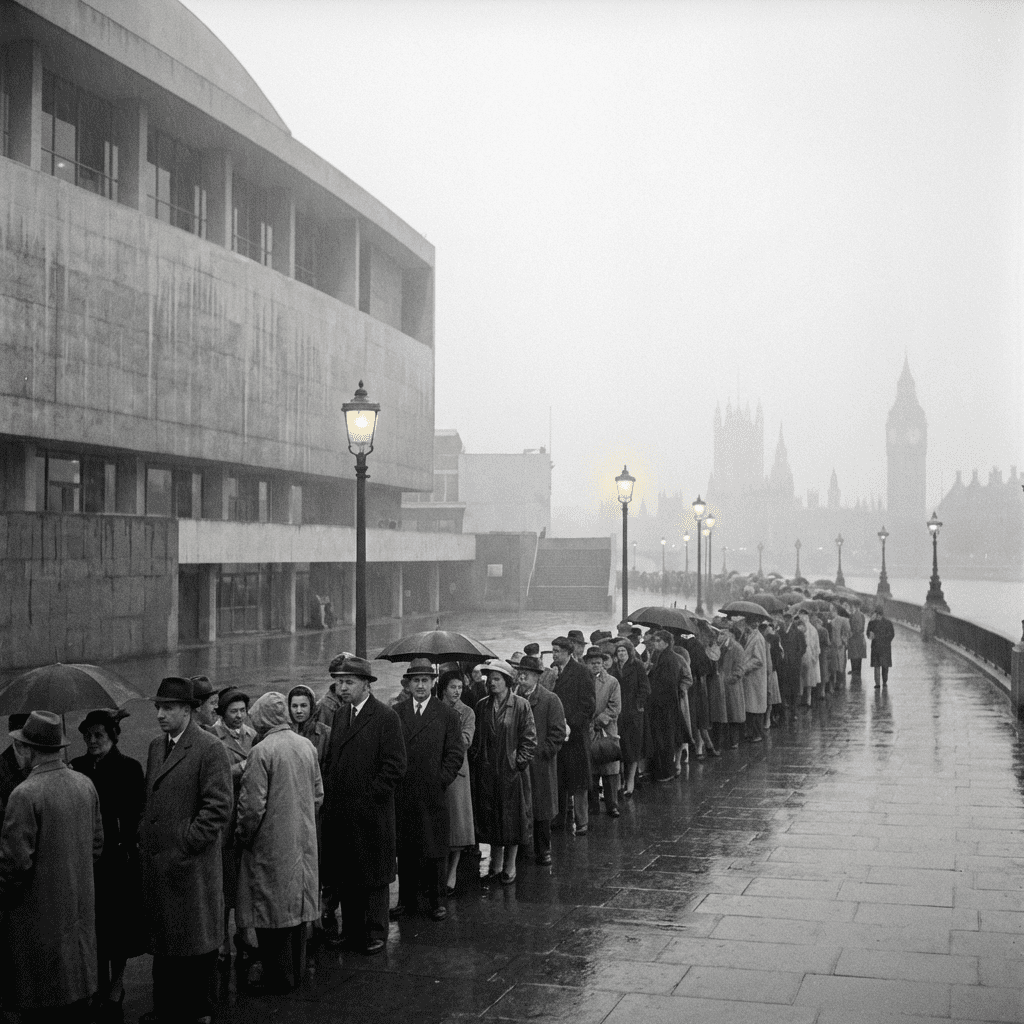
Much of Richter’s London narrative runs through Victor Hochhauser, whose memoir and interviews give the tours their human shape: negotiations, Soviet bureaucracy, and the performer’s stubborn insistence on artistic control. Hochhauser described Richter as “a remarkable man… also a great poet. He wasn’t easily friendly, but those who knew him knew what a great personality he was”. Before the 1975 concerts, he recalled Londoners queuing from 5am in pouring rain simply to obtain tickets.
One behind-the-scenes episode, dated to 1974 in Hochhauser’s telling, illustrates Richter’s temperament. Soviet authorities proposed him for a Moscow festival exchange with Britain; Richter refused. “‘Richter said, “I know nothing about this, I’m not playing,”’” Hochhauser recalled. The issue was not politicking but repertoire and agency: Richter wanted to choose what he played, rather than satisfy an official brief, and he forced the promoter to cancel an announced concert. In London, where musicians often arrive wrapped in PR, Richter’s refusal to perform anything except the music on his own terms became part of his mystique.
Other memoir material reinforces a quieter image: shyness with the press, reluctance to socialise, a solitary manner in the city. An anecdote attributed to the pianist Nikolai Petrov describes Richter travelling on the Underground in simple clothes after the 1961 debut, surprising those who expected a public monument rather than a private person. Whatever its exact contours, the story aligns with the consistent portrait: in London, Richter was both an event and, personally, elusive.
Where to find Richter in London today — archives, broadcasts and exhibits
The London Richter trail is unusually practical. It lives in places you can search, request, and sometimes hear.
BBC Radio archives and BBC Legends
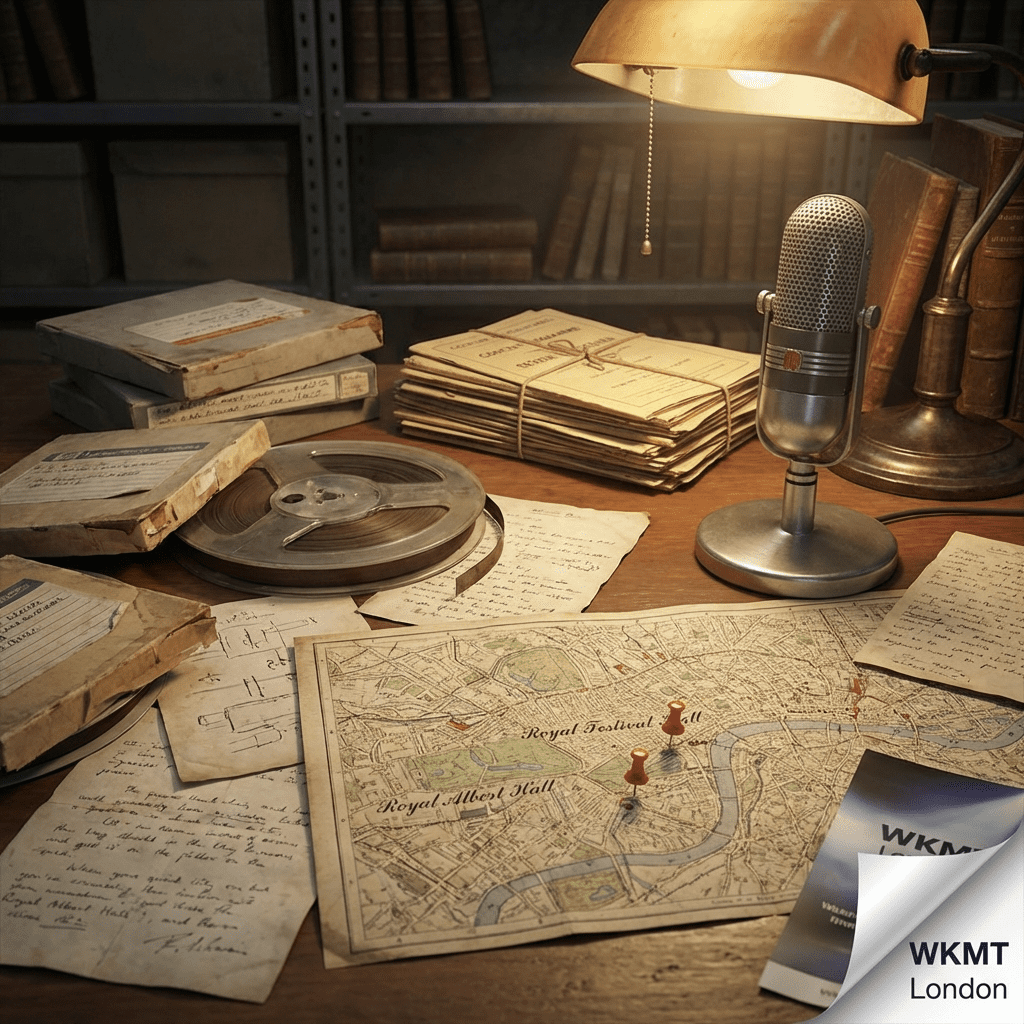
Many London concerts were broadcast on the BBC. The BBC Legends series reissues the 1961–63 recitals and the 1975 Beethoven recital, and BBC Radio 3 archive programming occasionally rebroadcasts historic performances. BBC iPlayer and BBC Sounds searches can be useful when archive seasons run. (Last checked: 2026-03-10.)
British Library Sound Archive
The British Library Sound Archive holds historical broadcasts and may include copies of Richter’s London concerts through BBC transfer reels. The online catalogue at sound.bl.uk supports keyword searching, with listening access typically available to registered readers. (Last checked: 2026-03-10.)
Southbank Centre / Royal Festival Hall archive
The Southbank Centre archive holds programmes and press cuttings and can confirm dates and repertoire across the 1961, 1963, 1975 and 1979 appearances. While much is not fully online, researchers can request scans—particularly relevant where programme lists remain incomplete in secondary circulation.
Royal Albert Hall archive
The Royal Albert Hall’s records list Richter’s 1961 concerto appearance, and its archive catalogue (including press cuttings files) can be consulted by appointment. (Last checked: 2026-03-10.)
National Portrait Gallery and specialist libraries
The National Portrait Gallery’s online database includes a photograph of Richter with Britten and Fischer-Dieskau (1965, by Michael Peto). For researchers, the Royal College of Music library is also noted as holding press files on Richter’s tours. No commemorative plaque is known, but occasional exhibitions and anniversary events have displayed London posters and programmes.
Richter’s legacy for London pianists and institutions
Richter’s London impact was amplified by two institutions that make reputations durable: the Royal Festival Hall and the BBC. A handful of evenings—especially 1963 and 1975—became reference recordings and, for many British pianists, a benchmark of what musical integrity sounds like in public. The influence is often described less in technical terms than ethical ones: seriousness of purpose, refusal of routine, and the courage to risk roughness for the sake of meaning.
Andrew Clements’s judgement on the 1975 Hammerklavier recording captures why that legacy persists in London’s musical culture: the performance still persuades listeners, years later, that Richter’s stature was not a legend in search of evidence. In a city saturated with great pianism, Richter’s brief visits helped cement the Festival Hall’s image as a place where pianists do not merely perform—they declare a view.
Practical resources
Further reading about Sviatoslav Richter
For biography and context, key sources cited in the research base include Karl Aage Rasmussen’s Richter: Pianist (2012), and Bruno Monsaingeon’s documentary and book Richter: My Many Lives. Victor Hochhauser’s memoir The Quiet Showman (2013) supplies the most detailed London-facing anecdotes and tour logistics.
Selected discography (London-related)
- BBC Legends series — live 1961–63 and 1975 Royal Festival Hall concerts.
- Richter in London (ICA Classics/IMC), 2012 — 11 June 1975 Beethoven recital (Royal Festival Hall).
- Richter’s First London Visit (Classical Heritage/Apple Music listings), 2013 — July 1961 recitals.
- Live issue (2020) — Royal Albert Hall 16 July 1961 with Kondrashin (Chopin Op. 22; Dvořák Op. 33).
Primary evidence you can request
- Programme booklets and press cuttings from the Southbank Centre archive (Royal Festival Hall appearances).
- Royal Albert Hall performance listings and press files (16 July 1961).
- BBC broadcast documentation and, where available, rebroadcast schedules.
- British Library Sound Archive catalogue entries for relevant BBC recordings.
FAQ on Sviatoslav Richter
- When and where did Richter give his London debut?
- His first UK recital was at the Royal Festival Hall in July 1961 (10 July 1961), followed by a second recital on 12 July. He also appeared that month at the Royal Albert Hall as a concerto soloist.
- Which London venues did Sviatoslav Richter perform at?
- Mainly the Royal Festival Hall (solo recitals in 1961, 1963, 1975, 1979) and the Royal Albert Hall (with the LSO in 1961). The research base states he never played Wigmore Hall.
- Are any of Richter’s London concerts available to hear?
- Yes. BBC Legends issued live London recitals from 1961–63 and the 1975 Beethoven recital. The 1975 programme is also available on ICA Classics (2012). BBC archives and occasional rebroadcasts may also be available. (Last checked: 2026-03-10.)
- What did Richter play in London in 1975?
- An all-Beethoven programme at the Royal Festival Hall (11 June 1975): Sonata Op. 2 No. 3, the Hammerklavier Sonata Op. 106, and Bagatelles from Op. 126.
- Which London concerts appear on the BBC Legends “Richter in London” set?
- The set includes the 1963 Royal Festival Hall recitals (27 January and 2 February 1963), and London material is also represented across BBC broadcasts and related releases referenced in the research base.
- Where can I research Richter’s London programmes and press reaction?
- The Southbank Centre archive (Royal Festival Hall) holds programmes and press cuttings; the Royal Albert Hall archive documents the 1961 orchestral concert; and the British Library Sound Archive may hold broadcast copies. BBC listings and archive programming provide further trails.
Conclusion on Sviatoslav Richter
London heard Richter only intermittently, but it heard him at moments that mattered: a Cold War debut in 1961, a documented pair of 1963 recitals, the incandescent Beethoven of 1975, and a late Schubert programme in 1979. For listeners, the legacy is not merely the legend of ticket queues; it is the survival of the performances themselves—broadcast, archived, and still capable of unsettling the complacent ear.
If you value that lineage of serious pianism, WKMT London curates classical piano experiences that treat listening as a craft, not a pastime. You can subscribe to our newsletter for concerts, masterclasses and curated listening, or explore the WKMT London piano studio for lessons shaped by the same insistence on musical truth that made Richter’s London nights unforgettable.
Continue the London listening tradition
Explore WKMT London’s concerts, masterclasses and piano tuition—designed for listeners and pianists who value the same seriousness of purpose that makes Sviatoslav Richter in London such a lasting reference.
Sources for Sviatoslav Richter
BBC Music Magazine/classical-music.com
theartsdesk interview (Hochhauser)
Classical Source (BBC Legends review)