 TRIAL LESSON
Haydn Sonatas, Music Theory Resoucers
Haydn Sonata in E Minor Hob XVI 34 – First Movement Analysis
Feb
Haydn Piano Sonata in E Minor Analysis
Haydn Sonata in E Minor Hob XVI 34 – First Movement Analysis
Overview
Joseph Haydn’s Piano Sonata in E minor, Hob. XVI:34, composed in the late 1770s, is a significant work that reflects both his personal circumstances and the broader musical trends of the time.
Do not forget to explore our other music analysis of piano sonatas by J. Haydn.
Historical Context and Haydn’s Life
During the late 1770s, Haydn was employed as the Kapellmeister at the Esterházy court, a position he held for much of his career. This role provided him with a stable environment to compose prolifically. The Sonata in E minor was published in London around 1783 by Beardmore & Birchall.
Musical Style and Influences
The sonata comprises three movements:
- Presto: This opening movement is in sonata form and is characterised by its turbulent and unsmiling nature, which is unique among Haydn’s sonatas. The movement is described as a collection of musical fragments that never seem to gather momentum, with sudden stops that halt the music’s progress.
- Adagio: Set in G major, this movement provides a contrast to the first with its lyrical and embellished theme. It is shorter, consisting of 49 measures, and can be performed with rubato within the beats, even if the beats themselves are quite regular. The movement ends with a deceptive half cadence and modulation to E minor, creating a transition to the finale that ceases on the dominant chord. This is one of the few times in Haydn’s sonatas where movements are connected.
- Vivace molto: The finale is in rondo form and features a simple, folk-like theme in E minor, with a recurring E major episode. It uses Alberti bass and has strong harmonic features.
This sonata is notable for its expressive depth and structural innovation, showcasing Haydn’s mastery of classical forms and his ability to convey a wide range of emotions within a single work.
Innovative Aspects
One of the distinctive features of this sonata is the seamless connection between the first and second movements, in which the final cadence ends with three repeated E-notes creating a feeling of suspense (unconventional ending for a first movement) giving way to the second movement (Adagio)
This connection is almost re-created in the second to third movements, achieved through a deceptive cadence and then the ending on a Half cadence on B major (dominant of the tonic key, E minor) that leads directly into the finale with the instruction “attacca subito”. This approach was relatively uncommon in Haydn’s sonatas and demonstrates his experimental approach to form and continuity. Haydn Piano Sonata in E Minor Analysis.
First Movement: Presto in Duple Compound Time
The first movement strikes for two reasons: One, the speed and character instruction is “Presto” (fast and lively) instead of the more common “Allegro” for most Sonatas. The second is the time signature, a compound Duple 6/8 ,which is not conventional for a first movement in a Sonata form.
During the Classical period, it was relatively uncommon for the first movement or “Allegro di Sonata” (a term sometimes used to describe the standard sonata form), to begin in a 6/8 time signature. The preferred time signatures for first movements were usually 4/4 (common time), 2/4, or cut time or “Alla Breve” (2/2), which better accommodated the balanced phrasing, symmetrical structures, and clear articulation typical of the period.
Another example of this same time signature in Haydn’s work is his Sonata in G Major, Hob XVI 40, in which the first movement is a theme and variations in 6/8 time signature.
Reasons Why 6/8 Was Less Common:
- Association with Dance Forms:
The 6/8 metre was often linked to dance forms such as the gigue, which tended to appear in finales rather than first movements. The light, compound duple feel was more suited to dance-like character pieces rather than the more structured, serious tone often found in first movements. - Sonata-Allegro Form Preferences:
The sonata-allegro form, which dominates first movements, relied heavily on the contrast between themes and the clear articulation of harmonic progressions, which were easier to achieve in simple duple or quadruple time. - Classical Aesthetic:
The Classical period composers favoured clarity, proportion, and balance in their music. Simple and regular time signatures were considered better suited for expressing these ideals, while compound meters like 6/8 often introduced rhythmic complexities that were more characteristic of later Romantic styles.
Haydn Piano Sonata in E Minor Analysis
The analysis nomenclature is taken from the book of “Analyzing Classical Music” of William Caplin, and the symbols of analysis are taken from the analyst Jan LaRue. For further details, please refer to our analysis course website, in which all the pertinent information is there for further clarification:
7.1 – Main Symbols of Analysis – Compose your Music
Tempo Marking
In Joseph Haydn’s extensive collection of piano sonatas, it is uncommon for the first movements to be marked with the tempo indication “Presto.” The majority of his sonatas begin with tempo markings such as “Allegro,” “Moderato,” or “Allegro moderato.” However, there are notable exceptions where Haydn chose to commence the first movement with a “Presto” marking, adding a distinctive briskness and vivacity to the opening.
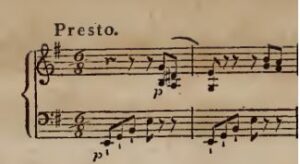
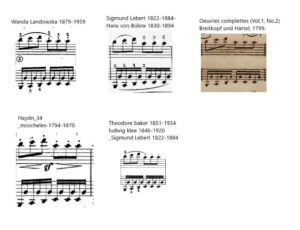
There are some differences between editions regarding the accurate speed of the piece. Three editions mark 100 bpm the dotted crotchet beat:
- Sigmund Lebert 1822-1884- Hans von Bülow 1830-1894
- Theodore baker 1851-1934 ludwig klee 1846-1920 – Sigmund Lebert 1822-1884
- No. 34 Moscheles – 1794-1870
The rest of the editions just mark “Presto”
Ornamentations
There are some discrepancies among different editions regarding the ornamentation in bars 22, 23 and 24.
Editions with ornaments:
Edition:Georg Feder 1927-2006
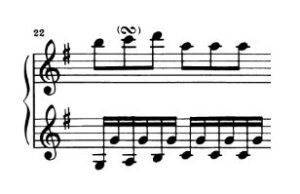
Edition: Christa Landon 1921-1977
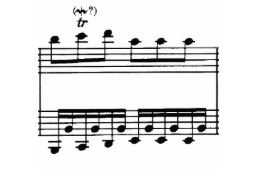
Edition: Carl Adolf Martienssen 1881-1955 and Karl Päsler 1863-1942
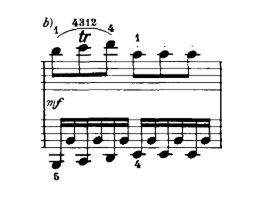
Editions without ornaments:
Main Theme Bars 1-8
The Main Theme presents the conventional Sentence Theme type (coined by Schonberg)
The Basic Idea (b.i.) is on the tonic, E minor:
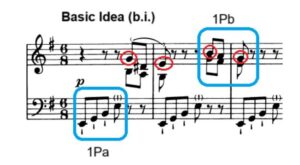
This motive or basic idea contains two distinctive elements:
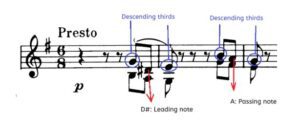
1Pa is the ascending arpeggiation on the left hand with a staccato articulation
1Pb is a descending pattern that conveys a third; in the first bar with an ornamentation of the leading note D# in between the G and E and on the second third a passing note A in between the B and the G. Both patterns form the full chord of the tonic, E minor (E-G-B)
These two elements will give birth to the Transition and Subordinate Theme that will be discussed in due course.
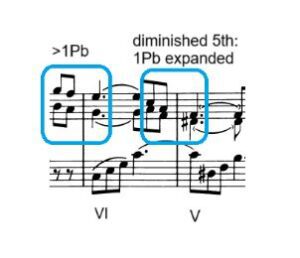
The repetition to the basic idea ,part of the presentation phrase of this sentence is presented in the form of a statement response with a submediant and dominant harmonies (VI and V)
Completing the first part, with the basic motive 1Pb on the subdominant and the expansion of the interval of the third previously stated now on the dominant harmony (as a diminished 5th C-F#)
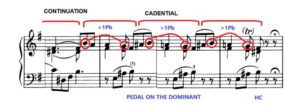
The material of the second part of the sentence, the continuation is derived from the elements of 1Pb (written >1Pb on the score) and lastly a pedal on the dominant leading to a half cadence in bar 8 (HC on the score):
Below we can see the whole structure of the Main Theme:
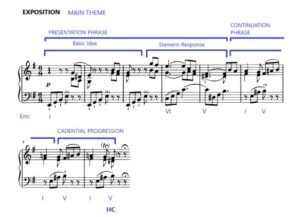
The analysis made by William Caplin in his book “Analyzing Classical Music” in page 291 expands the description of the main theme:
“The opening three measures are supported by root-position tonic, and the move to VI in m. 4 can be seen to prolong this harmony. But the change in surface harmony combined with a change in articulation (from staccato to legato) permits m. 4 to group with the following measure, supported by V6 . An HC on the second beat of m. 6 marks the structural end of the theme. The final harmony of the cadence is further prolonged by a standing on the dominant, consisting of twofold repetition of the half-cadence idea in mm. 7 and 8. The resulting grouping structure (3 + 3 + 2) creates an asymmetrical subdivision of the 8-m. theme. (Measure 6 could also be seen to group motivically with its following two measures, thus yielding a 3 + 2 + 3 structure.) From a form-functional point of view, mm. 1–3 are clearly initiating, yet interpreting these measures either as an expanded basic idea or a compressed presentation seems somewhat unconvincing. Measures 4–6 bring continuation and cadential functions, and mm. 7–8 are postcadential. The theme is clearly related to the sentence, but that theme type remains insufficiently expressed.”
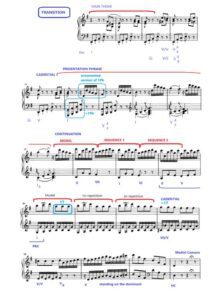
Transition Bars 9 – 29
The beginning of the modulating transition reiterates the material drawn from the Main Theme, supported by the home key, then it progresses towards G major (relative major of E minor, the tonic key) from bar 12 in which there is a tonicization toward A minor (Subdominant of E minor) now re-signified to be the supertonic of the new key, G major.
As a thematic unit of the exposition, a transition is constructed out of the same basic phrase functions associated with main themes.
The sentential functions of presentation, continuation, and cadential are used in this sonata, which is commonly employed:
The presentation phrase starts in bar 14 with a 2-bar basic idea, repeated in bars 16 and 17 under the progression I-V (bars 14-15) and repeated I-V (bars 16-17)
The continuation uses material from this presentation, now more ornamented using a model-sequence device, closing with a PAC in bar 22. This continuation is extended from this bar with another model-sequence using a three-repeated-note motive named 1T (transitional motive) that will be used later in the piece; this model sequence closes finally with a standing on the dominant and a half cadence in bar 29.
Something particularly interesting in this sonata is the closing of the transition with a Medial Caesura in bar 29.
A Medial Caesura , according to William Caplin’s book “Analyzing Classical Music” states:
“The theory of sonata form recently proposed by James Hepokoski and Warren Darcy gives special prominence to the textural gap—the silence—that often accompanies the very final moment of the transition. […] In their work, Hepokoski and Darcy discuss many techniques by which composers may “fill in” the gap created by the medial caesura with actual music. Here, the term is restricted to those cases where there exists a literal caesura created by a moment of silence, or else a fermata on the final sounding sonority of the transition.” (page 310)
Subordinate Theme Bars 30 – 45
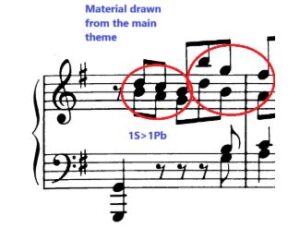
The Subordinate Theme starts, conventionally, on the relative major of E minor, G major.
The material is derived from the Main theme, more especially 1Pb, hence the symbols on the score: 1S>1Pb:
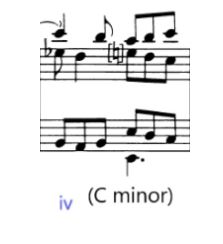
He employs a modal mixture in bar 33 (a modal interchange to the Aeolian mode by the use of the minor subdominant, C minor) which is common use in this section of a Sonata:
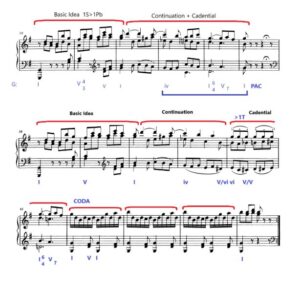
It presents a loose sentence structure, with the presentation phrase starting in bar 30 to 35 with a caesura (fermata or pause) in bar 35. These pauses are an expressive tool that Haydn will use more than once and started in the Medial Caesura at the end of the transition.
The Subordinate Theme employs a common loosening structural device by repeating the presentation phrase in bars 30 to 35 in bars 36 to 38; this time the continuation will lead to the cadential progression finishing in a PAC in bar 42, eliding with the final section, the Coda up to bar 45.
Development Section – Bars 46 – 78
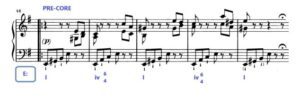
Pre-Core – Bars 46-51
This section starts with the presentation of the Main Theme now in the parallel Major (E major) as the Pre-Core (Term coined by William Caplin) and remains incomplete , that is, lacking one of its full complement of functional elements, which the concluding function presented in the exposition.
In Haydn’s piano sonatas and symphonies, the use of the parallel major in the development section of minor-key sonata form movements was not a standard practice but did occur occasionally (as well in the Classical period, which the convention dictates a minor-key sonata will start the development in the relative major key)
Haydn was known for his innovative and often unpredictable approach to form and harmony, frequently using remote key relationships and sudden contrasts, rather than always relying on the parallel major. Haydn Piano Sonata in E Minor Analysis.
Another example of this can be found in his Symphony No. 44 in E minor (“Mourning”) in bar 62 (or 3’40’’ on this video)
Core Bars 52-71
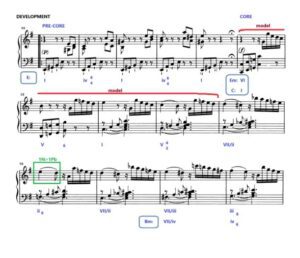
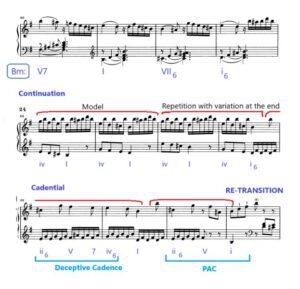
The Core, according to W. Caplin, establishes a large-scale model, usually lasting four to eight bars (in this case are 8 bars starting in bar 52) and then a sequential repetition of the complete model, one or more times (in this case one complete in bar 59) After which it comes a fragmentation into smaller grouping units (we can see it in the upbeat of bar 68) the fragments are built from material drawn from the core (Bar 56 1N>1Pb) The harmonic pathway leads to the key of B minor that starts in bar 58 with a pivot chord, Em.
Retransition Bars 72-78
The retransition starts in the key of B minor (Developmental key) In bar 74, a sequential progression by descending thirds in E minor lead to a half cadence (Bar 78)
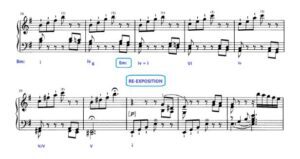
Descending thirds sequence:
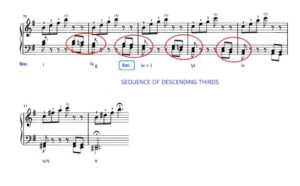
In Summary, This plan features a Pre-Core, a single core that ends in a development key, followed by a retransition that returns the music to the home key:
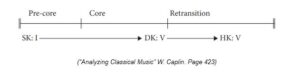
(“Analyzing Classical Music” W. Caplin. Page 423)
Recapitulation (Bars 79-127)
Main Theme: Bars 79-86 in E minor
Bridge: Bars 86-94
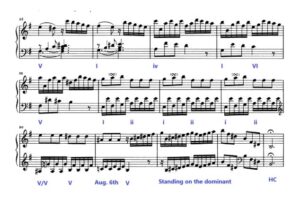
Subordinate Theme: Bars 95-124
As convention, the theme is now in E minor (tonic key) ending in bar 100 with a caesura (pause or fermata)
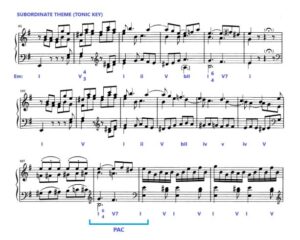
The Theme now cadences to E minor through a PAC in bar 109 starting a section which is much longer than the exposition, lasting only four bars and in the recapitulation lasting 15 bars.
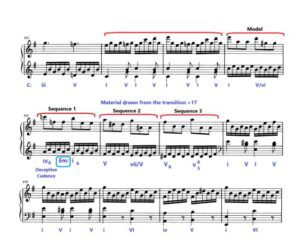
There is a harmonic deviation towards the VI (C major) in bar 111 which modulates towards E minor through a model in bar 114 which is repeated three times in sequence leading to the tonic Key in bar 118, continuing to reaffirm the key until the Coda (bar 124).
Coda Bars 124-127
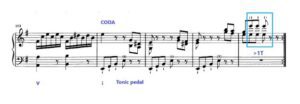
Material drawn from the Main Theme, ending with three-repeated E notes, drawn from the Transition material (>1T) this is an unconventional ending for a first movement, creating a suspense instead of giving a secure closure, which is conventional for a 1st movement:
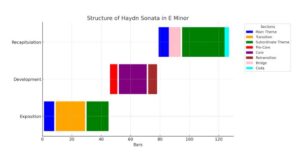
Summary of Haydn Piano Sonata in E Minor Analysis
Main Theme: Bars 1-8, Bars 79-86
Transition: Bars 9-29
Subordinate Theme: Bars 30-45, Bars 95-124
Development: Bars 46-78
- Pre-Core: Bars 46-51
- Core: Bars 52-71
- Retransition: Bars 72-78
Recapitulation: Bars 79-127
- Main Theme: Bars 79-86
- Bridge: Bars 86-94
- Subordinate Theme: Bars 95-124
Coda: Bars 124-127
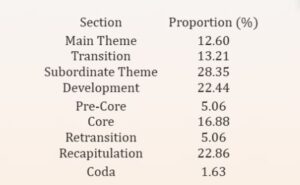
Proportions of sections:
Exposition
- Main Theme: 1-8
- Transition: 9-29
- Subordinate Theme: 30-45
Total bars in Exposition: 8 (Main Theme)+21 (Transition)+16 (Subordinate Theme) = 45 bars
Development
- Development section: 46-78
Total bars in Development: 33 bars
Recapitulation + Coda
- Recapitulation: 79-127
- Coda: 124-127
Total bars in Recapitulation + Coda: 49 (Recapitulation) +4 (Coda) = 53 bars
Proportions:
Exposition: 34.1%
Development: 25.0%
Recapitulation + Coda: 40.2%