
 TRIAL LESSON
Piano Lessons
The Collaborative Pianist — Skills, Repertoire, and Why Ensemble Playing Matters
Feb
The Collaborative Pianist — Skills, Repertoire, and Why Ensemble Playing Matters
The collaborative pianist is not a soloist who happens to share a stage — they are a distinct musical practitioner, trained in listening, flexibility, and structural awareness that solo performance rarely demands. For London piano students at every level, developing collaborative skills is one of the most rewarding and practically useful things a piano education can offer.

Ensemble playing develops musical intelligence that solo practice cannot replicate.
In This Guide
- What a collaborative pianist actually does — and how it differs from solo performance
- The six core skills every collaborative pianist must develop
- Piano duets — the ideal entry point for beginners
- Trios, chamber music, and more advanced ensemble repertoire
- Why ensemble playing builds listening skills no amount of solo practice can
- Recommended repertoire, grade by grade
- How WKMT students develop as collaborative pianists
The term collaborative pianist refers to a pianist who performs alongside other musicians — whether instrumentalists, singers, or fellow pianists — in a relationship of genuine musical partnership. In professional circles, the field encompasses accompanists, chamber music pianists, piano duo partners, and vocal coaches. The broader term “collaborative pianist” has largely replaced “accompanist” because it better describes the role: not a background support function, but an equal and active musical voice.
For students at WKMT London, collaborative piano playing is not a specialist add-on. It is a natural part of a complete piano education, introduced early through duets and developed progressively through chamber music, song accompaniment, and ensemble projects. The skills it builds — acute listening, rhythmic steadiness, harmonic awareness, and the ability to shape a musical line while responding to another performer — are foundational to musicianship at every level.
What Does It Mean to Be a Collaborative Pianist?
The collaborative pianist occupies a unique position in music. Unlike the soloist, who controls every aspect of a performance, the collaborative pianist must simultaneously sustain a clear musical identity and subordinate parts of that identity to the needs of the ensemble.
Historically, the accompanist was often treated as a lesser role. That view has shifted substantially. Figures such as Gerald Moore helped establish the collaborative pianist as a professional specialism in its own right. Today, pianists such as Malcolm Martineau and Roger Vignoles are recognised as major artists precisely for their ensemble work.
“Accompanying is not, as many believe, a minor craft. It is an art demanding the utmost musicianship, sensitivity, and self-effacement.”— Gerald Moore, The Unashamed Accompanist (1943)
The Six Core Skills of the Collaborative Pianist
Collaborative piano playing demands a distinct set of competencies, each of which can be practised and developed systematically.
Active Listening
Hearing the other performer’s intonation, phrasing, and breathing in real time — and responding, not just reacting.
Rhythmic Reliability
Providing a pulse the other musician can depend on, especially in moments of expressive flexibility.
Dynamic Balance
Calibrating volume and texture so the piano supports rather than overwhelms the other voice or instrument.
Score Reading
Reading two or more lines simultaneously to understand harmonic and structural context.
Adaptability
Adjusting to live performance variables: hesitations, tempo changes, unexpected dynamics.
Communication
Using gesture, breath, and subtle timing to signal entries and phrase endings without speaking.
Piano Duets — The Natural Starting Point
Piano duets (four-hand piano, or piano à quatre mains) are the most accessible entry point for students beginning to work as collaborative pianists. Both players share the same instrument — one on the lower (secondo) part, one on the upper (primo) — which immediately creates demands of physical coordination, shared pedalling, and mutual awareness that solo playing never requires.
The repertoire for piano duets is vast and spans every level. ABRSM’s Piano Star series includes ensemble pieces from initial grade onwards. Pieces by Bartók (Mikrokosmos duets), Diabelli, and Beethoven’s early four-hand works give beginners manageable yet musically satisfying material. At more advanced levels, Schubert’s Fantasy in F minor and Brahms’s Waltzes offer substantial ensemble challenges.
Duet playing introduces collaborative skills from the earliest stages of piano study.
Piano Trios, Quartets, and Chamber Repertoire
Beyond the duet, the collaborative pianist enters the world of chamber music proper. The piano trio — piano, violin, and cello — offers some of the richest collaborative repertoire for advancing students. Haydn, Beethoven, Schubert, Schumann, Brahms, and Dvořák all wrote major piano trios.
At WKMT, students interested in chamber music receive guidance on appropriate repertoire and approach. The studio’s ensemble culture means opportunities arise organically, both in lessons and in the regular concert and festival programme.
Six-Hand Piano Pieces and Group Ensemble Formats
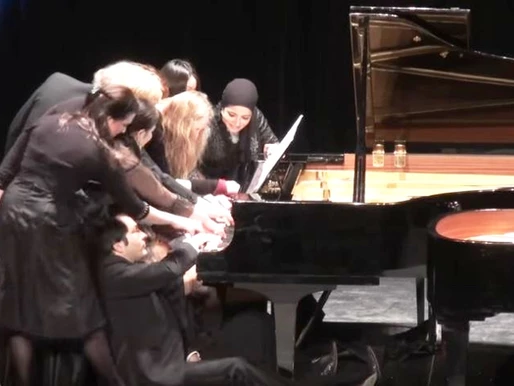
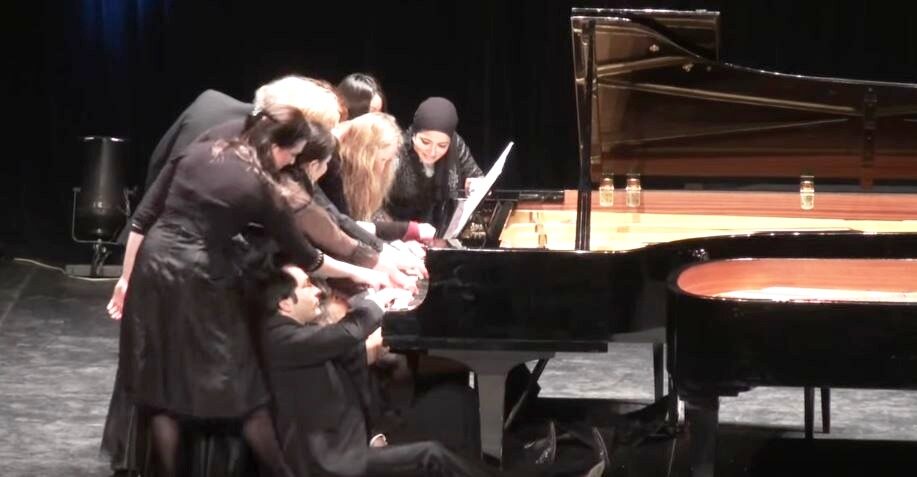
Less commonly known but highly effective for group teaching are six-hand piano pieces, where three players share a single instrument. Beyond these formats, the collaborative pianist’s skills apply equally to song accompaniment. For students who wish to develop accompaniment skills, WKMT offers specific guidance on the techniques and repertoire appropriate to this demanding discipline.
The Listening Skills Only Ensemble Playing Develops
One of the most significant contributions of collaborative piano work is to a student’s listening. Solo practice encourages inward listening — attending to one’s own sound, phrasing, and balance. Ensemble playing forces outward listening: hearing what another musician is doing, in real time, and responding without stopping to reflect.
“The pianist who has never played with another musician has heard only half of what music can be.”— WKMT London pedagogical principle
These benefits extend beyond the piano lesson. As explored in WKMT’s guide to music and teamwork, the collaborative habits developed through ensemble playing have measurable transfer effects into other areas of learning and communication.
Collaborative piano skills develop progressively — each ensemble format adds competencies that solo practice alone cannot supply.
Recommended Collaborative Piano Repertoire by Level
| Level / ABRSM Grade | Format | Composer / Work | What It Teaches |
|---|---|---|---|
| Initial – Grade 2 | Piano Duet | Bartók, Microcosmos Duets; ABRSM Piano Star Ensemble pieces | Shared pulse, turn-taking, basic dynamic balance |
| Grade 2 – 4 | Piano Duet | Diabelli, Melodious Pieces Op. 149; Turk, Easy Duets | Primo/secondo roles, sustaining a line while listening |
| Grade 4 – 6 | Piano Duet | Beethoven, Sonatina in C; Mozart, Sonata in D K. 381; Grieg, Norwegian Dances | Harmonic listening, ensemble phrasing, stylistic awareness |
| Grade 5 – 7 | Piano Trio (simplified) | Haydn, Piano Trio in G Hob. XV/25; Telemann, trios | Multi-voice balance, cue awareness, structural understanding |
| Grade 6 – 8 | Piano Duet | Schubert, Fantaisie in F minor D. 940; Brahms, Waltzes Op. 39 | Sustained ensemble musicality, expressive flexibility |
| Grade 7 – 8+ | Piano Trio | Beethoven, Trio in B flat Op. 11; Schubert, Trio in B flat D. 898 | Professional ensemble listening, full collaborative partnership |
| Post-grade / advanced | Song accompaniment | Schubert Lieder; Fauré melodies; Britten folk songs | Vocal balance, adaptability, expressive subordination |
The Collaborative Pianist vs the Solo Pianist: A Different Mindset
Being a collaborative pianist requires a genuine shift in orientation. The solo mindset is self-directed; the collaborative mindset is other-directed. A student who has spent time as a genuine collaborative pianist — listening hard, adjusting in real time, making the other musician sound their best — almost always returns to solo playing with an enhanced understanding of structural balance, phrase shaping, and dynamic proportion.
Common Student Mistake
Many students begin duet or ensemble playing by treating it as solo practice with another person present. They focus entirely on their own part and do not listen to the partner’s line. This produces coordinated but musically dead ensemble playing. The single most important instruction for new ensemble players: put half your attention on what the other person is playing, all the time.

Ensemble work at WKMT develops musical intelligence and ensemble awareness from an early stage.
Is Collaborative Piano Suitable for My Level?
Yes — with the right repertoire, collaborative piano playing is accessible from the earliest stages. Grade 1 students can work on simple duets. Students often worry that ensemble playing requires a higher standard than their current solo work. In practice, a student working on Grade 4 solo pieces may find that a Grade 2 duet is the right level of ensemble challenge — complex enough to require genuine listening, accessible enough to free attention from technical difficulty.
WKMT Pedagogical Approach
At WKMT London, ensemble playing is integrated into the teaching programme as a natural development, not a specialist add-on. From duets in early-stage lessons through to chamber music projects and student concerts, the studio’s approach to the Scaramuzza technique includes attention to how the body, breath, and physical gesture communicate between performers — skills as relevant to ensemble playing as to solo performance.
How WKMT Students Develop as Collaborative Pianists
WKMT’s piano lessons in London provide individual instruction that includes attention to listening skills, structural awareness, and the technical foundations of collaborative playing. Students interested in pursuing collaborative piano seriously can discuss specific goals with their teacher at WKMT.
- Start with duets early. Even Grade 1 students benefit from four-hand pieces. Choose repertoire that is technically straightforward so attention can go to listening.
- Practise your part before ensemble rehearsal. Ensemble listening is only possible if you do not need to concentrate entirely on your own notes. Secure the part first.
- Listen to the other line, not just your own. Practise following your partner’s phrasing and dynamics, not executing your own independently.
- Learn to keep going. In ensemble playing, stopping to correct a mistake is often worse than the mistake itself. Develop the habit of playing through and recovering.
- Attend ensemble concerts as a listener. Studying how professional collaborative pianists balance, phrase, and respond to their partners accelerates development in your own playing.
Frequently Asked Questions
What is the difference between a collaborative pianist and an accompanist?
“Collaborative pianist” is the contemporary preferred term, reflecting the equal musical partnership involved. Most professional pianists working in ensemble contexts now use this term to describe their work.
At what age or grade should students start collaborative piano work?
Students can begin with simple piano duets from Grade 1 onwards. ABRSM’s Piano Star series includes ensemble pieces from initial level. There is no minimum grade threshold.
Do I need to be able to sight-read to play in ensembles?
Basic sight-reading ability is helpful but not a prerequisite for beginning collaborative piano playing. Duets and chamber pieces can be learnt and prepared in the same way as solo repertoire.
Are ABRSM ensemble exams a good route for student collaborative pianists?
Yes. ABRSM’s ensemble exams provide a structured, externally assessed framework for duet and chamber music study. Discuss with your WKMT teacher whether this route is appropriate for your goals.
Does playing in ensembles help with solo performance?
Consistently, yes. Students who develop ensemble experience tend to return to solo playing with improved phrase awareness, more natural tempo flexibility, and a better-developed sense of musical balance.
What is the best piano duet repertoire for a Grade 4 student?
Strong options include Mozart’s Sonata in D K. 381, Beethoven’s early four-hand pieces, Grieg’s Norwegian Dances (simplified versions), and selected Schubert dances. The Bartók Mikrokosmos duets at Volumes III–IV also offer excellent ensemble material.
How does the Scaramuzza technique apply to collaborative piano?
The Scaramuzza technique emphasises the physical transmission of musical intention through the arm, wrist, and finger. In ensemble playing, the way a pianist breathes, lifts, and moves communicates musical intention to their partner as visibly as sound does. Students trained in Scaramuzza principles often find ensemble communication more natural.
Develop Your Skills as a Collaborative Pianist
WKMT London offers piano lessons for students at every level, from beginner duets to advanced chamber music preparation. Our teaching programme in West Kensington integrates ensemble skills from the earliest stages.