
 TRIAL LESSON
Piano Lessons
The advantages of a metacognitive approach to practice
Oct
Metacognitive approach to practice
The Metacognitive Approach to Piano Practice — How Self-Awareness Transforms Your Progress
Research by Chaffin (2002) and Hallam (1997) shows that what separates effective piano students from struggling ones is rarely raw talent — it is the ability to think about their own thinking while they practise.
What You Will Learn
- What metacognition means in the context of piano practice
- The four stages of learning a new piano piece (Chaffin 2002)
- How expert and novice musicians practise differently (Hallam 1997)
- The six metacognitive skills every piano student needs to develop
- How WKMT teachers demonstrate metacognitive monitoring in lessons
- Practical exercises to build self-monitoring habits at home
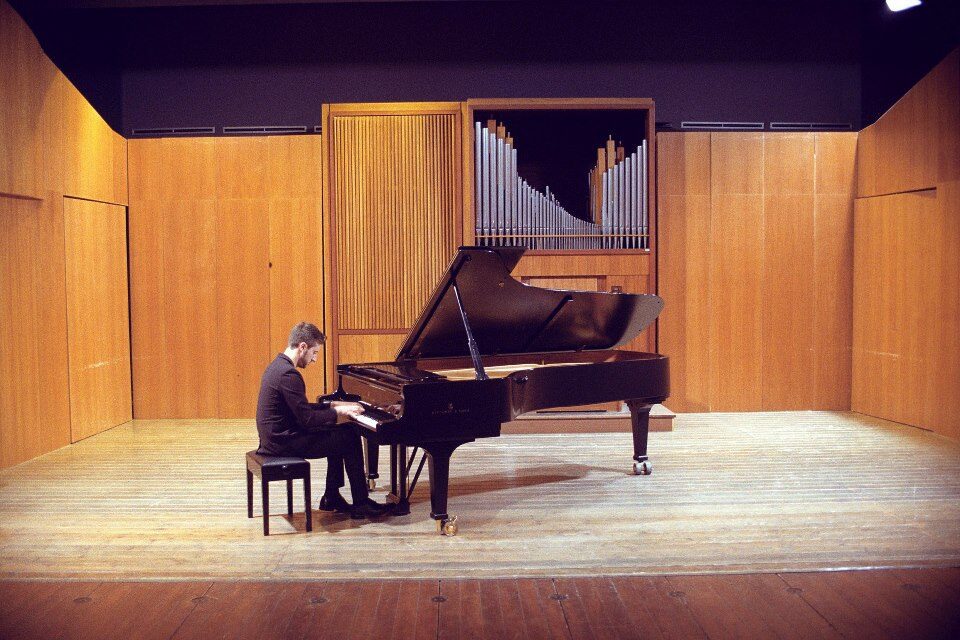
The metacognitive approach to practice is one of the most important — and most consistently underused — tools available to piano students. Most students know they need to practise. Fewer know how to use that practice time with genuine intelligence. The difference between a student who plateaus after three years and one who continues to develop with increasing independence nearly always comes down to this: the ability to observe, analyse, and regulate their own learning process while sitting at the keyboard.
At WKMT London, our teaching philosophy places metacognitive practice at the centre of instrumental development. What follows is a distillation of the academic research on this subject — particularly the seminal work of Chaffin (2002) and Hallam (1997) on piano practice and musical learning — combined with the practical application of these principles that our teachers use every day in lessons.
What Is Metacognition? A Definition for Piano Students
Metacognition, in its simplest form, is thinking about your thinking. In the context of piano practice, it means being aware of what you are doing, why you are doing it, whether it is working, and what you should do next if it is not.
A student without metacognitive awareness practises by repetition: they play the piece from the beginning, hope that errors will resolve themselves through repetition, and move on. A student with a metacognitive approach to practice does something fundamentally different: they listen to themselves critically, identify precisely where and why errors are occurring, select a targeted strategy to address them, monitor whether that strategy is working, and adjust accordingly.
Antonio Losciale, one of WKMT’s teachers, wrote about this distinction in his MMus research paper on learning and memorisation in piano performance — a paper grounded in the primary academic literature on the subject. His key insight was that this skill — knowing how to learn — is itself teachable, and that it is the teacher’s primary job to model it explicitly in every lesson.
The Four Stages of Learning a Piano Piece (Chaffin 2002)
Roger Chaffin’s 2002 study, Practicing Perfection: Memory and Piano Performance, documented the learning process of concert pianist Gabriela Imreh as she prepared Bach’s Italian Concerto for performance. What emerged was a four-stage model of how expert musicians actually approach learning a new work — a model any piano student can apply.
- Stage 1 — The Big Picture: Before any serious technical work begins, the musician gets a broad overview of the piece. This means listening to a recording, reading through the score away from the piano, identifying the overall character, the form, the key areas, and the passages likely to present difficulty. The student who jumps straight to bar one and begins drilling has skipped this stage entirely — and will pay for it with fragmented understanding of the work as a whole.
- Stage 2 — Technical Practice: With the big picture in mind, the student breaks the piece into manageable sections and addresses the technical demands of each. Slow practice, metronome work, hands-separately work, and focused repetition of difficult passages all belong here. The goal is automation: getting the physical execution reliable enough that the mind can begin to direct interpretation rather than manage mechanics.
- Stage 3 — Polishing for Performance: Once technical reliability is established, the focus shifts to expression, phrasing, dynamics, and continuity. Run-throughs of whole movements or sections become appropriate here for the first time.
- Stage 4 — Maintenance: After a piece has been learnt and performed, it requires ongoing maintenance. Expert musicians plan this stage deliberately; students without metacognitive awareness tend to abandon a piece the moment the performance is over.
“To implement these four stages in individual practice is possible, for example, to include activities such as listening to a recording or teacher performance of the work prior to learning to identify the basic character, as well as the possible difficulties; identifying repetitions and slow practice to overcome technical problems; considering articulation and dynamics in developing the interpretation and playing the piece through in preparation for a performance.”
— Chaffin, R., Imreh, G., & Crawford, M. (2002). Practicing Perfection: Memory and Piano Performance. Erlbaum Associates.
Novice vs Expert Practice — Hallam’s Landmark Research (1997)
Susan Hallam’s 1997 study shows that novice and expert musicians can be reliably distinguished not by how long they practise, but by the kind of thinking they bring to the practice room.
| Characteristic | Novice Practice (Low Metacognition) | Expert Practice (High Metacognition) |
|---|---|---|
| Approach to errors | Leaves errors uncorrected; continues playing through them | Stops immediately; isolates the passage and addresses the cause |
| Run-through habit | Plays from beginning to end repeatedly | Plays through to identify problem areas, then targets them specifically |
| Strategy selection | One strategy (repetition) applied to all problems | Different strategies selected for different types of problems |
| Self-monitoring | Limited awareness of what went wrong or why | Continuous internal commentary: “What happened? Why? What should I try instead?” |
| Goal-setting | Vague (“practise for 30 minutes”) | Specific and measurable (“clean up bars 14–18 at dotted-crotchet = 60”) |
| Knowledge of difficulty | Cannot accurately predict where problems will occur | Can assess piece difficulty in advance and allocate time accordingly |
“The most important skill that can be taught by an instrumental music teacher is how to practise. Several studies point out the fact that even high-level music students, who spend many hours every week practising alone, still need to be taught how to use this time constructively; so the quality of practice prevails over the quantity.”
— Hallam, S. (1997). The development of metacognition in musicians: Implications for education. British Journal of Music Education, 14(01), pp.87–97.
The Six Metacognitive Skills Every Piano Student Needs
1. Task Recognition
Can the student accurately assess the difficulty of a new piece before beginning to learn it? Students with developed metacognition scan a new score and mentally map the technical terrain before playing a note.
2. Strategy Selection
Different problems require different solutions. Our guide on how to practise piano more efficiently goes deeper into strategy selection for specific technical challenges.
3. Progress Monitoring
The student must evaluate, during practice, whether their current strategy is producing improvement. If playing a passage ten times at slow tempo has not resolved a technical issue, the strategy is failing — not the student.
4. Goal Setting
Effective practice sessions begin with a specific, measurable goal. “Practise my piece” is not a goal. “Get bars 22–30 to tempo with correct articulation” is a goal.
5. Self-Evaluation
At the end of a practice session the metacognitive student asks: “Did I achieve what I set out to achieve? If not, why not? What should tomorrow’s session focus on?”
6. Knowledge of One’s Own Limitations
Expert musicians know what they do not yet know. They identify gaps in their technical arsenal and factor these into their practice planning.
How WKMT Teachers Demonstrate Metacognitive Monitoring
The teacher must demonstrate metacognitive monitoring during lessons, making the thinking process visible and explicit. In practical terms:
- Giving an overview before diving in — identifying what the section is doing harmonically, its technical demands, and likely difficulties (Chaffin’s Stage 1 in the classroom).
- Narrating the identification of difficulties — naming the type of error and explaining which strategy is appropriate for that specific problem.
- Integrating sections back into the whole — testing whether the repaired section now fits smoothly back into context.
- Setting specific goals for home practice — not “practise the piece” but “work bars 14–22 hands separately until each hand plays confidently at crotchet = 60.”
- Teaching students to listen to themselves — recording practice sessions, even on a phone, is one of the most powerful metacognitive tools available.
For adult learners returning to the piano after a break, the metacognitive approach to practice is particularly valuable. Adults already possess well-developed self-reflective capacities; what they need is guidance in applying those capacities specifically to the keyboard. Our adult piano lessons in London programme is built around exactly this philosophy.
Practical Metacognitive Exercises for Home Practice
- The Pre-Practice Scan: Before sitting down at the piano, spend two minutes looking at the score without playing. Identify the one passage most likely to give you trouble. Decide in advance what strategy you will use to address it.
- The Error Diary: Keep a small notebook at the piano. Every time you make the same error twice in a row, write down the bar number, the type of error, and the strategy you will use to fix it.
- The Slow-Motion Test: If you cannot play a passage perfectly at half speed, you do not yet understand it well enough to learn it at tempo. Any error at slow tempo is a structural problem, not a speed problem.
- The One-Bar Fix: Identify one bar you would be embarrassed to play in a lesson. Give it the first fifteen minutes of your session. At the end, assess honestly: is it better? If not, the strategy was wrong — not the effort.
- The Weekly Review: At the end of each week, play through everything from start to finish. Write down one specific goal for the following week.
Our article on practising problems at the piano explores strategies for specific technical challenges. For building structured practice habits, why practice makes perfect — and how to make it count provides a clear foundation.
The five-stage metacognitive practice cycle — applied by WKMT teachers and students in every lesson and home practice session.
Is the Metacognitive Approach Suitable for All Students?
In a word: yes — though the degree of explicitness must be calibrated to the student’s age and level. With younger children, the metacognitive framework is introduced through simple questions: “What went wrong there?” and “What should we try next?” With older students and adults, the framework can be discussed openly and the research rationale shared directly.
The goal of metacognitive practice is precisely to automate the technical and structural elements of performance so thoroughly that the musical imagination has room to operate freely. A pianist who has internalised the technical demands through intelligent, monitored practice is free to make music.
Our guide on the importance of figuring things out for ourselves explores the pedagogical case for developing student independence — which is, at its core, the long-term goal of the metacognitive approach to teaching.
The Research in Plain Language
What Chaffin and Hallam are saying is something every experienced teacher already knows from observation: the students who progress most reliably are not necessarily the most talented or the most diligent. They are the ones who think most carefully about how they are practising. They stop when something goes wrong. They ask themselves why. They try something different. They check whether the new approach is working. They adjust.
These habits are learnable. They are the product of a teacher who models them clearly, asks the right questions consistently, and — over time — makes the student’s internal critic more articulate and more useful than their internal cheerleader.
Study Piano at WKMT London
Our teachers bring academic research and classical pedagogy together in every lesson — from the Scaramuzza technique for physical freedom at the keyboard to the metacognitive practice frameworks described above. Whether you are an adult returning to the piano or a young student beginning serious study, we build the habits and skills that produce genuine, lasting progress.