
 TRIAL LESSON
Uncategorized
Concert Pitch and Piano Tuning — A Brief History of A440 Hz
Sep
A440 Hz – Who was the first person using A = 440 Hz?
Concert Pitch and Piano Tuning — A Brief History of A440 Hz
Every piano you sit at is tuned to A440 Hz — but this universal standard is barely a century old. The story of how the world settled on a single concert pitch is a fascinating window into the physics, politics, and pedagogy of the piano.
In this article
- Who first proposed A440 Hz — Johann Heinrich Scheibler and the 1834 Tonometer
- The chaotic variation in European concert pitch before standardisation
- Baroque pitch (A=415 Hz) and what it means for piano students studying Bach
- Equal temperament versus well-tempered tuning — the difference that matters for the WTC
- Why pianos go out of tune and how professional tuning maintains A440
- Practical guidance: how often should your piano be tuned?
Today’s tuning is so commonplace that most piano students take it entirely for granted. The A above middle C vibrates at exactly 440 Hz on every concert grand, every upright piano, every electronic keyboard. Yet this specific number — A440 Hz — was only internationally codified in 1939, and formalised as ISO 16 as recently as 1975. The story of how the world arrived at a universal concert pitch is more contested, and more interesting, than most piano students realise. Understanding it sheds genuine light on the music of Bach, on historical recordings, and on the practical reality of keeping your instrument in tune.
A440 Hz is also directly relevant to anyone studying the music of Western musical development — a topic that spans centuries of shifting performance practice, instrument building, and acoustic science. This guide covers the history, the technical implications, and the practical consequences for your piano practice.
Who First Proposed A440 Hz? — Johann Heinrich Scheibler and the Tonometer
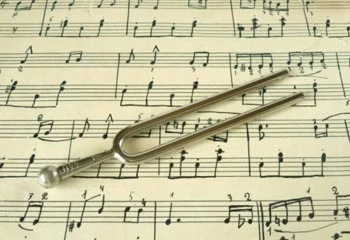
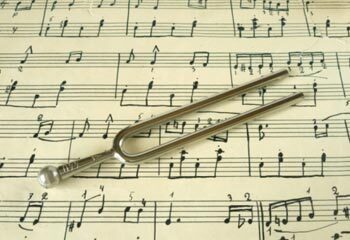
The story begins not with a musician, but with a German silk merchant and amateur physicist, Johann Heinrich Scheibler (1777–1838). In 1834, Scheibler invented a precision tuning device he called the Tonometer — from the German Der Tonmesser. It consisted of fifty-four tuning forks, precisely manufactured to cover the range from 220 Hz to 440 Hz in steps of four Hz each. By listening to the beats produced between adjacent forks — the pulse you hear when two near-identical frequencies interact — a musician could determine the exact frequency of any given pitch with remarkable accuracy for the time.
Scheibler presented his Tonometer and his recommendation for A=440 Hz as a universal concert pitch to the Society of German Natural Scientists and Physicians at their meeting in Stuttgart in 1834. The body approved his recommendation, which is why A440 is sometimes called Stuttgart pitch. His 1834 pamphlet, Der physikalische und musikalische Tonmesser, set out the acoustic mathematics with precision. Scheibler is now recognised as the father of the A440 standard.
Scheibler’s Tonometer received wide acclaim in Europe and the USA, and its principle was imitated by many other technicians — none more ambitiously than German physicist Rudolph Koenig, who in 1876 built a tonometer with 670 tuning forks covering the entire range of human hearing.
The Chaos Before Standardisation — European Concert Pitch Before 1939
Scheibler’s recommendation did not immediately settle the matter. For the next century, concert pitch varied wildly across Europe, and the variation is well-documented in Hermann von Helmholtz’s landmark book On the Sensations of Tone (first published in German in 1863). Helmholtz compiled a comprehensive survey of tuning standards used by European orchestras, organ builders, and instrument makers. The range he recorded was extraordinary:
| Source / Location | Pitch (Hz) | Era |
|---|---|---|
| North German church (“chamber pitch”) | A = 424.2 Hz | Before 1800 |
| Organ in Lille, France | A = 432 Hz | 1854 |
| English organ builder’s tuning fork | A = 432 Hz | 1846 |
| Paris Orchestra | A = 440 Hz | 1829 |
| French government standard (Diapason Normal) | A = 435 Hz | 1859 |
| British piano tuners’ standard | A = 439 Hz | 1899 |
| Organ at St Paul’s Cathedral, London | A = 444.6 Hz | Helmholtz survey |
| International conference, BBC London | A = 440 Hz | 1939 |
| ISO 16 (global standard, current) | A = 440 Hz | 1975 |
The French government attempted to settle the issue in 1859, decreeing A=435 Hz as the national standard — the Diapason Normal. American instrument manufacturers reached an informal consensus around A=440 Hz in 1926; the American Standards Association formally recommended it in 1936. In England, piano tuners had used A=439 Hz since 1899 — unusable as an electronic reference because 439 is a prime number, as Sir James Swinburne pointed out at the 1939 London conference. In May 1939, delegates from France, Germany, the Netherlands, Italy, and England met at Broadcasting House and agreed on A=440 Hz. ISO adopted it in 1955, codified as ISO 16 in 1975.
The road to A440 Hz: key milestones from Scheibler’s Stuttgart proposal (1834) to ISO 16 (1975).
Baroque Pitch and What It Means for Piano Students
The historical variation in concert pitch has direct implications for anyone studying Baroque music. In the period instrument movement, a consensus has developed around a modern Baroque pitch of A=415 Hz — approximately a semitone below A=440 Hz. If you listen to recordings of Bach’s keyboard music on period instruments by specialists such as Gustav Leonhardt or Ton Koopman, you will notice the music sounds a semitone lower than on a modern piano. This is not an error. For piano students studying Bach’s Italian Concerto BWV 971 or the sons of Bach who shaped the Galant style, these recordings are valuable references — your piano tuned to A=440 Hz is the correct instrument for study.
Some online communities claim A=432 Hz has spiritual or health benefits over A=440 Hz. There is no scientific basis for these claims. A=432 Hz was not a universal historical standard — Helmholtz’s survey shows pre-standardisation pitches ranged across more than 20 Hz.
Equal Temperament vs Well-Tempered Tuning — What Bach Students Need to Know
Modern pianos are tuned in equal temperament: the octave divided into twelve exactly equal semitones. This allows a piano to play in any key without retuning. The well-tempered tuning systems of Bach’s era were different — they allowed playing in all twenty-four keys while preserving subtle acoustic differences between keys. Bach’s Das Wohltemperirte Clavier (1722 and 1742) was written to exploit this property. In modern equal temperament, all keys are acoustically identical — that characteristic colour is lost, or at least flattened.
When you play the WTC on a modern equal-tempered piano, you hear a complete and beautiful musical experience — but not precisely what Bach’s contemporaries heard. The difference is subtle and does not affect how you should practise or perform the music. Musical depth, touch, and understanding are what matter.
Students wanting to understand these broader developments can explore WKMT’s writing on developments in Western music.
Why Your Piano Goes Out of Tune — and How A440 Is Maintained
A440 Hz is the standard, but maintaining it is an active process. Every string on a full-size concert grand is under approximately twenty tonnes of combined tension. That tension is affected by temperature and relative humidity — when the air is drier in winter, the soundboard contracts; when more humid, it expands. These changes shift the pitch of every note. A piano in regular use should be tuned a minimum of twice per year — in autumn and spring, when seasonal humidity changes are greatest.
We advise students to schedule tuning in October and April — the two transition points of the heating calendar. A piano significantly flat or sharp develops string tension imbalances that make exact-pitch recovery harder in a single visit. Regular tuning is also better for the strings and mechanism over the long term.
What a Piano Tuner Does: A440 in Practice
When a professional tuner visits, their first task is establishing A=440 Hz on the reference note using a calibrated electronic tuner or tuning fork. From that reference, they tune the rest of the instrument by interval comparison — checking octaves, fifths, and thirds for beating patterns that indicate correct equal temperament. A full tuning takes one to two hours for a well-maintained instrument.
- Establish A=440 Hz on the reference string (A above middle C)
- Set the temperament octave by adjusting intervals in equal temperament
- Work outward across the full compass, tuning each note to its octave
- Tune unisons: most notes have two or three strings, all must match exactly
- Final check: verify octaves and fifths across the full range by ear
Does Concert Pitch Matter for Your Daily Practice?
For most students, not directly — but understanding A440 Hz adds a layer of musical intelligence to your practice. It connects you to every concert hall, recording studio, and orchestra in the world. Where it matters more actively is in ear training: a piano significantly flat or sharp can introduce errors into your pitch memory. Regular tuning is not a luxury but a component of serious piano study.
Frequently Asked Questions on A440 Hz
Study Piano in London with WKMT
WKMT London offers piano lessons for adults and children, from complete beginners to diploma level. Our studio pianos are maintained to A440 Hz and our teaching integrates music history, theory, and practical technique.