
 TRIAL LESSON
Piano Lessons
Music and Wellbeing: A Parent Guide to Piano and Calm Practice
Aug
A parent guide from WKMT London
Music and Wellbeing: A Parent Guide to Piano and Calm Practice
Music and wellbeing meet most convincingly when a child feels safe enough to listen, try, pause and begin again. Piano practice can become one dependable part of family life: purposeful without being severe, expressive without demanding a performance.
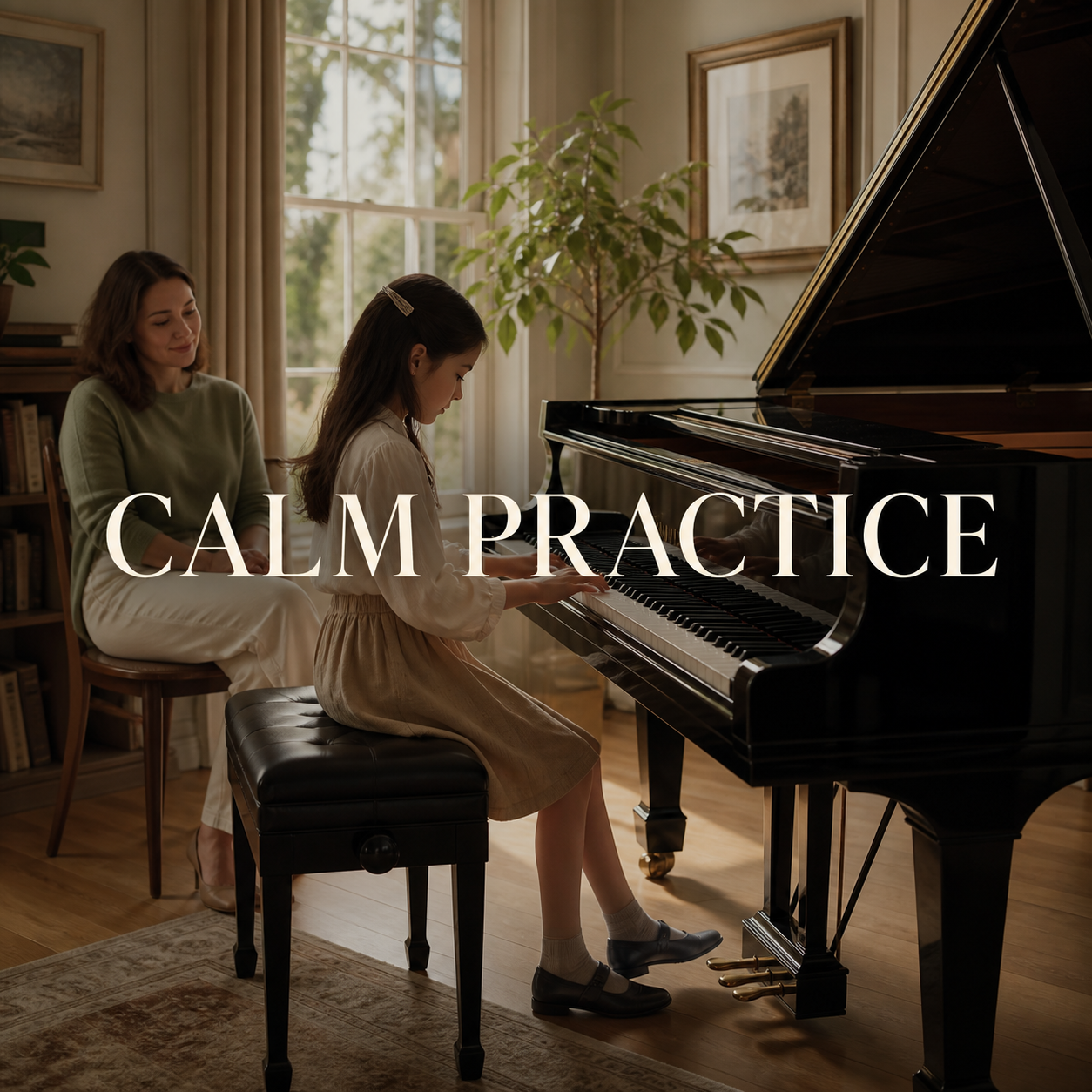
For parents, the useful question is not whether music guarantees happiness. It does not. Nor should piano lessons be described as therapy. The better question is more practical: what kind of musical routine helps a child feel capable, connected and heard?
Research on music education and emotional development suggests promising benefits, while also reminding us that outcomes depend on the quality, context and continuity of the experience. A calm piano routine offers something modest but valuable: a regular place to notice feeling, regulate effort, solve a small problem and finish with a sense of movement. This is where music and wellbeing become practical for family life rather than abstract.
What music and wellbeing can mean for a child
Wellbeing is broader than a cheerful mood. In a learning context it includes feeling secure, having some agency, recovering from frustration, enjoying connection and recognising progress. Music can touch each of these areas because it joins body, attention, memory, emotion and relationship in one activity. For children, music and wellbeing often meet in small repeated experiences rather than dramatic breakthroughs.
A systematic review of music used educationally with children aged three to twelve found generally positive effects across emotional intelligence, prosocial skills and related developmental outcomes. The authors also described variation across studies. That is an important caution: music creates opportunities for growth; it is not a guaranteed shortcut to it.
At the piano, these opportunities appear in ordinary moments. A child chooses a piece with the teacher. They hear that a phrase sounds restless and try a gentler touch. They make a mistake, work out where it happened and return without shame. They play something recognisable for a parent. These small events give emotion a form that can be heard and changed.
The calm-practice cycle
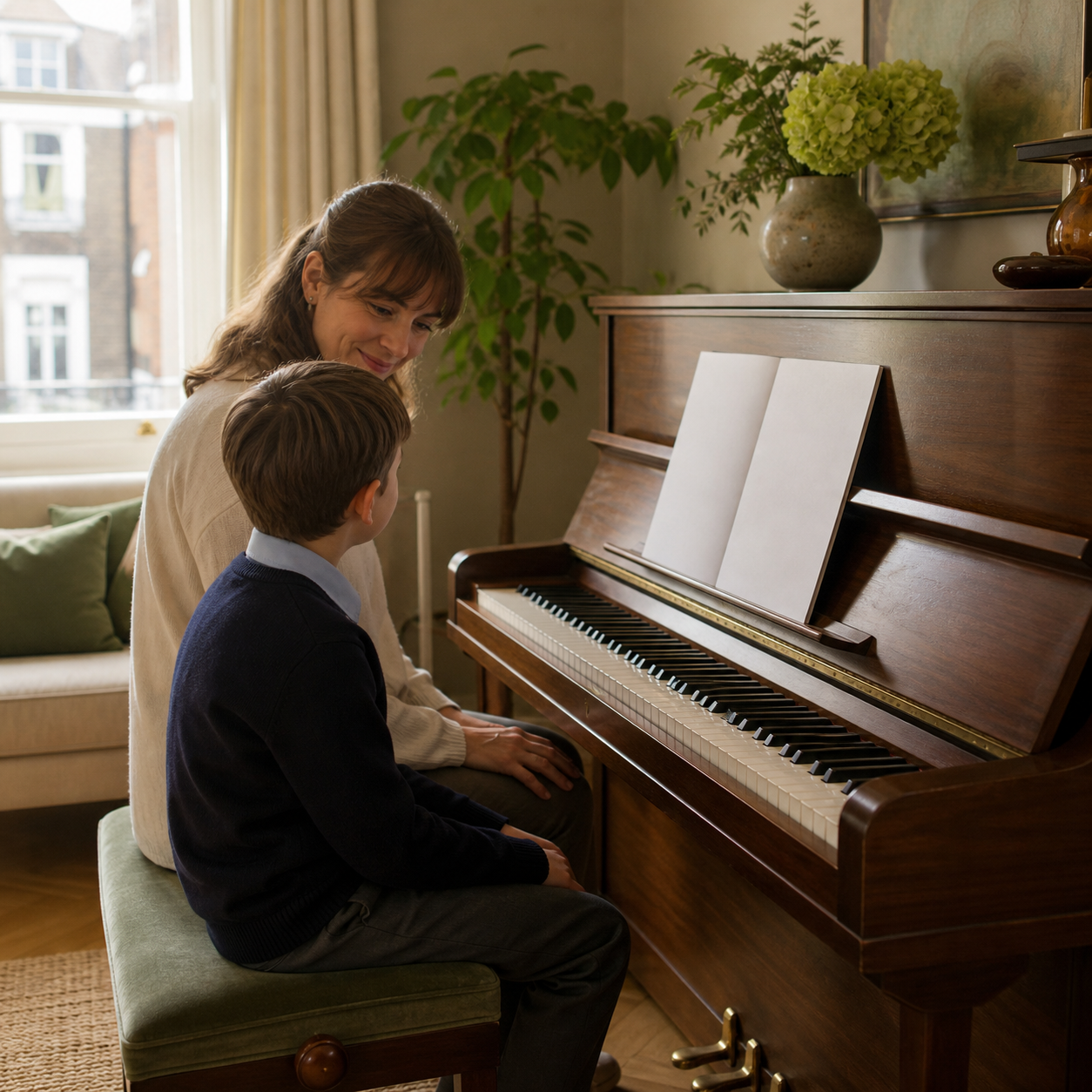
Children rarely regulate attention because an adult tells them to concentrate harder. They do better when the task has a visible shape. The following cycle turns practice into five manageable movements.
This is not a rigid prescription. A six-year-old may spend seven minutes on it; a teenager may stay for forty. Its value lies in predictability. Starting and stopping cease to feel arbitrary, and the child begins to recognise the signs of useful effort.
“The healthiest practice is demanding enough to be interesting and safe enough for the child to remain curious.”
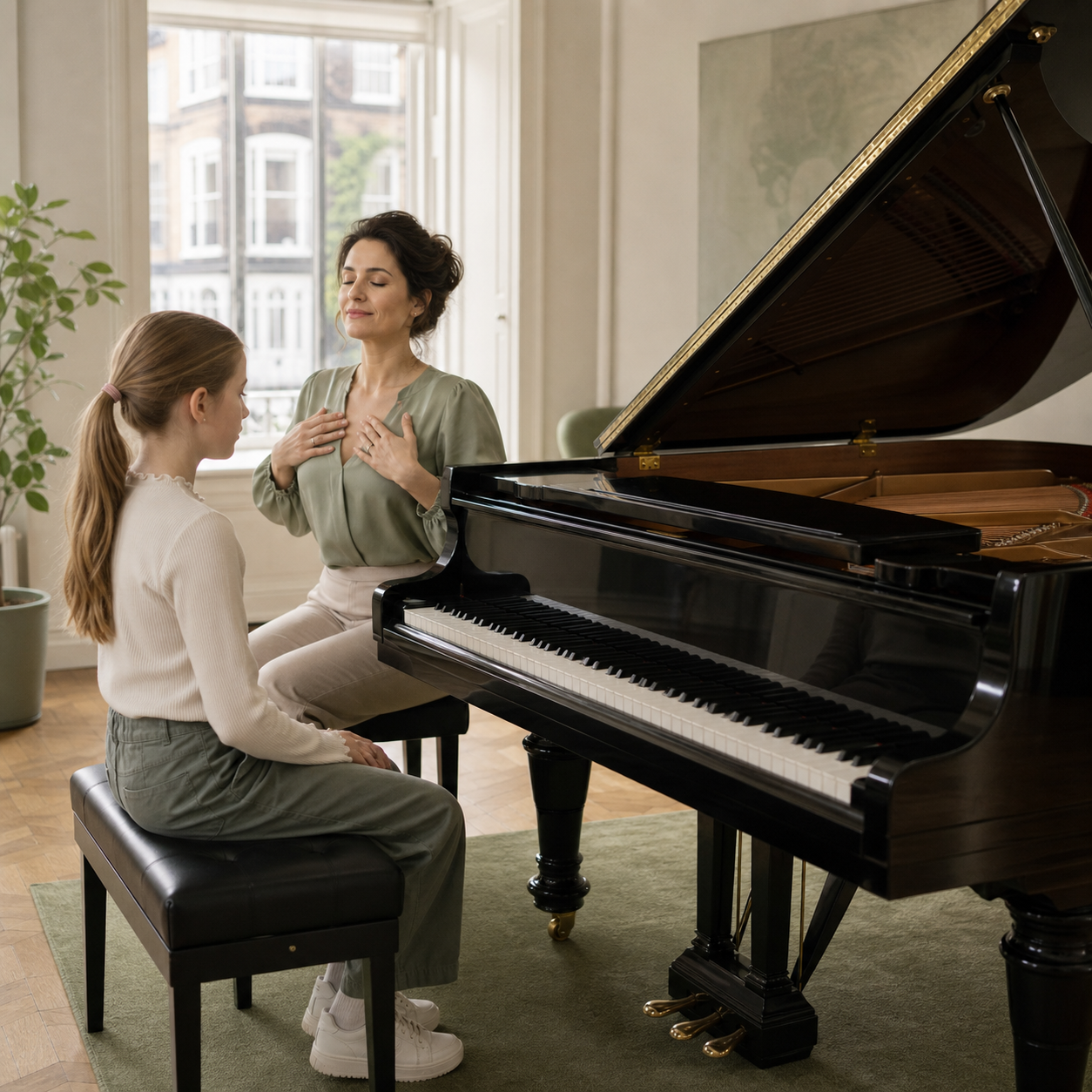
How piano practice supports emotional awareness
Music gives children a vocabulary before they have perfect words. Tempo can feel hurried or spacious. Harmony can sound settled or unresolved. Touch can be sharp, weighty, floating or warm. When a teacher asks, “What changed when you played that phrase more quietly?”, the child links an audible choice with an inner response.
Work with adolescents has also explored music as a route into emotional awareness and regulation. In one school-based programme, participants reported improvements in identifying and managing emotion, although the authors were careful not to claim a corresponding clinical change in symptoms. For families, the sensible translation is simple: musical language can help a young person notice and discuss feeling, but it does not replace appropriate health support.
Pressure and progress are not the same thing
Parents often add pressure because they care. A lesson has been paid for; a concert is approaching; the child once begged for a piano and now avoids practising. Yet repeated reminders, comparisons and distant targets can turn the instrument into a test of family harmony.
The alternative is not indifference. It is good task design. Compare the two patterns below.
| Moment | Pressure-led response | Calm, purposeful response |
|---|---|---|
| Starting | “You must practise for thirty minutes.” | “Which small job shall we begin with?” |
| Mistake | Immediate correction from across the room. | Allow a moment, then ask what the child heard. |
| Frustration | Insist on finishing the whole passage. | Pause, reduce the task and restore an easy movement. |
| Ending | List what remains wrong. | Name one change and choose tomorrow’s first step. |
Research on music training and executive function is relevant here because piano asks a child to hold instructions in mind, inhibit an impulsive response and shift attention between musical elements. Findings are encouraging, but reviews also point to different methods and effects across studies. Parents should therefore notice the child’s actual behaviour rather than treating a broad research claim as a promise.
Five signs the routine is working
A healthy music and wellbeing routine is visible. Look for changes such as these over weeks, not in a single evening:
- Starting becomes easier. The child needs less negotiation because the time and first task are familiar.
- Mistakes become information. A wrong note leads to listening or adjustment rather than collapse.
- The child can describe a choice. They can say that a phrase needs more shape, steadier pulse or a different character.
- Tension is noticed earlier. Shoulders, hands and breathing can be reset before discomfort grows.
- Music leaves the practice room. The child hums a phrase, shares a piece, listens more closely or returns to the piano voluntarily.
What parents can do without becoming the teacher
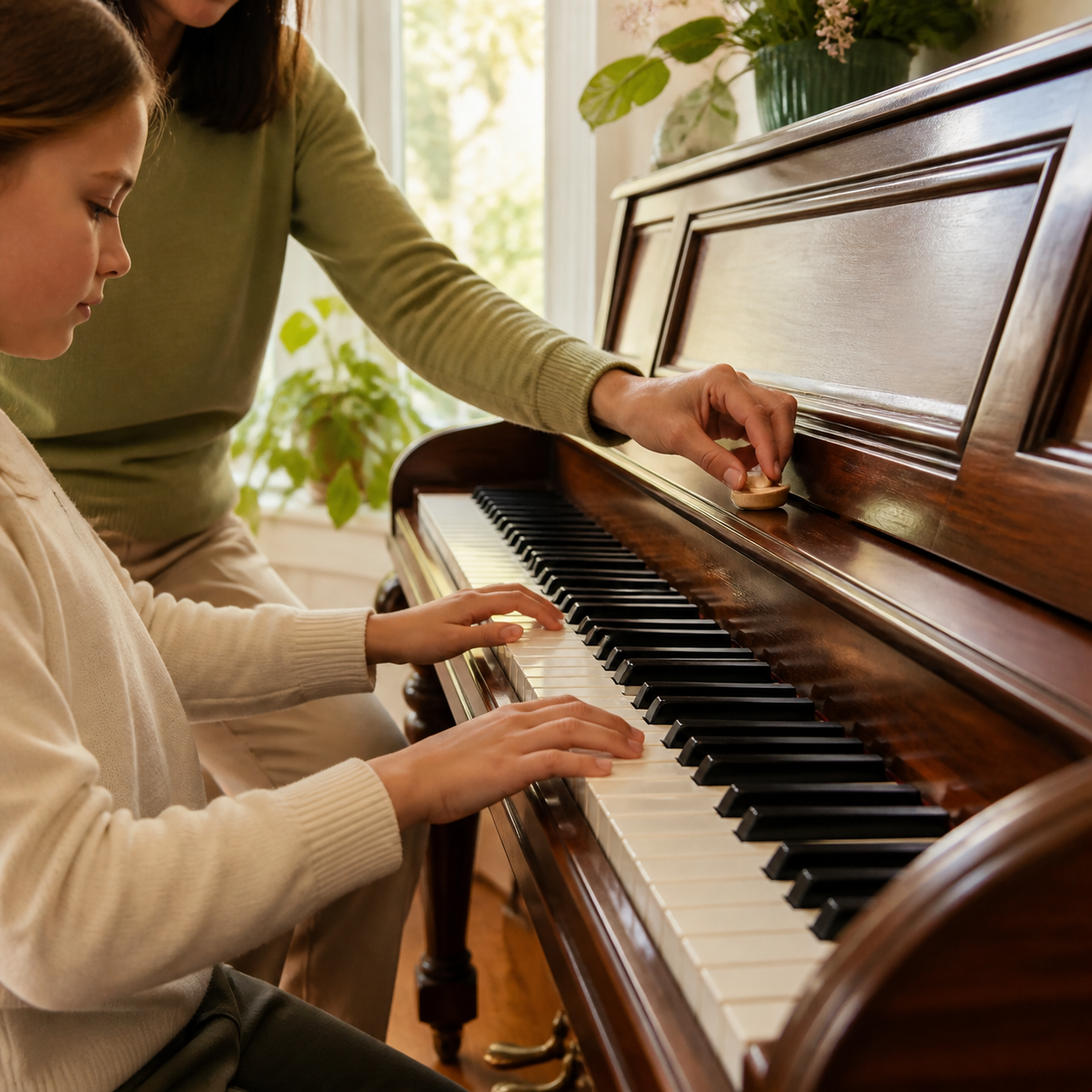
The parent has a powerful role, but it is not to run a second lesson. Protect the time, help the child begin and listen with interest. Leave technical diagnosis to the teacher, especially when posture, discomfort or persistent difficulty is involved.
Offer bounded choices: before or after tea; scales or the new piece first; two short sessions or one longer one. Keep praise specific. “You kept the pulse when the left hand changed” teaches more than “Brilliant”. When the child is resistant, ask whether the problem is fatigue, confusion, boredom, physical discomfort or fear of getting it wrong. Different causes need different responses.
For a wider view of motivation and development, WKMT’s article on reasons for children to begin music lessons offers useful context. Families curious about cognition can also read the site’s introduction to music and brain activity. These are supporting perspectives; the child’s lived experience remains the test.
Give calm practice a skilled framework
WKMT’s teachers help young pianists build technique, listening and confidence through age-appropriate musical work in London.
Explore piano lessons for childrenChoosing lessons that protect curiosity
A constructive lesson does not avoid standards. It gives standards a humane sequence. Within WKMT’s wider classical piano teaching in London, the teacher observes the child’s age, attention, coordination and musical appetite; selects material with enough challenge; explains how to practise; and adjusts when the task is not yet landing.
Parents should feel able to ask how home practice ought to sound, how long is suitable, what signs of strain to notice and how progress will be shared. In well-structured piano lessons for children in London, the weekly lesson and the family routine should support one another rather than compete.
Music and wellbeing: a balanced conclusion
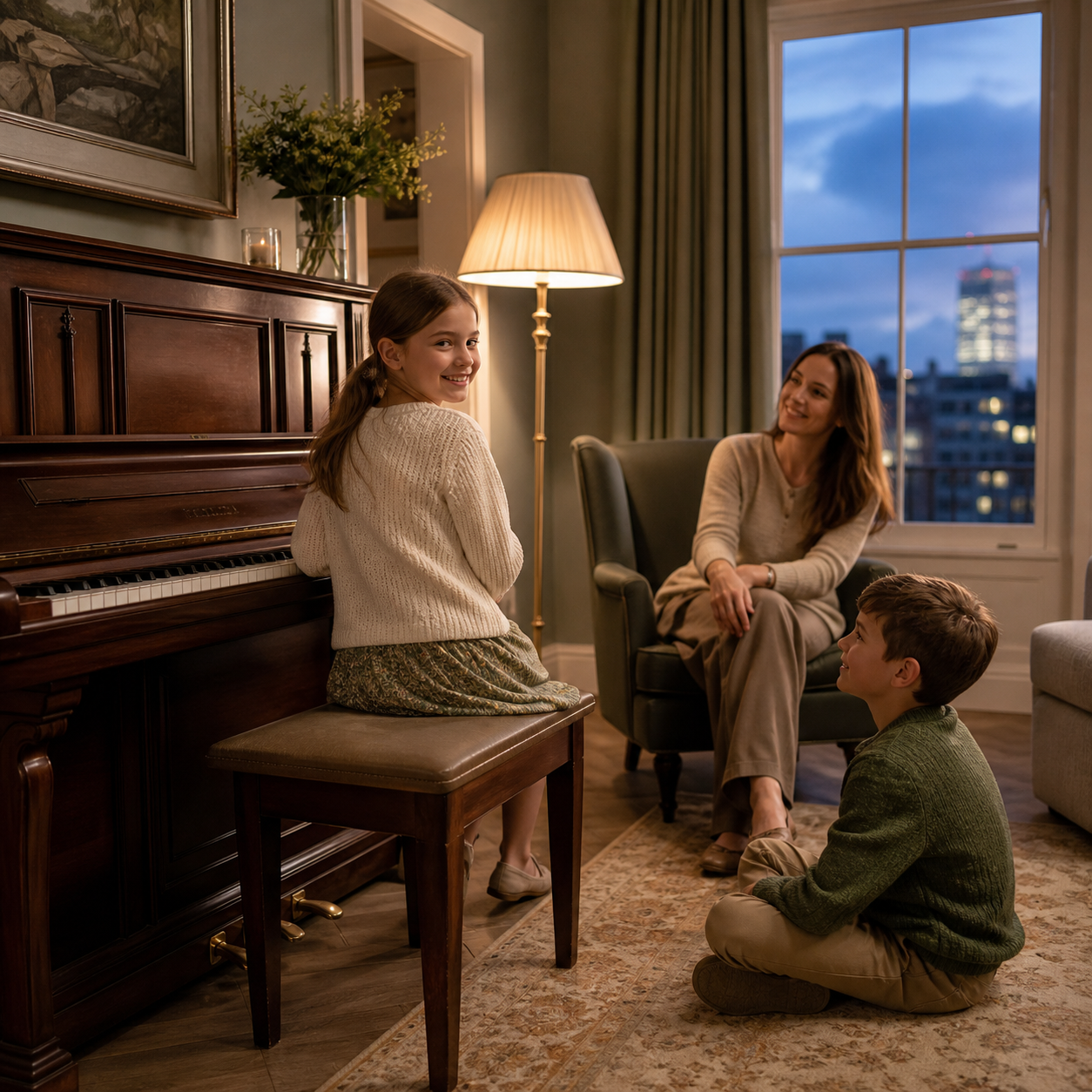
Music and wellbeing belong together when the musical experience respects the child. Piano can provide routine, expression, mastery and connection, but the benefits do not come from mere attendance or from forcing more minutes at the instrument. They grow through appropriate teaching, realistic tasks, regular listening and a family atmosphere in which errors can be repaired.
The most useful music and wellbeing ambition is neither perfection nor permanent calm. It is a child who can meet a musical difficulty, stay in relationship with the task and discover that effort can lead somewhere beautiful.
Sources
- Effects of the Educational Use of Music on 3- to 12-Year-Old Children’s Emotional Development, International Journal of Environmental Research and Public Health / PMC. Checked 20 August 2026.
- Tuned In Emotion Regulation Program Using Music Listening, Frontiers in Psychology. Checked 20 August 2026.
- Sustained Effect of Music Training on Executive Function in Preschool Children, Frontiers in Psychology. Checked 20 August 2026.
- Effects of Music Training in Executive Function Performance in Children: A Systematic Review, Frontiers in Psychology. Checked 20 August 2026.
- What Is the Evidence on the Role of the Arts in Improving Health and Well-Being?, WHO Regional Office for Europe. Checked 20 August 2026.
- The Power of Music to Change Lives: A National Plan for Music Education, UK Department for Education. Checked 20 August 2026.
Related video
Music benefits to children is embedded below from YouTube for educational listening and context. Rights remain with University of Vermont Health / YouTube.