
 TRIAL LESSON
Music Theory Resoucers
Modern Challenges in Counterpoint Composition: Navigating Tradition and Innovation in Contemporary Classical Practice
Dec
Modern Challenges in Counterpoint Composition Complete Guide
Modern Challenges in Counterpoint Composition: Navigating Tradition and Innovation
Counterpoint is an old discipline with a modern problem: how to keep independent lines intelligible when harmony is post‑tonal, rhythm is polymetric, timbre behaves like a voice of its own, and technology can propose a thousand solutions before breakfast. The art that shaped Renaissance motets and Bach fugues still underpins film cues and contemporary concert music. Yet today’s practitioners must navigate unfamiliar terrains — atonal voice‑leading, microtonal palettes, cross‑genre syntax, and the realities of rehearsal. This piece considers the modern challenges in counterpoint composition and shows how tradition remains an asset rather than an anchor.
A Brief History — From Species to 20th Century
Species counterpoint, codified in Johann Joseph Fux’s Gradus ad Parnassum, distilled Renaissance practice into a pragmatic method. Its lasting influence is less about style than training: writing note‑against‑note lines sharpens attention to interval quality, independence and resolution. Nineteenth‑ and twentieth‑century composers who wrote far beyond stile antico still learned from it. Arnold Schoenberg, teaching in a century of rupture, defined counterpoint as a method of training to be used in one’s own music later — an ethic that made technique portable across idioms.
The twentieth century expanded counterpoint’s remit. Schoenberg’s free atonality and twelve‑tone technique reframed coherence as motivic and intervallic rather than tonal. Stravinsky, Bartók and later Elliott Carter pursued rhythmic stratification; Ligeti fused dozens of lines into micropolyphonic clouds; Lutosławski embraced limited aleatory to manage complexity. By century’s end, counterpoint was as much about organising time and colour as pitches. In the UK, composers such as Thomas Adès and Mark‑Anthony Turnage absorbed this legacy, weaving historical awareness with contemporary languages. The past did not disappear; it became the training ground for new problems.
Why Traditional Species Counterpoint Still Matters
Species counterpoint endures because it builds habits: line craft, dissonance control, and listening. Conservatoires continue to teach it not to produce pastiche but to develop precision. The Royal Conservatoire The Hague requires mastery of sixteenth‑century counterpoint, even improvisation under Renaissance rules — a practical way to internalise independence and placement of dissonance. Educators note that composers lacking contrapuntal grounding often produce muddied textures; those trained to keep lines clear write music that reads coherently to the ear.
Crucially, this training scales. Schoenberg’s pedagogy and his own practice show how strict counterpoint informs post‑tonal writing. Ligeti’s commentaries point the same way: master the craft, then bend it. Whether reimagining a cantus firmus as a row form, or treating textural canons as living harmony, the discipline transfers. In contemporary practice, species remains a gym for the inner ear.
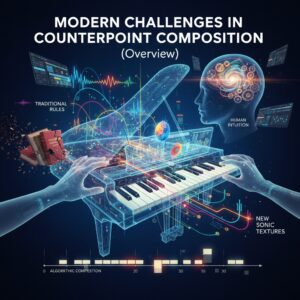
Overview of modern challenges in counterpoint composition — balancing post‑tonal harmony, polymeter, timbre and technology.
Core Modern Challenges
Harmonic language and functional tonality vs. modal/atonal practice
Without functional harmony, coherence depends on interval cycles, centric pitches, or set‑class constraints. Schoenberg’s circle treated intervals and motifs as the glue; twelve‑tone lines behave like interlocking counterpoints. In recent orchestral writing, Thomas Adès often organises layers by limited interval sets. In Asyla, passages derive from overlapping interval patterns that substitute for key centres; the result can sound freely dissonant yet gravitate towards focal sonorities. The task is to design self‑imposed rules that make lines converse rather than collide.
Rhythm, meter and polymetric textures
Polymeter and polyrhythm turn time into a contrapuntal parameter. Carter’s tempo modulations give each instrument its own grid; Adès layers irrational subdivisions, inspired in part by Nancarrow’s mechanised studies. The third movement of Asyla (“Ecstasio”) accumulates pulses at different rates, then aligns them for impact — a temporal cadence. Where strict precision is unmanageable, Lutosławski’s limited aleatoric technique lets players execute independent rhythms within controlled windows, creating a web whose verticals are conductor‑cued rather than bar‑aligned.
Timbre, orchestration and voice identity in dense textures
Timbre now functions like counterpoint. Ligeti’s micropolyphony stacks dozens of close, independent lines that merge into evolving clusters; motion exists within texture rather than as melody‑plus‑accompaniment. Spectral practice orchestrates the overtone stack: groups articulate partials with surgical balance so a harmony breathes as a multi‑voice entity. Orchestration becomes voice‑leading in colour — dynamics, attack and spatial placement determine which line is heard and when. Adès’s orchestrational palette, including colour inflections such as a quarter‑tone‑tuned piano, turns timbre into structural argument.
Microtonality, extended techniques and notational clarity
Microtonal counterpoint widens the interval palette and the scope for confusion. Notation has caught up: Dorico, Sibelius and MuseScore support custom accidentals and playback, so composers can audition 24‑EDO or just‑intonation passages while writing. In practice, clarity rests on register spacing, timbral contrast and restraint; very small intervals can collapse lines for listeners if not separated by colour or range. Practice is widening too: Sampo Haapamäki’s work with quarter‑tone instruments, including bespoke keyboards, shows how instrument design intersects with contrapuntal viability.
Poly‑stylistic fusion — jazz, pop, and spectral influences
When lines carry different idioms, counterpoint becomes cultural translation. Turnage’s Blood on the Floor places a jazz trio against orchestra; canonic imitation and layered riffs integrate the languages while acknowledging feel. Notation cannot wholly encode swing or funk; solutions include simplifying orchestral rhythm and allowing jazz players to lead with authentic phrasing. Contemporary British voices such as Hannah Kendall place historical forms alongside Afro‑diasporic rhythm and colour, creating dialogues where style itself behaves like an independent voice.
Technology, algorithmic composition and AI‑assisted counterpoint
Algorithmic tools can generate lines, flag rule breaches or propose canons; machine‑learning models can harmonise in historical styles. BachDuet demonstrates real‑time duet‑making with a responsive partner. These are aids, not substitutes: models trained on common‑practice output do not grasp microtonal or free‑rhythmic idioms unless taught. The craft remains curatorial — setting constraints, selecting, revising, and humanising material so it reads with intent.
Practical constraints: ranges, stamina, rehearsal time
Scores succeed in performance or not at all. Complex polymeter requires anchors, click tracks, or float methods; microtonal passages need cues, practice strategies and clear notation; choral dissonance benefits from reference unisons. Balance is decisive: dynamic counterpoint — precise hierarchies of mf vs. p, registral spacing, and thinning at points of entry — helps the audience hear what matters. Ambition is shaped by rehearsal economies; write the ideal, but stage the achievable.
Analytical Case Studies
Pivot of the 20th century: Schoenberg and Ligeti
Schoenberg’s shift from tonality to ordered dissonance reframed counterpoint as intervallic logic. A twelve‑tone line becomes a subject whose transformations supply coherence vertically and horizontally. Ligeti, taking a different path, dissolved subject–answer rhetoric into texture: in Lux Aeterna and Atmosphères, canons at the unison expand and contract chromatically, producing harmonic clouds whose direction is felt as a slow morph. Both demonstrate that counterpoint’s essence is independence and relation — not style.
A contemporary UK lens: Thomas Adès’s Asyla
Asyla is a compendium of modern contrapuntal thinking. In “Ecstasio”, polymetric layers — ostinati implying different meters — accumulate towards a tutti whose sonority carries tonal allusion. Around 2:50 the strands begin to align; by 4:20 they collide on a chord that evokes B minor coloured by an added C♯. Throughout, interval sets (notably minor thirds and inversions) govern materials so that when layers stack, they form a quasi‑tertiary harmony with a deliberate bite. In the slow movement, a bass oboe melody operates as an atonal cantus firmus; surrounding lines refract its intervallic identity, reharmonised by changing accompaniment colours. The listener tracks coherence not via key but via persistent interval DNA.
Cross‑genre practice: Turnage’s Blood on the Floor
Turnage uses canonic imitation and antiphonal layering to bind jazz riffs to orchestral fabric. When a saxophone statement is answered by brass at a displaced interval, classical technique develops jazz material without bleaching its character. Harmony hovers between extended chords and deliberate dissonant overlays, voiced to colour rather than clash. Practicalities are candid: orchestras struggle to swing on the page, so the trio’s drummer becomes the rhythmic reference while the notation for sections is simplified. In elegiac movements, a jazz‑inflected solo line and a classical countermelody approach and withdraw — familiar dissonance–consonance rhetoric recast in contemporary diction.
Compositional Frameworks for Today
Constraint‑led composition
Define the rules that create dialogue. Options include interval inventories (e.g., minor third complexes), centricity without functional cadence, row‑based derivation for inventions, or spectral partial mapping across instruments. Treat these not as dogma but as decision trees that keep lines related while freeing harmony from past syntax.
Layered strategies for clarity
Clarity is engineered. Separate registers; offset rhythms to avoid constant vertical collisions; create dynamic hierarchies so a principal line projects; rotate roles to refresh texture. In polymeter, align structural downbeats (least‑common‑multiple points) or supply periodic cues. When writing microtonally, keep crucial gestures in distinct colours and ranges; reserve very small intervals for areas of repose or focused colour rather than busy contrapuntal knots.
Notation and rehearsal‑ready scores
Write what players can read. Use clear cueing, breath marks, and rehearsal letters at alignment points. For complex tuplets or irrational meters, consistency beats cleverness. Provide performance notes for microtonal systems and extended techniques; offer MIDI mock‑ups to illustrate intended balance. Where ensemble alignment is precarious, consider limited aleatory: independent rhythmic windows with conductor‑cued entries can achieve complexity without gridlock.
Pedagogy and Training — what conservatoires should teach now
A robust curriculum starts with species, canon and fugue — not as stylistic endpoints but as muscle training for line control. It then generalises the principles to post‑tonal, rhythmic and timbral contexts: write a two‑part invention on a twelve‑tone row; orchestrate a micropolyphonic canon; build a polymetric trio with periodic alignments. Analysis of twentieth‑ and twenty‑first‑century repertoire should sit beside Palestrina and Bach, so students see continuity of method through change of language.
Technology has a role: software that checks species work accelerates learning; visualisations that colour‑code voices help students perceive structure. Institutions that still teach writing in historical manners set useful limits that can be transferred. Ultimately, the aim is bilingualism — fluency in tradition and confidence in innovation — so the next generation can make counterpoint audible in contemporary sound worlds.
Tools, Editions and Resources
Notation suites such as Dorico, Sibelius and MuseScore support polymeter, custom accidentals and microtonal playback, making complex textures practicable on the page and audible at the desk. Archives including IMSLP and CPDL put contrapuntal repertoire within reach for study; publishers and critical editions provide reliable texts. Libraries and online collections host composer essays and analyses — valuable context for techniques like aleatory counterpoint. For experimentation and analysis, environments such as music21 or patch‑based systems enable rule‑checking, generative sketches and structural visualisation. Together these tools reduce mechanical friction so composers can concentrate on sound and sense.
Conclusion — Practical Next Steps on Modern Challenges in Counterpoint Composition
Counterpoint survives because it solves musical problems: how independent ideas can cohere. In the modern era those problems span harmony, rhythm, colour and technology. The craft answers are consistent: set constraints, design clarity, write for performers, and listen for the line. Analyse both old and new scores; try short studies in varied idioms; use software to hear and refine; collaborate early with players. If you value tradition as a living practice, keep testing whether each voice speaks and whether the ensemble makes sense.
Further Reading and WKMT
If you wish to develop these skills with tailored guidance, WKMT London offers one‑to‑one composition lessons and counterpoint tuition grounded in classical technique and responsive to contemporary practice. Explore how species training, atonal voice‑leading, polymeter, timbre and microtonality can become usable tools in your own work.
Sources on Modern Challenges in Counterpoint Composition
Johann Joseph Fux: a concise biography
The Lessons of Arnold Schoenberg in Teaching the Musikalische Gedanke
Music Theory and Practice – Introduction to Counterpoint
Decoding Ligeti’s Micropolyphony: Lessons for Composers | by Jinhee Han | Medium
The Lessons of Arnold Schoenberg in Teaching the Musikalische Gedanke
Asyla, Thomas Adès | Articulate Silences
[PDF] Thinking Irrational, Thomas Adès and New Rhythms – Huw Belling
Microtonal playback in Dorico – Scoring Notes
FMQ – Instruments that play between the notes
Blood on the Floor with the Oslo Philharmonic – Bachtrack
Turnage’s Blood on the Bore/Argo – Classics Today
The jazz player in disguise | Music | The Guardian
New Music Ensemble – IU Blogs – Indiana University
Play a Bach duet with an AI counterpoint
Writing | Conservatoire national supérieur de musique et de danse …
Is counterpoint still relevant in today’s music? – 2024 : r/musictheory