
 TRIAL LESSON
Uncategorized
Is Classical Music the Pop music of the Past?
Nov
Is Classical Music the Pop music of the Past?
Was Classical Music the Pop Music of the Past? A Guide for Piano Students and Parents
Is classical music the pop music of the past? The question is more interesting — and more useful for piano students — than it first appears. Understanding how classical music was actually received, performed, and consumed across history changes how we hear it today, and why it still matters.
What You’ll Learn in This Guide
- How classical music functioned as popular entertainment in its own time
- The role of the piano in spreading classical music through society
- What Beethoven, Mozart, and Chopin meant to their contemporaries
- How the concert hall changed the relationship between music and audience
- Why this history matters for how we teach and learn piano today
- WKMT’s perspective on classical music as living, relevant repertoire
Classical Music Was Popular Music — Just Not in the Way We Think
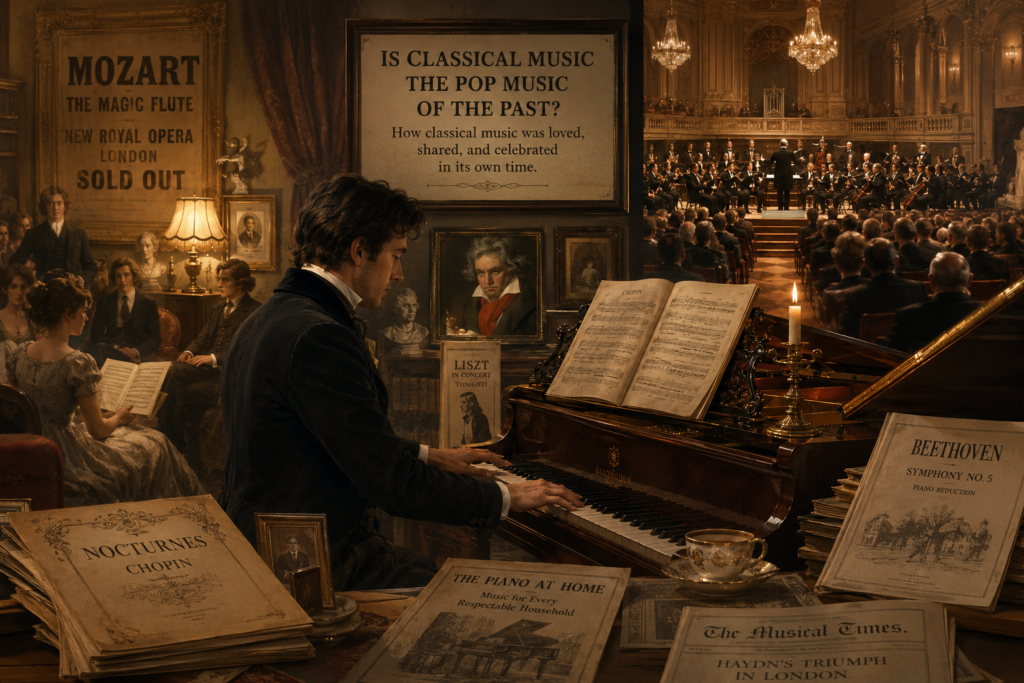
Is classical music the pop music of the past? The short answer is: partly, and the nuance matters. Music that we now classify as “classical” was composed for audiences who experienced it not as cultural heritage but as contemporary entertainment — in many cases, as the most exciting and fashionable sound of their time. Handel’s oratorios sold out London theatres. Mozart’s operas were the blockbusters of their era. Chopin’s nocturnes were played at private soirées the way a singer-songwriter might play a living room concert today.
But the parallel is imperfect. Unlike modern pop music — which is designed, marketed, and distributed as a commercial product — much of the music we call “classical” was produced within systems of patronage, civic culture, and aristocratic prestige that had no real equivalent in contemporary commercial entertainment. A symphony by Haydn was not like a hit single. It was a social event, a display of technical and intellectual refinement, and a gift to a patron — all at once.
The question “is classical music the pop music of the past?” is really asking something more specific: was this music widely heard, widely enjoyed, and culturally central in its own time? And the honest answer is yes — much of it was. Understanding this changes how students approach it at the piano.
The Courts, the Salons, and the Concert Hall — How Classical Music Spread
For most of the Baroque and early Classical periods, serious music was concentrated in courts and churches. Bach worked for the Thomaskirche in Leipzig and for the court at Köthen. Handel served the Elector of Hanover before relocating to London. Vivaldi was employed by an orphanage in Venice. These were institutional positions, not careers built on public popularity.
The shift began in the mid-18th century. Public concerts — ticketed events open to anyone who could pay — became commercially viable in London and Paris, then across Europe. Haydn’s two visits to London in the 1790s were triumphs of public music-making: his symphonies, written specifically for these occasions, were reviewed in newspapers, discussed in coffee houses, and heard by mixed audiences that included merchants, professionals, and aristocrats sitting together. This was new.
Mozart’s relationship with his audience was more complicated. He composed music of genuine popular appeal — his piano concertos were designed to please both the connoisseur and the general listener simultaneously, as he described in his own letters. Yet he also struggled commercially, and died in relative financial difficulty despite his fame. Popular recognition did not reliably translate into economic security in the way it does for modern artists.
The salon culture of the early 19th century — the private gatherings in aristocratic and upper-middle-class homes where musicians performed for invited guests — was the primary vehicle for Chopin’s music during his lifetime. Chopin gave very few public concerts; he composed nocturnes, mazurkas, and waltzes for a cultivated private audience, not for the concert platform. His music circulated through published sheet music and through the networks of the Parisian salon world. This is as close to the model of a contemporary recording artist — distributing music through media rather than live performance — as the 19th century got.
The Piano and the Democratisation of Classical Music
No instrument did more to spread classical music than the piano. By the mid-19th century, the piano had become the standard domestic instrument of the European middle class, and amateur piano-playing was central to respectable social life. Sheet music publishers produced simplified arrangements of orchestral and operatic works — Beethoven symphonies reduced to four hands, popular operatic arias transcribed for solo piano — so that families could perform in their drawing rooms what they heard in the concert hall.
This is one of the strongest arguments for the “classical music as pop music” parallel. The 19th-century drawing room piano was the equivalent of a Spotify playlist: a way of accessing the most culturally prestigious and emotionally engaging music of the time in a domestic, personal context. The difference is that engaging with this music required skill — you had to be able to play it yourself, or know someone who could.
This connects directly to why learning classical piano lessons remains one of the most effective forms of musical education. The repertoire was designed to be played, not merely heard. The physical and intellectual engagement it demands is part of its nature, not an accident of history.
“The 19th-century piano was the streaming service of its time — the technology that brought the best music of the age into ordinary homes, and made engaging with it an everyday act rather than a special occasion.”
— WKMT London
Lisztomania — When Classical Music Generated Pop Hysteria
The clearest evidence that classical music once occupied the cultural position now held by pop music is the phenomenon of “Lisztomania” — a term coined by Heinrich Heine in 1844 to describe the scenes of collective excitement that Franz Liszt generated on his concert tours across Europe. Audience members fainted, fought over broken piano strings as souvenirs, and followed Liszt’s carriage through the streets of cities he visited. This was not merely admiration; it was the same kind of mass cultural intoxication that surrounded Elvis Presley in the 1950s or the Beatles in the 1960s.
Liszt was consciously performing celebrity as much as music. He understood the theatre of the concert hall, pioneered the solo piano recital as a format, and cultivated a public image of romantic genius and physical magnetism. His audiences came to be moved, to be dazzled, and to feel themselves part of a cultural event. The music was the vehicle; the experience was the product.
When Classical Music Stopped Being Popular
The divergence between classical music and popular music is largely a 20th-century phenomenon. Recording technology, radio, and eventually television created mass audiences for music that could be produced and distributed cheaply, without requiring any musical training to enjoy. The economics of scale meant that simplified, repetitive, hook-driven music could reach audiences of millions — audiences for whom the complexity and sustained attention demanded by a Beethoven sonata were neither necessary nor desired.
Classical music did not become less good; it became less accessible — not in the sense of being technically harder to perform (it always required training), but in the sense of requiring more sustained attention and musical literacy than mass entertainment formats encouraged. The concert hall, which had once been a site of mixed popular and elite culture, became increasingly associated with a specific kind of educated, older, white-collar audience.
This is the cultural moment we are still living in — though the picture is more complicated than a simple decline narrative suggests. Streaming data shows that classical music, film scores, and contemporary orchestral music reach younger audiences than concert hall attendance figures suggest. The music has not lost its power; the distribution model has changed.
| Period | Primary Venue | Typical Audience | Distribution Method | Modern Parallel |
|---|---|---|---|---|
| Baroque (1600–1750) | Courts and churches | Aristocracy, clergy | Manuscript, performance | Exclusive private events |
| Classical (1750–1820) | Public concert halls | Mixed middle/upper class | Published scores, concerts | Theatre and live events |
| Romantic (1820–1900) | Salons, concert halls | Middle class, professionals | Sheet music, domestic piano | Streaming playlists |
| Late Romantic (1880–1920) | Large concert halls | Broad public | Early recordings, concerts | Live albums and radio |
| 20th century onward | Specialist venues | Educated niche audience | Recordings, broadcast, streaming | Niche genre streaming |
What This Means for Piano Students Today
Understanding that classical music was once the dominant popular culture — not a rarefied academic pursuit — changes how students and parents should think about learning it. This repertoire was not written to be difficult or exclusive. It was written to move people, to entertain them, to make them feel something. The technical demands it places on performers exist because the composers wanted the music to sound as rich and expressive as possible — not as a barrier to entry.
At WKMT, we use this historical perspective in teaching. When a student is struggling to connect emotionally with a piece of Beethoven or Schubert, it sometimes helps to explain the context in which that music was first heard — not as a museum artefact, but as something a room full of people encountered for the first time, with excitement, with tears, with the sense of something completely new. The music was alive then. It is alive now. The technique is the means of accessing that life.
Good piano practising habits are built on understanding the musical purpose of what you are practising — and understanding the social and cultural world in which the music was created is part of that musical purpose.
“Classical music was not born in a museum. It was born in rooms full of people who had never heard anything like it. Teaching it well means keeping that sense of discovery alive.”
— WKMT London
WKMT Teaching Note: Context in the Lesson
At WKMT London, we regularly bring historical context into piano lessons — not as musicology, but as a way of unlocking musical interpretation. A student who understands that Chopin’s nocturnes were composed for private salons, not large concert halls, will immediately adjust their touch, their dynamic range, and their sense of phrasing. A student who knows that Beethoven’s Pathétique Sonata was considered shockingly modern in 1799 will approach its drama with more conviction. History is not a distraction from piano technique — it is a tool for using technique more expressively. See also our guide to chamber music for more on how social context shapes musical practice.
The Risk of Over-Simplifying the Parallel
The claim that “classical music is just the pop music of the past” can become a lazy justification for treating it as equivalent to contemporary popular music in all respects — which it is not. The complexity of a Bach fugue, the harmonic language of a late Beethoven quartet, or the formal architecture of a Brahms symphony require sustained engagement that most contemporary pop music is not designed to demand. The historical parallel is useful for motivation and context; it should not become an excuse for avoiding the depth that serious musical study requires.
- Listen to classical music in context. Find recordings of the same works played in historically informed ways — period instruments, smaller ensembles, the acoustic environments the music was written for. This changes your perception of what the music was designed to do.
- Read about the first performances. Contemporary reviews of Beethoven premieres, accounts of Chopin’s salon performances, descriptions of Liszt’s concert tours — all of these are accessible and reveal how the music was actually experienced by its first audiences.
- Connect the historical context to your piano practice. If you are learning a Schubert Impromptu, knowing that it was composed for domestic piano performance in a Vienna salon in the 1820s should influence your dynamics, your pedalling, and your sense of scale.
- Remember that complexity is not elitism. Classical music makes demands on its listeners and performers that pop music typically does not — but those demands are not arbitrary. They exist because the composers were trying to do something more intricate and sustained than a three-minute song allows.
Frequently Asked Questions
Is classical music the pop music of the past?
In part, yes. Much of what we call classical music was composed for audiences who experienced it as contemporary popular entertainment — widely heard, widely discussed, and culturally central. But the parallel is imperfect: classical music was also embedded in systems of patronage, civic culture, and technical complexity that have no precise modern equivalent. The comparison is useful for motivation and context, but should not be stretched too far.
Was Mozart popular in his own time?
Yes, significantly so — though his popularity fluctuated and he died in financial difficulty despite his fame. His operas were celebrated across Europe, and his piano concertos were designed to appeal simultaneously to general audiences and musical connoisseurs. He was widely recognised as extraordinary by his contemporaries, even if the posthumous canonisation of his genius exceeded what he experienced in life.
What was Lisztomania?
Lisztomania was a term coined by Heinrich Heine in 1844 to describe the mass enthusiasm — fainting, fighting over souvenirs, following carriages — that Franz Liszt generated on his European concert tours in the 1840s. It is among the clearest historical examples of a classical musician generating the kind of collective cultural excitement now associated with major pop stars.
Why did classical music stop being popular?
The divergence between classical and popular music accelerated in the 20th century with the rise of recording technology, radio, and commercial music designed for mass audiences. Classical music did not become less valuable; it became less accessible in the sense of requiring more sustained attention and musical literacy than mass entertainment formats encouraged. The concert hall audience became increasingly specialised as a result.
How did the piano spread classical music?
The piano became the dominant domestic instrument of the European middle class during the 19th century. Publishers produced simplified arrangements of orchestral and operatic works for amateur pianists, making classical music accessible in drawing rooms across the continent. This was the primary vehicle through which classical music reached non-specialist audiences before the age of recording.
Does understanding music history make you a better piano player?
Yes, in a practical sense. Understanding the context in which a piece was composed — its intended audience, performance venue, and social function — directly informs interpretation. A student who knows that Chopin’s nocturnes were written for private salons will approach them differently from a student who treats them as abstract concert pieces. Historical knowledge is a tool for musical expression, not a separate academic pursuit.
Study Piano in London — Classical Repertoire, Taught in Context
WKMT London offers piano lessons for students of all ages and levels, from beginner to advanced. We teach classical technique as the foundation for musical expression — and we bring the history of the music into every lesson.