
 TRIAL LESSON
Uncategorized
Igor Stravinsky Piano Music — A Complete Guide for Students
Apr
Igor Stravinsky Piano Music — A Complete Guide for Students
Igor Stravinsky Piano Music — A Complete Guide for Students
Stravinsky is remembered for the Rite of Spring, but his solo piano output ranges from beginner-accessible finger studies to some of the most technically ferocious music ever written for the instrument. This guide covers every major Stravinsky piano work with grade-equivalent difficulty ratings, performance notes, and practical advice for students.
What You Will Find in This Guide
- Stravinsky’s biography and training as a pianist-composer
- His three compositional periods and what they mean for pianists
- A complete Stravinsky piano works catalogue with ABRSM difficulty ratings
- The Petrushka transcription in depth — the centrepiece of his piano output
- The neoclassical works: Piano Sonata, Serenade in A, and Concerto
- The early and lighter works: Piano-Rag-Music and Les Cinq Doigts
- How to approach Stravinsky’s rhythmic language at the keyboard
- Whether Stravinsky is suitable for your current level
Who Was Igor Stravinsky?
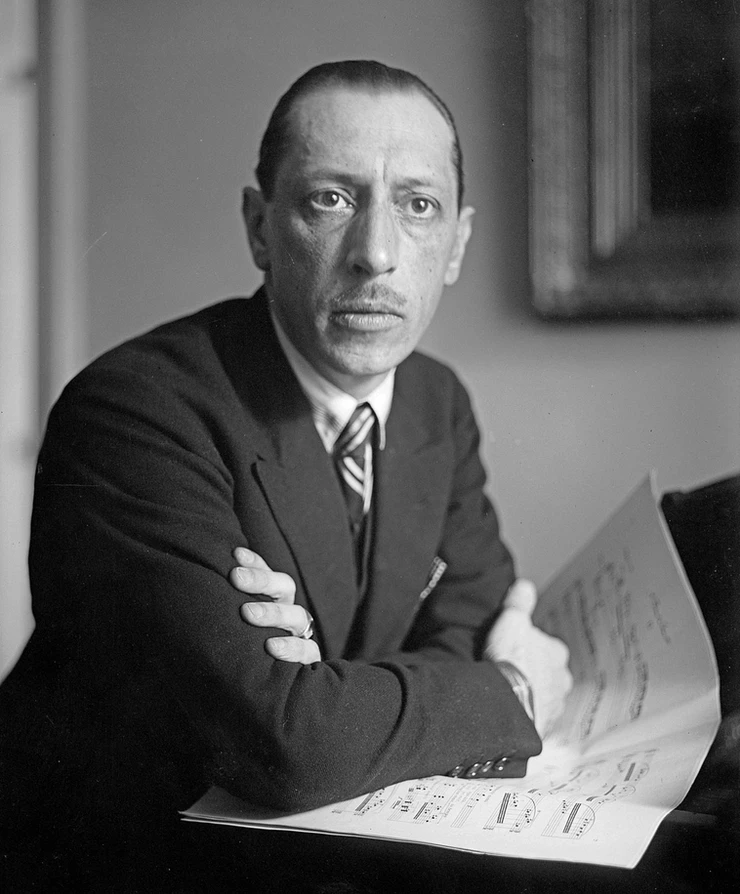
Igor Fyodorovich Stravinsky (1882–1971) was born into a musical family in Saint Petersburg, where his father was a celebrated opera bass at the Mariinsky Theatre. He grew up taking piano and music theory lessons and, despite studying law at the University of Saint Petersburg, was determined to pursue composition. His early encounter with Nikolai Rimsky-Korsakov proved decisive: Stravinsky studied privately under him until Rimsky-Korsakov’s death in 1908, absorbing a rigorous training in orchestration and harmony that would underpin everything that followed.
Within two years of his teacher’s death, Stravinsky had composed The Firebird (1910) for Sergei Diaghilev’s Ballets Russes — and was suddenly the most talked-about young composer in Europe. Petrushka (1911) and The Rite of Spring (1913) followed, the latter causing uproar at its Paris premiere and permanently changing the way composers understood rhythm, metre, and musical structure. What is often forgotten is that throughout his career, Stravinsky was also a working pianist. He accompanied singers, performed his own works in concert, and recorded extensively — including his own piano concerto and several solo pieces. His pianism was described by contemporaries as rhythmically precise, almost percussive, with less concern for colour or legato than for structural clarity. That attitude shaped every note of his solo piano music.
For students interested in how his thinking about music evolved, the article on Stravinsky’s viewpoint on the concept of art on this site explores his aesthetic ideas in depth.
Three Periods, Three Approaches to the Piano
The Russian period (roughly 1908–1920) produced dramatic, folk-inflected, rhythmically volatile music. The neoclassical period (1920–1951) is the golden era for Stravinsky piano music — the Piano Sonata (1924), Serenade in A (1925), Concerto for Piano and Wind (1924), and the Three Movements from Petrushka (1921). The serial period (1954–1968) produced the Movements for Piano and Orchestra (1959) — brief, extremely complex, rarely encountered below post-diploma level.
“I have always found it easier to accept the rigours of a musical problem than to find solutions in complete liberty. The more constraints one imposes, the more one frees oneself.”
— Igor Stravinsky, Poetics of Music (1942)
The Centrepiece: Three Movements from Petrushka (1921)
If there is one Stravinsky piano work that every advanced student should know, it is the Three Movements from Petrushka. Stravinsky arranged it from his 1911 ballet score at the request of Arthur Rubinstein. The three movements correspond to tableaux from the ballet: the Russian Dance, Petrushka’s cell (with its famous polytonal clash of C major against F-sharp major), and the Shrovetide Fair.
Technically, this is one of the most demanding works in the entire solo piano repertoire. It requires enormous hand spans, ferocious octave passages, extreme changes of register, and the ability to sustain multiple independent rhythmic layers simultaneously. Most conservatoire-level pianists consider it post-Grade 8, requiring several years of advanced work beyond diploma level.
The Three Movements from Petrushka is frequently listed in “most difficult piano pieces” surveys alongside Ravel’s Gaspard de la nuit and Balakirev’s Islamey. It is not suitable for students below post-diploma level. However, listening to it and understanding its structure is valuable from intermediate level onwards.
Complete Stravinsky Piano Works: Difficulty Guide
| Work | Year | ABRSM Equiv. | Notes |
|---|---|---|---|
| Les Cinq Doigts | 1921 | Grades 1–3 | 5-finger miniatures; ideal for early-intermediate students |
| Piano-Rag-Music | 1919 | Grade 7–8 | Jazzy, irregular metres, bitonality; written for Rubinstein |
| Piano Sonata | 1924 | Grade 8+ | Neoclassical; spare, Bachian textures; absolute clarity required |
| Serenade in A | 1925 | Grade 8–Diploma | 4 movements, each designed to fit one 78rpm record side |
| Concerto for Piano and Wind | 1924 | Post-Grade 8 / Diploma | Major concert work; stark, unforgiving |
| Capriccio for Piano and Orchestra | 1929 | Diploma | More approachable than the Concerto |
| Three Movements from Petrushka | 1921 | Post-diploma / LRAM | Virtuoso showpiece; one of the most demanding in the repertoire |
| Movements for Piano and Orchestra | 1959 | Post-diploma / specialist | Serial period; brief but extreme in complexity |
A visual difficulty ladder showing Stravinsky’s piano works from beginner to virtuoso level.
Stravinsky Piano Works — Difficulty Ladder
GRADES 1–3
GRADES 7–8
GRADE 8+ / DIPLOMA
POST-DIPLOMA / VIRTUOSO
Les Cinq Doigts (1921)
8 finger studies — Grades 1–3
Piano-Rag-Music (1919)
Jazzy, irregular metres — Grade 7–8
Piano Sonata (1924)
Neoclassical clarity — Grade 8+
Serenade in A (1925)
4 movements — Grade 8–Diploma
Concerto for Piano & Wind
Major concert work — Diploma
Capriccio for Piano & Orch.
Concerto-level — Diploma+
3 Mvts from Petrushka (1921)
Virtuoso — post-diploma
Difficulty ratings are approximate ABRSM grade equivalents for a polished performance.
How to Practise Stravinsky’s Rhythmic Language
- Count out loud first. Before touching the keys, count every bar using syllables that register each subdivision. Stravinsky often writes bars of 5/8 or 7/8 adjacent to 4/4; the internal groupings (2+3, 3+4) need to be felt before they are played.
- Practise hands separately at a very slow tempo. In the Petrushka transcription, the right and left hands often carry independent rhythmic figures that must each be accurate before combining.
- Use a metronome for assembly. Combine hands at half speed with a metronome. Do not rely on feel to align the parts — verify against the beat.
- Mark the accentuation. Stravinsky’s accent markings are structural, not expressive. An sforzando on an off-beat is a rhythmic pivot point. Mark these in the score and observe them exactly.
- Record and listen back. Rhythmic distortions in Stravinsky are very difficult to hear from the inside. A short recording will reveal whether the pulse is actually stable.
Frequently Asked Questions about Stravinsky Piano Music – Igor Stravinsky Piano Music
What is the most famous Stravinsky piano piece?
The Three Movements from Petrushka (1921) is the most celebrated work in his solo piano output, and one of the most recognised virtuoso showpieces of the 20th century. Among his more accessible works, Les Cinq Doigts is widely known in pedagogical circles.
Is Stravinsky piano music hard to play?
It depends on the work. Les Cinq Doigts is accessible at Grades 1–3. The Piano Sonata and Serenade in A are manageable at Grade 8 and above. The Petrushka transcription is post-diploma level and is considered one of the most technically demanding works in the entire piano repertoire.
Did Stravinsky play the piano himself?
Yes. Stravinsky was a working pianist throughout his career. He recorded his own piano concerto as soloist and performed many of his own works. His playing was described as rhythmically precise and structurally clear.
What ABRSM grade is the Petrushka transcription?
The Three Movements from Petrushka sits well beyond Grade 8. Most teachers classify it at post-diploma or LRAM level. It requires conservatoire-standard technique and is not encountered on ABRSM syllabi.
Is there any Stravinsky piano music suitable for adult beginners?
Les Cinq Doigts is entirely suitable for adult beginners and early-intermediate players. The pieces are brief, musically coherent, and technically undemanding — an excellent alternative to conventional beginner repertoire.
Study Stravinsky with an Expert Piano Teacher in London
WKMT London’s teachers guide students from Les Cinq Doigts through to the advanced neoclassical works. Lessons for students from beginner to diploma level.