
 TRIAL LESSON
Piano Lessons
Fun Songs to Learn on Piano in London: A Positive, Motivating Repertoire for Older Beginners
Jan
Fun Songs to Learn On Piano Complete Guide
Fun Songs to Learn on Piano: A Positive, Motivating Repertoire for Older Beginners (London)

Motivation is not a sentimental extra in adult learning; it is the engine.
Quick overview — why choosing the right ‘fun’ songs matters for older beginners
Picture a crisp Saturday morning in a London park: a small crowd gathers as an enthusiastic retiree settles at the piano bench and leads a sing-along of “Stand By Me”. It’s a modest scene, but it gets to the point. For many beginners in their 50s, 60s and beyond, the quickest route to confidence is not a technical etude — it is a familiar tune that the hands can learn without the spirit losing interest.
Motivation is not a sentimental extra in adult learning; it is the engine. Studies reported in the UK suggest that even a few weeks of weekly piano lessons can improve sensory processing and lift mood in adult learners. In a city with London’s everyday musical life — buskers in Camden, community choirs in Islington — choosing fun songs to learn on piano helps older beginners feel included quickly, and accomplished honestly. With supportive teaching (including at WKMT), these songs can be tailored to your pace so that practice feels purposeful rather than punitive.
How we chose these songs
This list is designed for older beginners who want music that sounds like music — not an exercise disguised as a song. Our criteria are practical and unapologetically learner-centred:
- Familiar melodies to jumpstart ear training and memory.
- Simple chord patterns so the right hand can focus on shape and timing, not complexity.
- Singability, because humming (or singing) stabilises rhythm and phrasing.
- Easy left-hand options such as root–5 patterns, light octaves, or straightforward broken chords.
- Transposability, so a piece can sit in a friendlier key if needed.
Many songs here work naturally in C major for beginners, and some can be moved to D or G if desired. We also favoured pieces with clear phrases, so you can learn a line at a time and still feel you are “playing the song”. Most titles are widely available in beginner-friendly arrangements from UK publishers and retailers.
30 fun songs to learn on piano
Below, each piece includes: why it’s fun, a clear difficulty label, a recommended key, an easy arrangement idea, an approximate time-to-learn estimate, and a practical sheet-music pointer.
Pop & Singalongs – Top 8 Pop Piano Songs
- Let It Be (The Beatles)
Why it’s fun: An uplifting chorus that carries itself, even with simple harmony.
Difficulty: Easy. Recommended key: C major.
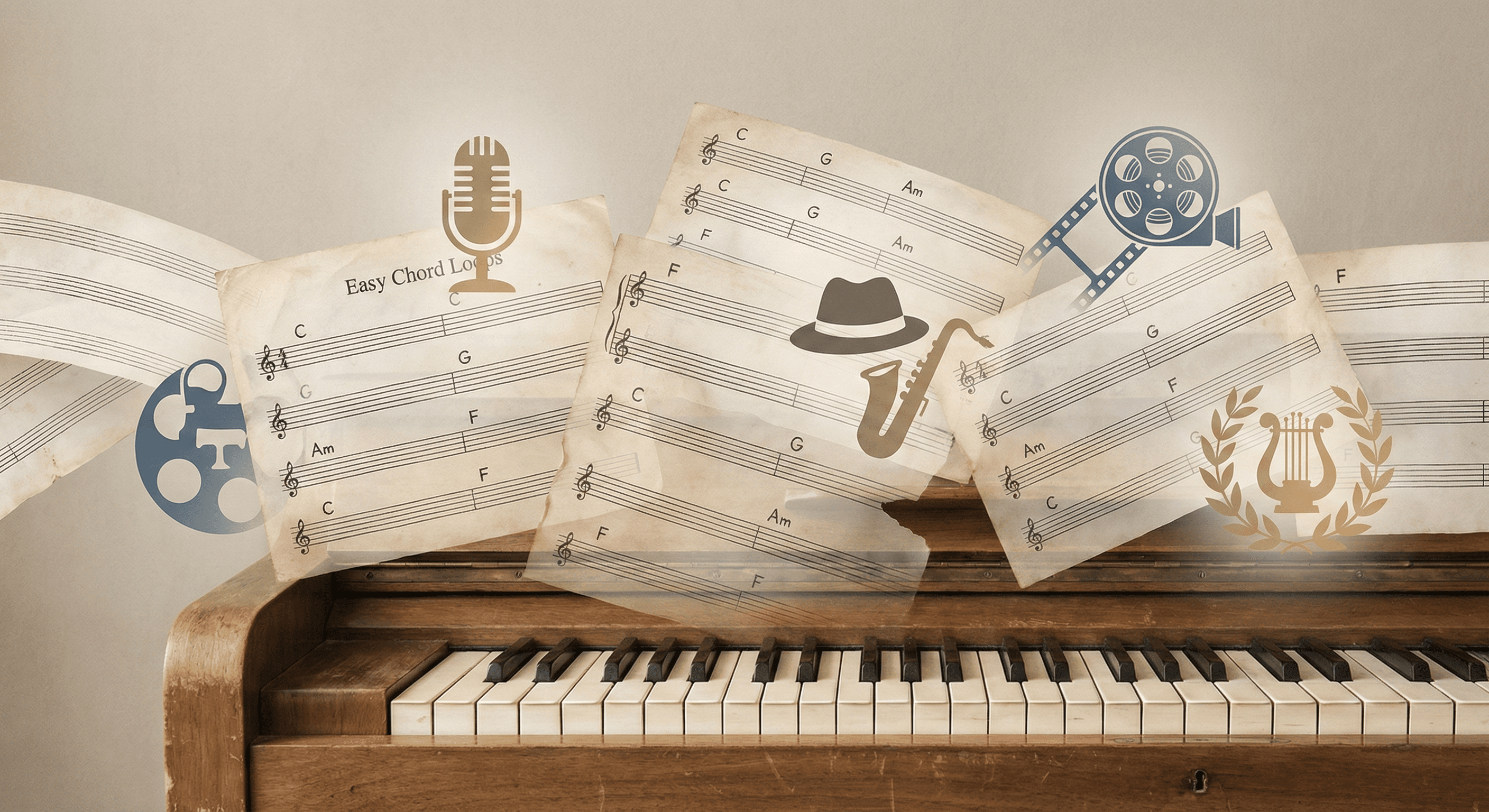
Simple arrangement idea: Block chords with the classic loop (C–G–Am–F).
Time to learn: ~2–3 weeks.
Sheet music: Hal Leonard’s Beatles Songbook.
- Imagine (John Lennon)
Why it’s fun: Slow, memorable, and forgiving — it rewards calm repetition.
Difficulty: Easy. Recommended key: C major.
Simple arrangement idea: Block chords with a light broken-chord feel in the intro.
Time to learn: ~3–4 weeks.
Sheet music: John Lennon hits songbook (as listed in common published collections).
- Lean On Me (Bill Withers)
Why it’s fun: A gospel-soul progression that sounds “full” without being difficult.
Difficulty: Easy. Recommended key: C major.
Simple arrangement idea: Chord blocks and a repeating vamp (C–F–G patterns).
Time to learn: ~3 weeks.
Sheet music: Easy-grade arrangement editions are widely available.
- Stand By Me (Ben E. King)
Why it’s fun: The classic harmony cycle and strong chorus make it instantly social.
Difficulty: Easy. Recommended key: C major.
Simple arrangement idea: Root–5 left hand on (C–Am–F–G), adding octave bass when comfortable.
Time to learn: ~2–3 weeks.
Sheet music: Many easy arrangements exist, including Musicroom editions.
- What a Wonderful World (Louis Armstrong)
Why it’s fun: Gentle melody with a touch of jazz colour — satisfying without fuss.
Difficulty: Easy. Recommended key: F major (or C).
Simple arrangement idea: Broken chords (F–Am–Bb–C) with a singing right-hand line.
Time to learn: ~3 weeks.
Sheet music: Available from Wise Music or Hal Leonard.
- All You Need Is Love (The Beatles)
Why it’s fun: A bright chorus that invites others in — ideal for family singalongs.
Difficulty: Easy. Recommended key: G major.
Simple arrangement idea: Block chords (G–C–Em–D).
Time to learn: ~2–3 weeks.
Sheet music: Beatles tab/folio collections.
- Can’t Help Falling in Love (Elvis Presley)
Why it’s fun: A waltz feel that teaches flow and timing almost by stealth.
Difficulty: Easy. Recommended key: C major.
Simple arrangement idea: Broken arpeggio pattern around (C–G–Am–F).
Time to learn: ~4 weeks.
Sheet music: Hal Leonard/Vice Music (UK).
- Happy Birthday (Traditional)
Why it’s fun: A tune you will use for the rest of your life — the definition of “useful repertoire”.
Difficulty: Very Easy. Recommended key: C major.
Simple arrangement idea: Melody with basic supporting chords (C and G7).
Time to learn: Days.
Sheet music: Widely available in beginner anthologies (last checked: 2025-11-25).
Classic Rock & Singers – Top 6 Rock Piano Songs
- Hey Jude (The Beatles)
Why it’s fun: That long, communal ending was made for group singing — even on a living-room piano.
Difficulty: Easy. Recommended key: C major.
Simple arrangement idea: Simple chords with familiar shapes (C–F–C–G).
Time to learn: ~3 weeks.
Sheet music: Beatles song collections.
- Wonderful Tonight (Eric Clapton)
Why it’s fun: Relaxed tempo, clear harmony — it’s a lesson in calm playing.
Difficulty: Easy. Recommended key: G major.
Simple arrangement idea: Broken chords (G–D–Am–C) with an even pulse.
Time to learn: ~4 weeks.
Sheet music: Clapton songbooks.
- Fire and Rain (James Taylor)
Why it’s fun: An introspective song with a fingerstyle feel that teaches control and balance.
Difficulty: Moderate. Recommended key: C major.
Simple arrangement idea: Fingerstyle-style arpeggios on (C–G–Am–F).
Time to learn: ~6 weeks.
Sheet music: Hal Leonard/Wise Publications editions.
- Something (The Beatles)
Why it’s fun: A lush melody that feels rewarding even at moderate tempo.
Difficulty: Moderate. Recommended key: C major.
Simple arrangement idea: Gentle chord blocks with attention to the melody line.
Time to learn: ~6 weeks.
Sheet music: Beatles Anthology.
- Nights in White Satin (The Moody Blues)
Why it’s fun: Dramatic, sustained harmony that teaches long phrasing and control of sound.
Difficulty: Moderate. Recommended key: C minor (or Eb).
Simple arrangement idea: Broken-chord patterns (Cm–Ab–Eb).
Time to learn: ~8 weeks.
Sheet music: Pop arrangements published by Wise Music.
- Bridge Over Troubled Water (Simon & Garfunkel)
Why it’s fun: A slow build that makes even simple harmony feel like a statement.
Difficulty: Moderate. Recommended key: C major.
Simple arrangement idea: Block chords (C–Am–F–G), increasing intensity gradually.
Time to learn: ~6 weeks.
Sheet music: Commonly available in Hal Leonard and Wise collections.
Jazz & Standards – Top 5 Jazz Piano Songs
- Autumn Leaves
Why it’s fun: The descending melody is clear and emotionally direct — perfect for learning shape and release.
Difficulty: Moderate. Recommended key: G minor.
Simple arrangement idea: Basic jazz comping that introduces ii–V movement without overloading the hands.
Time to learn: ~6–8 weeks.
Sheet music: Published by Hal Leonard (and widely performed; listen for it in BBC Radio 3 jazz programming).
- Fly Me to the Moon
Why it’s fun: Swing feel and familiar cadence — it teaches timing as much as notes.
Difficulty: Easy. Recommended key: C major.
Simple arrangement idea: A gentle “walking” outline (C–Am–Dm–G) with light jazzy chords.
Time to learn: ~3 weeks.
Sheet music: Widely available, including Wise Publications versions.
- My Funny Valentine
Why it’s fun: A moody ballad where expression matters more than speed.
Difficulty: Moderate. Recommended key: C minor.
Simple arrangement idea: Ballad-style chords (Cm–Fm) supporting a careful melody.
Time to learn: ~6 weeks.
Sheet music: Available on Sheet Music Direct and in Faber editions.
- Misty
Why it’s fun: Romantic harmony that introduces richer chords in a controlled way.
Difficulty: Moderate. Recommended key: Eb major.
Simple arrangement idea: Descending chord progressions with approachable jazzy voicings.
Time to learn: ~8 weeks.
Sheet music: Hal Leonard Easy Classics.
- Georgia on My Mind
Why it’s fun: Warm melody and soul harmony — it sits well under the fingers.
Difficulty: Easy. Recommended key: F major.
Simple arrangement idea: Block chords (F–Dm–Gm–C), focusing on legato connection.
Time to learn: ~4 weeks.
Sheet music: Wise Music (Ray Charles collection).
Film & Musical Themes – Top 4 Film Piano Songs
- Over the Rainbow
Why it’s fun: A melody with natural breath — it practically teaches phrasing for you.
Difficulty: Moderate. Recommended key: F major.
Simple arrangement idea: Block chords with flowing arpeggios (F–Dm–Gm–C).
Time to learn: ~6 weeks.
Sheet music: Disney collections (last checked: 2025-10-01).
- Moon River (Breakfast at Tiffany’s)
Why it’s fun: Gentle harmony and an uncluttered melody — ideal for a first “proper” ballad.
Difficulty: Easy. Recommended key: C major.
Simple arrangement idea: Arpeggiated chords (C–Am–F–G).
Time to learn: ~4 weeks.
Sheet music: Wise Publications.
- My Heart Will Go On (Titanic)
Why it’s fun: A dramatic pop ballad whose patterns repeat enough to feel manageable.
Difficulty: Easy. Recommended key: C major.
Simple arrangement idea: Broken chords (C–G–Am–F).
Time to learn: ~4 weeks.
Sheet music: Wise or Hal Leonard Disney hits books.
- Beauty and the Beast
Why it’s fun: A waltz-like sway that develops coordination without rushing you.
Difficulty: Moderate. Recommended key: F major.
Simple arrangement idea: Waltz-style chords (F–Gm–Bb–C).
Time to learn: ~6 weeks.
Sheet music: Disney piano books (Faber, Hal Leonard).
Classical / Pop-Classical Simplified – Top 4 Classical Piano Songs
- Minuet in G (Haydn)
Why it’s fun: Short, elegant, and structured — it teaches style without intimidation.
Difficulty: Easy. Recommended key: G major.
Simple arrangement idea: Simple chordal accompaniment with clean phrasing.
Time to learn: ~2 weeks.
Sheet music: Featured for beginners in Pianist magazine (Jan 2026).
- Air in D minor (Purcell)
Why it’s fun: Lyrical and calm — good for developing a steady tone.
Difficulty: Easy. Recommended key: D minor.
Simple arrangement idea: Sustained chords with a simple bass foundation.
Time to learn: ~4 weeks.
Sheet music: Beginner baroque collections (including references in Pianist magazine).
- Minuet in F (L. Mozart)
Why it’s fun: A graceful teaching piece that rewards careful hand organisation.
Difficulty: Easy. Recommended key: F major.
Simple arrangement idea: Steady chords with hand-crossing introduced gently.
Time to learn: ~3 weeks.
Sheet music: Found in “Classical Hits for Beginners” books.
- Schubert Ecossaise in D
Why it’s fun: Lively dance character — a change of mood from ballads and hymns.
Difficulty: Easy/Moderate. Recommended key: D major.
Simple arrangement idea: Staccato chord shapes (D–G–A) with crisp rhythm.
Time to learn: ~3–4 weeks.
Sheet music: Available in beginner anthologies (including mentions in Pianist).
Easy Showstoppers – Top Show Piano Songs
- Memory (from Cats)
Why it’s fun: A controlled emotional arc — the sort of piece that makes a beginner feel like a musician.
Difficulty: Moderate. Recommended key: C minor.
Simple arrangement idea: Arpeggiated support (Cm–Bb–Ab–G) with clear dynamic shaping.
Time to learn: ~8 weeks.
Sheet music: Faber Music edition.
- My Way (Frank Sinatra)
Why it’s fun: A climactic ending that teaches you how to build intensity without playing faster.
Difficulty: Easy. Recommended key: C major.
Simple arrangement idea: Block chords (C–Am–F–G), focusing on timing and confidence.
Time to learn: ~4 weeks.
Sheet music: Carisch/Hal Leonard vocal books.
- Bridge Over Troubled Water (Simon & Garfunkel)
Why it’s fun: A singable climax that works beautifully in informal community settings.
Difficulty: Easy. Recommended key: C major.
Simple arrangement idea: Block chords (C–Am–F–G) with a gradual rise in intensity.
Time to learn: ~6 weeks.
Sheet music: Widely published (Hal Leonard, Wise).
Adapting pieces for older beginners and all ages
Older learners are often more reflective than younger students — and, occasionally, more impatient with discomfort. That is not a weakness; it is useful information. Start with posture. Sit on an adjustable bench so your elbows are level with the keys, feet flat, and the spine long rather than slumped. The Skoove piano guide is blunt on this point: correct bench height and relaxed posture reduce strain and make practice sustainable.
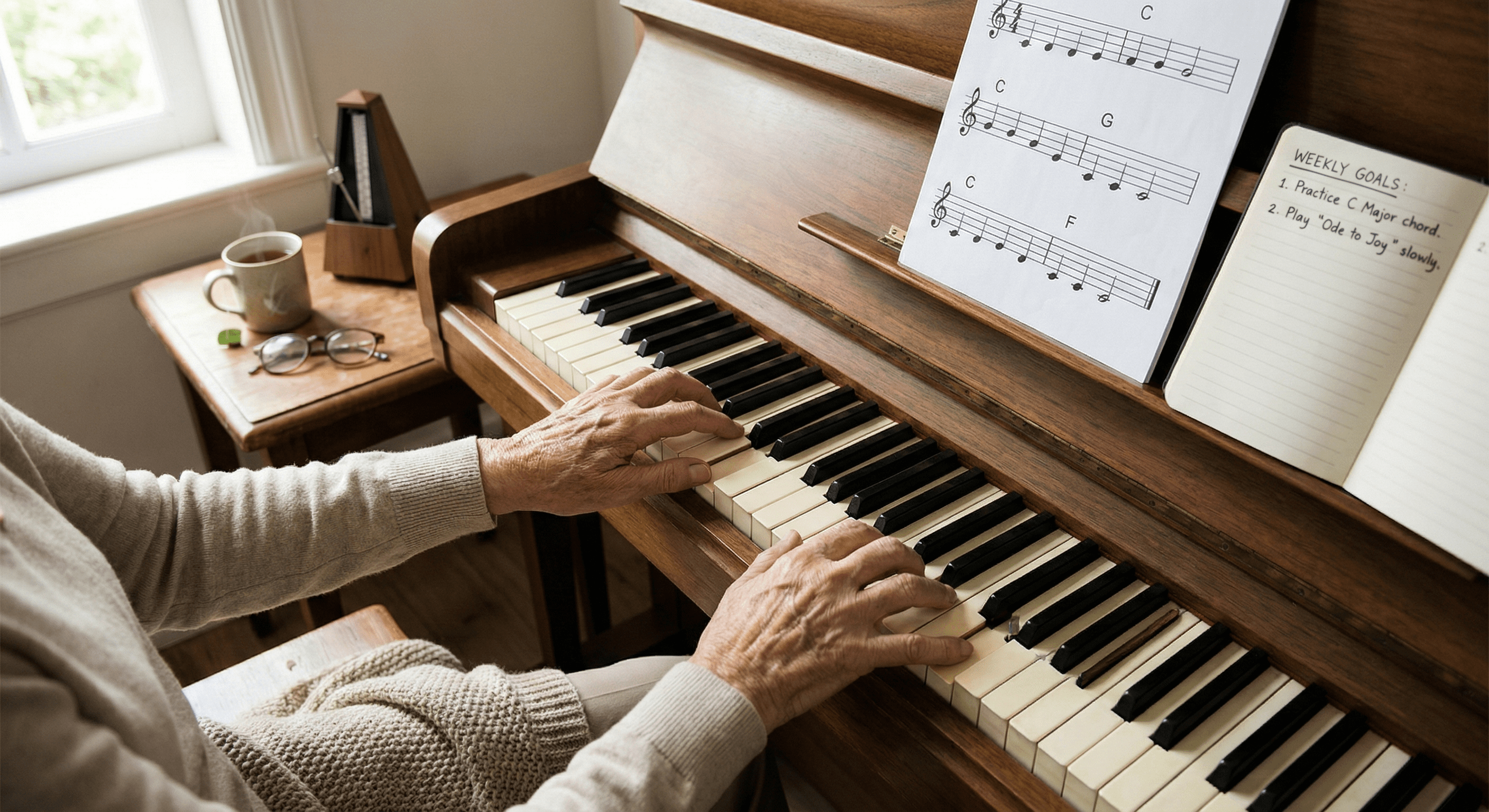
Technically, favour pieces with small stretches and comfortable hand positions. Use the simplest left-hand patterns that still sound like music: root–5, light octaves, or broken chords at a steady tempo. When a passage feels awkward, reduce the task: practise hands separately, then combine in small “chunks” (a phrase, not a page). Aim for slow, focused sessions — 15–20 minutes a day often outperforms the weekend marathon. Set short-term goals (two lines this week; chorus next week) and take the win when it arrives.
If reading notation feels like a second language, begin with chord sheets or simplified scores, then add treble and bass clef gradually. The long-term benefit is real: basic reading opens far more repertoire than memory alone. And there is a consoling fact in the background — research reports that adults can make rapid gains, with measurable improvements after weeks of weekly lessons. Progress is not reserved for the young; it is reserved for the consistent.
Where to learn and perform in London
London offers two things that matter to adult beginners: teachers with serious training, and communities where playing is normal. WKMT London provides structured piano lessons tailored for adults (and children), with qualified teachers and a strong emphasis on healthy technique and repertoire you actually want to play. WKMT’s founder, Juan Rezzuto (a Scaramuzza technique specialist), has taught since 2010 and is known for prioritising posture, sound, and realistic weekly goals. WKMT is open seven days a week (9am–9pm) in central London, with both in-person and online options (last checked: 2025-11-25).
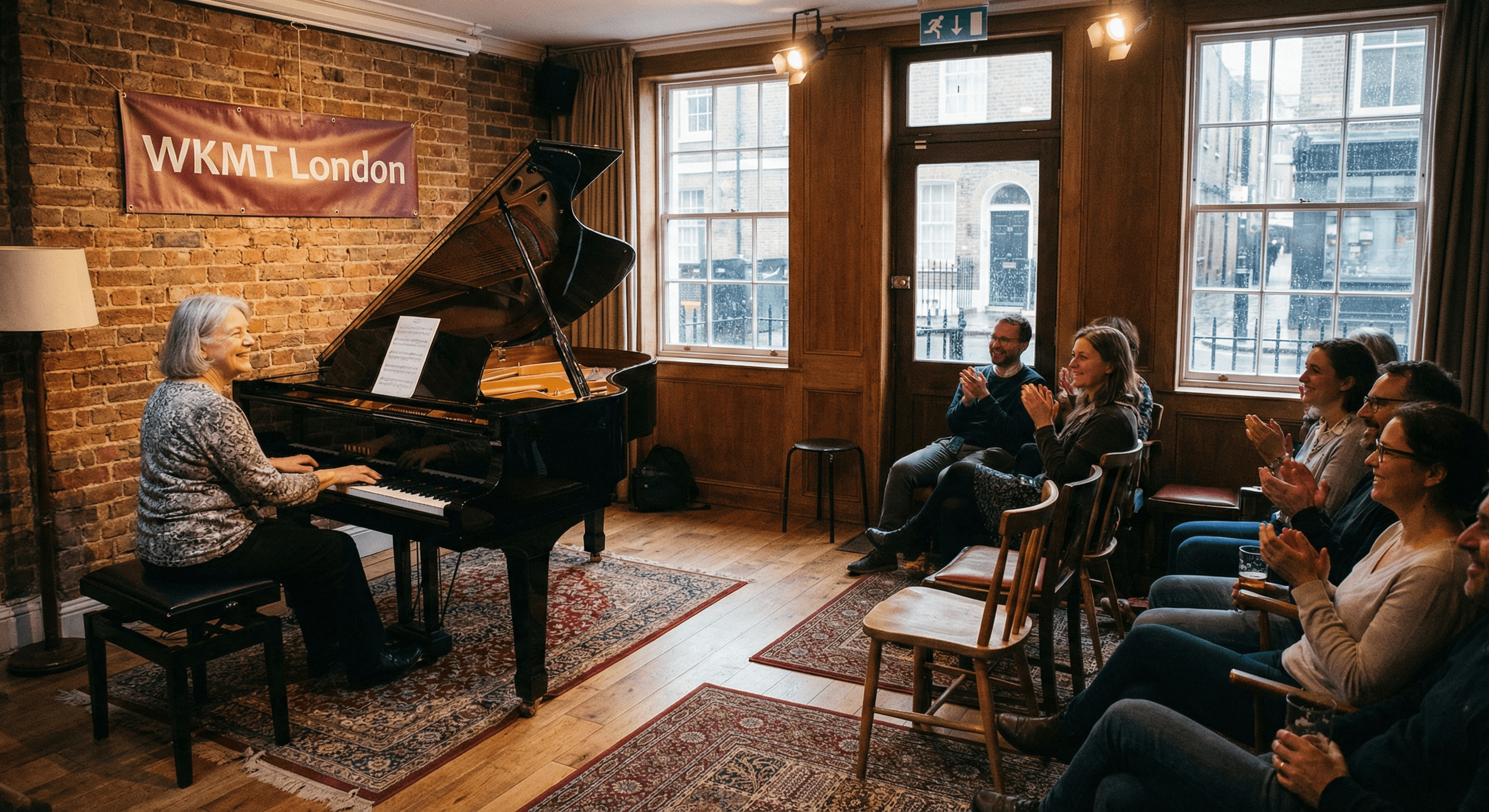
For performance, WKMT hosts informal soirées and an annual London Piano Festival in concert halls — a low-pressure route to the “real” satisfaction of playing for others. Beyond the school, London has beginner-friendly opportunities via community concerts and meet-ups; a modest recital in a local hall can be more educational than a dozen private run-throughs.
Practical FAQs
- Which song should I start with if I’m truly new?
- Choose a piece with a familiar melody and a short harmonic loop. “Happy Birthday” (for immediate usefulness), “Stand By Me”, “Let It Be”, and “Fly Me to the Moon” (in a simplified arrangement) are sensible starting points. The best first choice is the one you’ll gladly repeat.
- What’s an easy left-hand pattern that still sounds good?
- Root–5 is the classic: play the root note of the chord, then the fifth, in a steady rhythm. It works particularly well in “Stand By Me” and many C-major progressions. When that feels stable, turn it into broken chords to create flow without adding speed.
- I’m starting late — can I really learn piano?
- Yes. Reports in UK coverage of neuroscience and music learning describe measurable benefits in adult learners, including improved sensory processing and mood after a period of weekly lessons. Adults also bring patience, context, and listening habits — all of which count.
- How much practice do I need?
- Consistency beats volume. Even 15–20 minutes a day, five days a week, is enough to move forward. Keep it structured: a short warm-up, one focused task, and a brief review.
- Do I need to read music to play fun songs to learn on piano?
- It helps, but you can begin with chord symbols or simplified arrangements and build reading gradually. Many adult beginners start by learning the sound and the shape of a song, then add notation as their confidence grows.
Next steps
If you’d like a clear starting point, book a taster lesson or a repertoire workshop with WKMT London. Bring one or two songs from the list above and we’ll adapt them to your hands, your pace, and your musical taste. If you prefer something social, ask about low-commitment recital events and informal soirées — the kind that make practice feel connected to life.
Book a supportive starting point in London
Explore lessons tailored for adult learners and older beginners, and bring your favourite fun songs to learn on piano so your practice stays musical from day one.
Piano lessons for seniors in London
Piano lessons for adults in London
Book a first trial piano lesson
Sources for Fun Songs to Learn on Piano Guide
University of Bath (2022) – Press release on cognitive benefits of piano study.
BBC Science Focus (2025) – Article on brain health and music for older adults.
WKMT London – Official site for piano lessons (adult & kids programs).
Pianist Magazine (Jan 2026) – “10 memorable pieces for beginner pianists” (classical repertoire).
Skoove Piano Blog (2025) – Guide on posture and technique.
Hal Leonard (UK publisher) – Beatles/John Lennon songbooks.
Wise Publications (UK) – Easy piano anthologies of pop standards.
Musicroom (UK) – Retailer of sheet music (Beatles, Disney, etc).