
 TRIAL LESSON
Piano Lessons
Benefits of Playing Piano for Academic Success
Sep
Benefits of Playing Piano for Academic Success
Introduction to Benefits of Playing Piano for Academic Success
Nowadays, for many people, academic success is often the measure of achievement. Therefore, both parents and teachers are constantly looking for effective ways to develop children and students. Students also feel that there is something else that can help them learn effectively, besides just memorizing the material. One of the ways that deserves special attention is learning to play the piano. The thing is that music lessons not only develop aesthetic taste, but also have a number of benefits for academic success. Below we will explore how piano playing has a positive impact on learning and overall personal development. Benefits of playing piano for Academic success.
Enhancement of Cognitive Skills
One of the most significant and important benefits of playing the piano is the improvement of cognitive skills. Studies show that playing piano stimulates a number of mental processes. These include:
- memory,
- concentration,
- and the ability to solve problems.
When we learn to play the piano, we perform several tasks simultaneously:
- reading notes,
- coordinate hand movements,
- and control the rhythm.
All of this trains our ability to multitask and improves our cognitive flexibility. Another important benefits of learning piano are speed of reaction and attention span. It also improves academic performance.
Development of Discipline and Patience
Learning how to play piano requires patience and a high level of discipline. Every student who wants to play a certain composition and do it beautifully, systematically practices and improves their playing techniques. All this requires not only regularity but also perseverance. The benefits of learning piano as a child are especially pronounced in the development of discipline. This is because children learn to set goals and achieve them with confidence. Systematic piano lessons develop two important habits in students. Systematic and independent work. These skills will be useful throughout their lives. After all, life is such that it will bring more and more challenges.
And the older a student gets, the more complicated the learning process and academic disciplines become. Often, studying becomes so intense that even the ability to organize one’s time and the trait of discipline do not cover the range of tasks that need to be solved. Especially when it comes to writing a qualified written work. For example, an essay, assignment, research, or other academic paper. In such cases, it even becomes advisable to get a professionally composed paper and have time to master other priority skills via essay writing service UK. The only important thing in this context is to choose the right service. The one that is time-tested and offers qualified writers and authors of papers of varying complexity. This is the case with EduBirdie, which impresses with its professionalism, round-the-clock support and reliability. It is in EduBirdie that you will find experts in their field who will do the work on time, and it will meet all the requirements and standards of your educational institution.
Boosting Mathematical Skills
Playing the piano has an impact on the development of math skills. This influence is indirect, but significant. Music, like math, requires an understanding of proportions and rhythmic structures.
- By learning notes and rhythms, students develop skills such as pattern recognition and problem solving. These skills are very useful in math.
- Learning musical intervals and chords helps children understand the concept of proportions and parts. They are the foundation of math knowledge.
That’s why, when asked why learn piano, we can give an unequivocal answer about its math skills enhancement benefit.
Improvement of Reading and Comprehension Skills
When children learn to read music, they train their ability to decode information. This is similar to reading texts. So, is playing piano good for you? Indeed, within this context, learning to read music helps to improve one’s ability to read words and sentences and to understand them by connecting them into a whole. Thus, children who play the piano acquire the ability to navigate texts more easily and understand the integrity of the information presented in texts much better.
Emotional and Social Benefits
Playing the piano has a significant impact on both the emotional and social development of children. Music often becomes a powerful means of self-expression. Therefore, playing the piano can help children learn to manage their emotions, as they will transfer their excitement, joy, or anger into creative expression through playing.
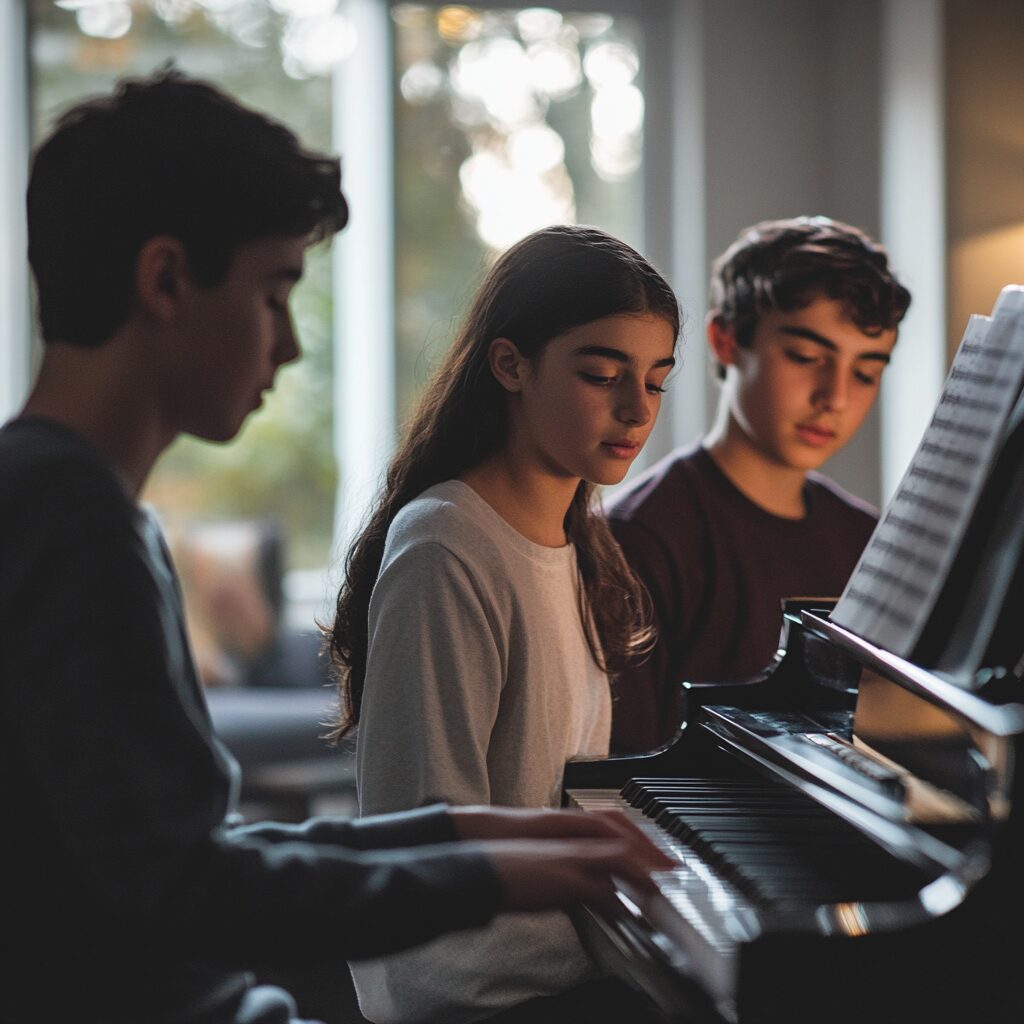
Music lessons can be not only individually, but also in groups. Competitions are also held periodically. This allows children to:
- interact with their peers,
- develop social skills,
- cultivate the desire to win through healthy competition.
So, if you’re still wondering why piano is important, here’s another answer, presented and explained above.
Creativity and Imagination Boost
Students who play musical instruments are often better at generating new ideas and solving non-standard problems. Music training helps them to develop their imagination through performing musical compositions and making up their own. This also has an impact on their academic success, as creativity contributes to a deeper understanding of subjects. So, playing piano, students not only enjoy the process, but also develop their creativity. This has a very positive impact on their academic achievements.
Summary of Benefits of playing piano
Piano lessons have a variety of benefits. In particular, for academic success. This includes the development of cognitive skills and self-discipline. As well as reading and math skills. Let’s not ignore the importance of emotional and social development, along with creative thinking. As you can see, the benefits of learning piano are quite significant for the development of a young person. After all, the impact goes beyond the art of music, helping to achieve success in academics and personal life. Thus, learning to play the piano is a powerful tool for all-round development.