
 TRIAL LESSON
Piano Lessons, Uncategorized
The Sostenuto Pedal: A Journey into Its History and Usage
Jan
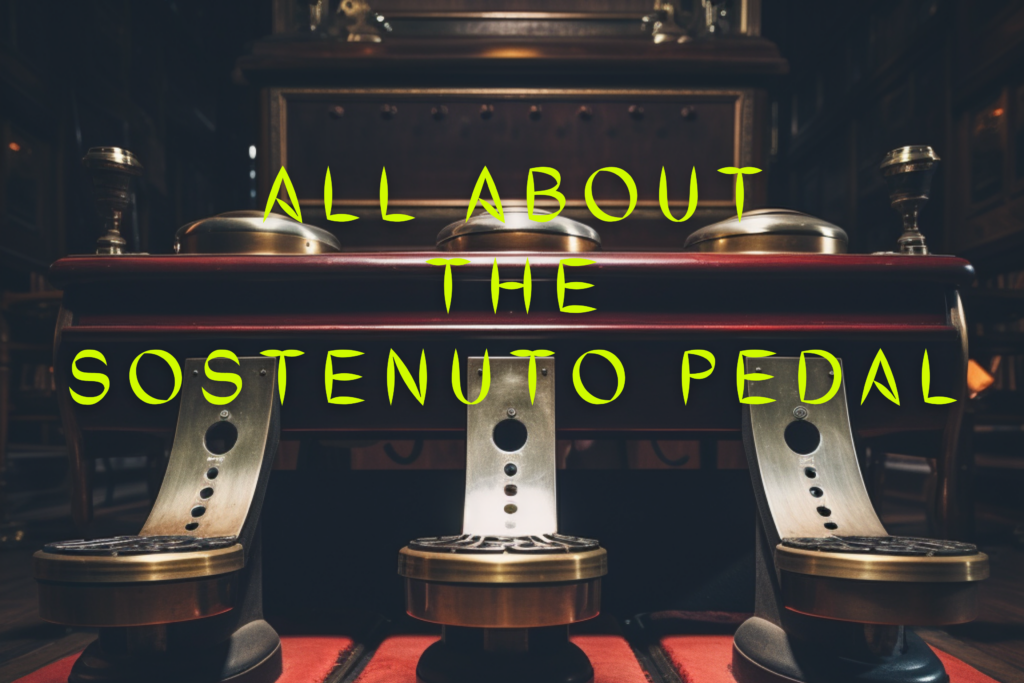
Sostenuto Pedal Complete Guide
The Sostenuto Pedal: A Complete Piano Guide to History, Mechanics and Repertoire
The sostenuto pedal is the least understood of the piano’s three pedals — and the most precisely expressive. This guide explains exactly what it does, why it exists, which composers wrote for it, and what pianists need to know before reaching for the middle pedal.
What You Will Learn in This Guide
- The sostenuto pedal is not the same as the sustain pedal — a very common confusion corrected
- Its Steinway patent history and the engineering problem it solved
- How the selective damper-locking mechanism works
- Which classical works specifically require or benefit from the sostenuto pedal
- Why most digital pianos do not implement a true sostenuto
- How to practise using it, with a step-by-step approach from WKMT teachers
What Is the Sostenuto Pedal — and What It Is Not
The sostenuto pedal is the middle pedal on a grand piano. When pressed, it sustains only the notes that were already being held down at the exact moment the pedal was engaged — leaving all other notes completely unaffected. Notes played after the pedal is depressed are dry and unstained, even while the originally selected notes ring on.
This selective sustain is the sostenuto pedal’s defining characteristic and the source of its expressive power. It allows a pianist to hold a bass note or chord underneath free, unblurred melodic movement — an effect impossible with the right damper pedal, which lifts all dampers simultaneously.
The sostenuto pedal is frequently mislabelled as “the sustain pedal” in beginner guides and even some instrument listings. This is incorrect. The sustain pedal (also called the damper pedal) is the right pedal — the one pianists use throughout virtually every piece they play. The sostenuto is the middle pedal, and it is one of three distinct pedals, each with a completely different function.
Right Pedal — Damper (Sustain)
Lifts all dampers simultaneously. Every note played while the pedal is held will sustain until the pedal is released. Used in almost every piece of piano music.
Middle Pedal — Sostenuto
Locks only the dampers of notes already held down when the pedal is pressed. All subsequent notes remain unaffected. Found only on grand pianos — used for specific repertoire effects.
Left Pedal — Una Corda (Soft)
Shifts the entire keyboard action sideways so that hammers strike fewer strings. Reduces both volume and tonal colour. Marked una corda or soft pedal in scores.
History: How the Sostenuto Pedal Came to Exist
The sostenuto pedal’s origins trace to 19th-century France, where early experiments with selective damper mechanisms appeared in the 1840s. The concept addressed a real compositional problem: how do you sustain a bass note over many bars of harmonic movement without muddying every note played above it? The damper pedal could not solve this — it was all or nothing.
It was in the United States, however, that the mechanism was refined into a workable engineering solution. In 1874, Steinway & Sons patented a sostenuto mechanism for their Model D concert grand — one of the most significant developments in 19th-century piano design. The Steinway implementation used a rotating bar that caught the underfelt of only those dampers whose keys were being held at the moment of engagement. This selective catching mechanism allowed the sostenuto to work with surgical precision.
“The problem Steinway solved in 1874 was not acoustic — it was mechanical. The piano could already produce sustained tones with the damper pedal. What it could not do was sustain a chosen note while allowing all others to remain crisp. The sostenuto mechanism solved that.”— WKMT London, piano technique department
Over subsequent decades, the sostenuto was incorporated into most grand piano designs, becoming a standard feature of the modern concert grand. Upright pianos sometimes include a middle pedal, but on most uprights it performs a different function entirely — often a practice mute that places felt between the hammers and strings. This is emphatically not a sostenuto.
How the Sostenuto Mechanism Works
Understanding the sostenuto’s mechanics helps pianists use it reliably under performance conditions. When a pianist presses a key, the key lifter raises the damper off the corresponding string(s). While the key is held down, that damper remains lifted. The sostenuto mechanism works by inserting a rotating bar — the sostenuto rail — between the damper levers and the damper guides at that precise moment.
When the sostenuto pedal is depressed, the rail rotates into position and catches the tab on the underside of each damper that is currently elevated (i.e., each damper whose key is being held). The rail then holds those specific dampers up regardless of what happens with the keys. The pianist can then release the keys and move on — those original dampers remain suspended by the rail until the sostenuto pedal is released.
The choreography this requires from the pianist is precise: press the key (or chord), while still holding it depress the sostenuto pedal, then release the key. The note will continue to sustain while the rest of the keyboard remains clean. Timing matters enormously — engage the sostenuto a fraction too late and the damper will have already fallen back, catching nothing.
The Sostenuto Pedal in Classical Repertoire
The sostenuto pedal is not common in the mainstream piano canon, but where composers call for it — or where its use is implied by what the score demands — it produces effects that cannot be replicated any other way.
| Composer | Work | Sostenuto Context | Student Level |
|---|---|---|---|
| Claude Debussy | Mouvement (Images, Book I) | Half-sostenuto to sustain inner voices under fast outer-voice movement — demonstrated by Frédéric Chiu below | Advanced (Grade 8+) |
| Claude Debussy | La Cathédrale Engloutie | Sustained bass pedal-point underneath bell-like chordal layers — requires selective pedal sustain | Advanced (Diploma) |
| Maurice Ravel | Jeux d’eau | Sustained low A underneath rapid figuration; sostenuto lets the bass ring freely | Advanced (Grade 8+) |
| Ludwig van Beethoven | Moonlight Sonata Op. 27 No. 2 | Senza sordini marking implies sustained bass; modern grands need sostenuto or careful half-pedalling | Upper-intermediate (Grade 7–8) |
| Franz Liszt | Various late works | Implied sustained bass notes under harmonic movement; sostenuto clarifies complex layered textures | Advanced (Diploma) |
“Debussy’s textures frequently demand that a specific sonority persist underneath rapid, articulate movement. The sustain pedal blurs everything. The sostenuto isolates exactly what he wanted to hold — and leaves the rest free.”— WKMT piano faculty, on Impressionist pedalling technique
It is worth noting that Debussy himself was an exceptionally skilled pianist whose exploration of pedal sonority was systematic and compositionally motivated.
The Three Pedals at a Glance
The Sostenuto Pedal and Digital Pianos
The majority of digital pianos — including popular beginner and intermediate models — do not implement a true sostenuto pedal on their middle pedal connector.
On many instruments (including several models in the Yamaha P-series range), the middle pedal socket is used for a different function altogether — typically a sustain half-pedal, a practice mode, or simply left unimplemented.
Many digital pianos list three pedal sockets but implement only one or two genuine pedal functions. Before purchasing, check the instrument’s MIDI specification: a genuine sostenuto will respond to MIDI controller 66 (sostenuto on/off). If the middle socket responds to MIDI 64 (damper/sustain), it is not a sostenuto.
How to Practise Using the Sostenuto Pedal
-
1Identify the target note(s). Decide exactly which note or chord you want to sustain selectively.
-
2Press and hold the target note(s). Depress the key firmly. Do not release it yet.
-
3While still holding the key(s), engage the sostenuto pedal. Press slowly enough to feel the mechanism catch.
-
4Release the key(s). The note should continue to ring. If it stops, the timing was off — repeat.
-
5Play the upper voice freely. Now completely independent — it will not sustain unless you add the right damper pedal.
-
6Release the sostenuto pedal when done. The damper falls back immediately.
Scaramuzza Technique and Pedal Coordination
The Scaramuzza technique, which underpins all teaching at WKMT London, treats sound production and pedal use as inseparable. The arm-weight approach — transmitting the natural weight of the arm from shoulder through elbow, wrist, and fingertip into the key — produces tones that already have natural sustain built into them. Pedal use is always subordinate to the finger sound.
For the sostenuto specifically, the quality of the target note must be established first through proper arm-weight contact. Establish the tone, then lock it with the sostenuto.
Students at our adult piano lessons in London working on advanced Debussy or Ravel are taught pedal technique in direct relationship to tone production.
Is the Sostenuto Pedal Relevant for Most Piano Students?
Honestly: not for the majority of the piano-learning journey. The sostenuto is a specialised tool for specific advanced repertoire contexts. Students at Grade 1–7 will almost certainly never need it.
Where it matters enormously is for students performing Debussy’s Images or Préludes, late Liszt, or Ravel’s solo piano works at a serious level. Understanding why the sostenuto exists, however, is useful at any level.
Frequently Asked Questions
Is the sostenuto pedal the same as the sustain pedal?
No. The sustain pedal (damper pedal) is the right pedal — it lifts all dampers at once. The sostenuto pedal is the middle pedal — it sustains only the notes already held at the moment of engagement. They are mechanically and musically completely different.
Do upright pianos have a sostenuto pedal?
Most do not. On the majority of uprights, the middle pedal is a practice mute. Some uprights have a bass sostenuto sustaining only bass-register notes, which is different from the full sostenuto on grand pianos.
Does my Yamaha digital piano have a sostenuto pedal?
Most entry-level and intermediate Yamaha digital pianos (P-45, P-125, P-515) do not implement a true sostenuto. Check the MIDI implementation chart — genuine sostenuto responds to MIDI CC 66, not CC 64.
Which composers wrote specifically for the sostenuto pedal?
Debussy and Ravel are the most prominent — their textures are best realised with sostenuto technique even without explicit notation. George Crumb explicitly notates sostenuto pedal markings. Beethoven’s pre-1874 notation implies the effect even though the mechanism didn’t yet exist.
Can I use the damper pedal instead of the sostenuto?
Half-pedalling or rapid pedal changes can approximate the effect, but not perfectly. The sostenuto is the only way to sustain a single bass note cleanly while playing completely dry notes above it.
How long does it take to learn to use the sostenuto reliably?
Most students can learn the basic coordination within a single focused practice session. Applying it fluently at performance tempo takes considerably longer — expect several dedicated sessions per passage.
Learn Piano Pedalling With Expert Guidance in London
Pedal technique — including the sostenuto — is taught at WKMT as part of a complete classical piano education, grounded in the Scaramuzza technique and tailored to each student’s repertoire.
We teach children and adults, beginners and advanced students, in-studio in West Kensington, Camberwell, and Bermondsey — and online worldwide.