 TRIAL LESSON
Uncategorized
A Complete Guide on Key Signatures
Jul
One of the most important things when starting to read music is to understand key signatures. Learn how they work and how to play key signatures on the piano with this tutorial.
What are scales and key signatures on piano
For understanding a key signature guide, first, we need to comprehend what are scales and key signatures. The collection of piano sharps and flats marked at the beginning of the piece and applied to that staff is called ‘key signature’. Every key signature corresponds to one major and one minor Scale.
That means that every Major Scale has a unique set of flats or sharps, which only shares with one Minor Scale. These pairs of keys are called ‘Relative Keys‘.
How to Identify the Key Signature
There are more than one ways to find the key signature.
The obvious is to read every accidental at the beginning of the piece. They are typically located on the right of the clef. However, a more practical way is to understand the logic of the ‘series of piano sharps and flats’.
What is the order of Piano Sharps and Flats?
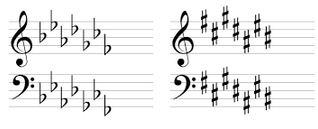
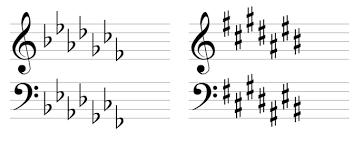
The order in which the accidentals appear in the Key Signature is always the same.
The order of the sharps is: #F-C-G-D-A-E-B
The order of flats is: ♭B-E-A-D-G-C-F
(notice that they are the same backwards)
This means that when the Key Signature has only one sharp, it will always be F#, when it has two, F# C#, a key with 3 flats will be #F, C#, G#, and so on.
How To Work Out Key Signatures
There is a simple trick to know how to work out key signatures, which is the following mnemonic:
For the Sharps:
#Father-Charles-Goes-Down-And-Ends-Battle
And for the Flats:
♭Battle-Ends-And-Down-Goes-Charles’-Father
So, which key signature is pictured here?

We see three flats. So, Battle-Ends-And or ♭B-E-A!
How to find the Major Scale from the Key Signature
Now that we can recognize the key signatures, we can recognize the Major Scale that they indicate.
SHARPS:
The last sharp of this Key Signature is the ‘Leading Note‘ of the key.
The Leading Note is the 7th note of every Scale and it is always one semitone under the ‘Tonic‘, the first note of the key.
So for a C major, B is the Leading Note, and for G major, F#, etc.
Example:
Which major Scale has three sharps?

Three sharps: Father-Charles-Goes (#F-C-G), G# is the leading note of A major. So A major has three sharps!
FLATS:
Now, the penultimate flat in the key signature would be the key.
Example:
Which major Scale has two flats?

Two flats: Battle-Ends (♭B-E), B ♭ major is the Scale!
One exception to this rule is the single-flat key signature (B♭), which belongs to F major.
How to find the Key Signature from the Major Scale
To find the key signature of a scale, you will have to invert the method.
SHARPS:
All major scales that do not start on a flat have sharps in the key signature (except F major).
To find the Key Signature: locate the Leading Note and include all sharps of the Series up to that one.
Example:
What is the Key Signature of B major?
In the picture above, the leading Note is A#, so the key signature includes all the sharps up to that:
Father-Charles-Goes-Down-And
B major has a key signature of five sharps (#F-C-G-D-A)
FLATS:
All the scales that start with a flat (plus F major) have flats in the Key Signature.
To find the Key Signature: add a flat, after you locate the key in the Series.
Example:
What is the Key Signature of D♭ major?
We should locate D♭ and add one more flat, that way Battle-Ends-And-DOWN-Goes.
So D♭ major has a key signature of five flats (♭B-E-A-D-G)
For Minor Scales:
As we said above, every Key Signature corresponds to two ‘relative keys’.
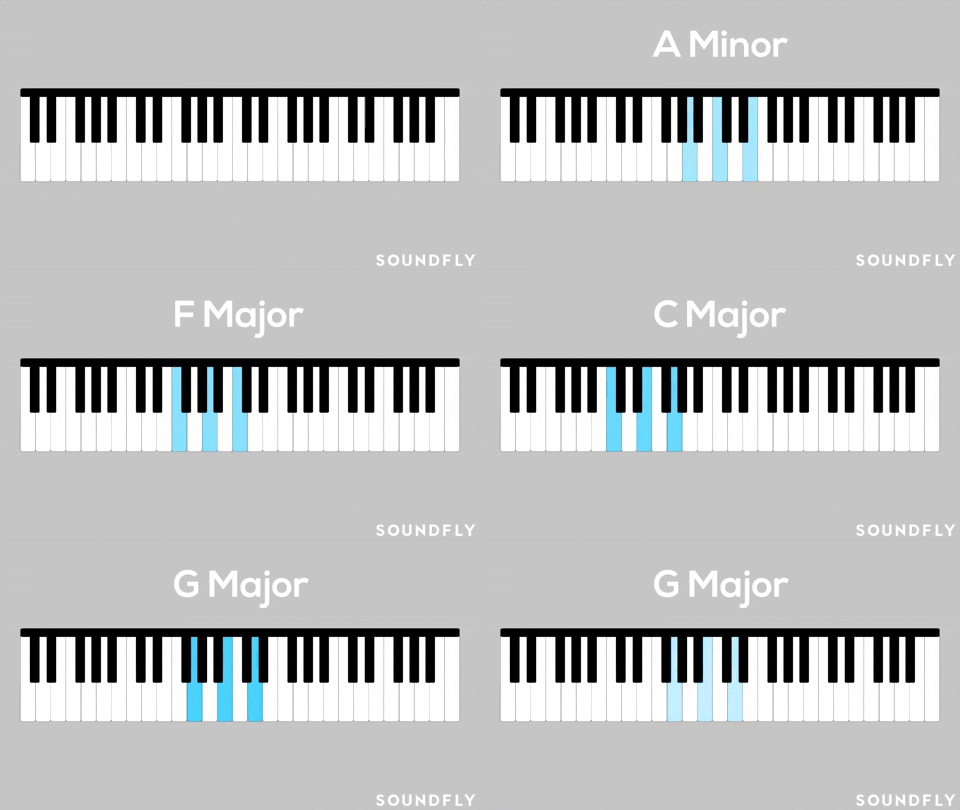
In order to be able to find the relative minor, you need to go a minor third down (3 semitones) from the Relative Major.
C major – A minor, G major – E minor, B♭ major – G minor and so on.
How to find the Minor Scale that a Key Signature belongs to
You need to, first, find the relative major and then move down a minor third to the relative minor.
For example:
Which minor key has three flats?
3 flats: Battle-Ends-And, E♭ is the penultimate flat and our Major Scale.
One minor third down from E♭, it is C. Therefore, C minor has three flats (♭B-E-A)
How to find the Key Signature of a Minor Scale
We must make the trip backwards.
First, we must find the relative major, one minor third above.
Then, depending on the relative major, we will look for either flats or sharps.
For example: Which is the key signature of F minor?
F minor is relative to A♭ major, which has flats. Following the method, we find that both scales have keys with four flats (♭B-E-A-D).
Be Careful!
The additional accidentals that appear in Harmonic and Melodic Minor scales do not appear in the key signature, but rather during the piece.
So how many Key Signatures are there?
There are twelve different keys. Therefore we would expect twelve different key signatures.
But there is a catch! We use three Major Scales (and their relative minors) with two different names.
These Scales are B/C♭ major, F#/G♭ major and C#/D♭ major. They are considered to be Enharmonically identical, but they are notated differently.
We, therefore, have fifteen different key signatures, 7 sharps, 7 flats and one with none.
What is the pattern?
Looking at the Series of Sharps, we notice that every sharp is one fifth higher than the previous.
Looking at the Series of flats, we notice that every sharp is one fifth lower than the previous.
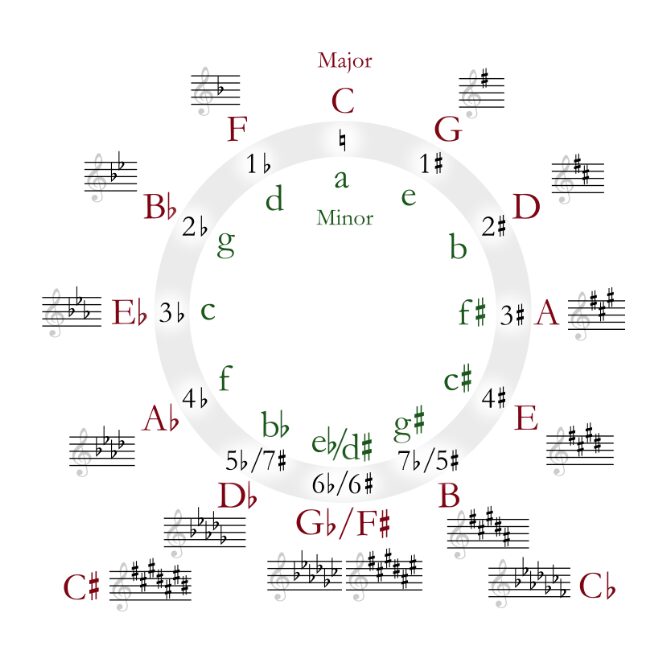
Similarly, the Scales themselves appear in that pattern. This creates what we call the Circle of Fifths.
In this famous clock-like representation, you can see all the Scales.