
 TRIAL LESSON
Piano Lessons
Early Literacy and Piano: How Listening, Symbols and Rhythm Meet
Sep
Early literacy for your piano traning in London
WKMT London parent guide
Early Literacy and Piano: How Listening, Symbols and Rhythm Meet
Before a child reads a sentence or a score, they learn to notice pattern: where a sound begins, how long it lasts, what repeats and what changes. Piano lessons can make that attentive listening vivid, social and memorable.
What early literacy includes
Early literacy is broader than recognising letters. Children build vocabulary through conversation, learn that stories have sequence, notice rhyme and syllables, and begin to understand that marks can carry meaning. Phonological awareness concerns the sound structure of language; phonics later connects those sounds to written symbols. Keeping these terms distinct helps parents understand what music can and cannot contribute.
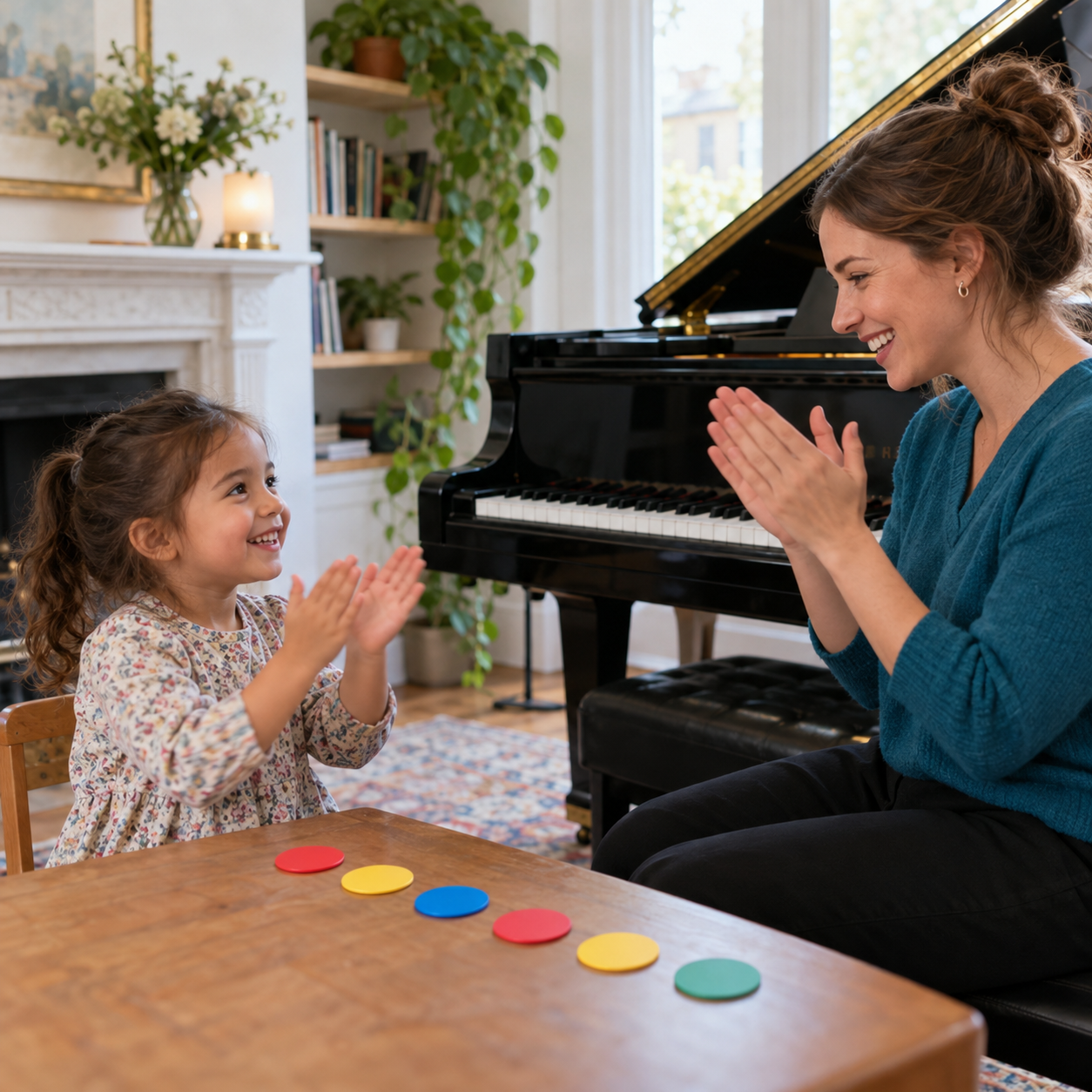
Music shares several useful demands with spoken language. Both unfold in time, organise sound into groups and depend on memory for what has just happened. A child who echoes a short rhythm must listen, hold a sequence and reproduce its order. Those actions are musical first, yet they offer disciplined practice in attention and pattern recognition that sits naturally beside early literacy development.
Listen
Hear the whole pattern before responding.
Group
Notice beats, pauses, rhyme-like returns and endings.
Represent
Connect a heard pattern with a gesture or simple symbol.
What research says about music and early literacy
Research is encouraging but should be described proportionately. A meta-analysis of controlled studies found a small positive effect of music training on phonological awareness, while effects on broader reading fluency were less secure. A 2026 systematic review of rhythmic training likewise reported improvements in several studies, particularly for phonological awareness and reading fluency, but emphasised varied methods and populations.
These findings do not show that any piano lesson automatically improves reading. Programme design, teaching quality, duration and the child’s starting point all matter. Music is most credible as a complementary learning environment: it gives rhythm, listening, memory and symbol use an expressive purpose, while explicit literacy teaching remains the direct route to reading and writing.
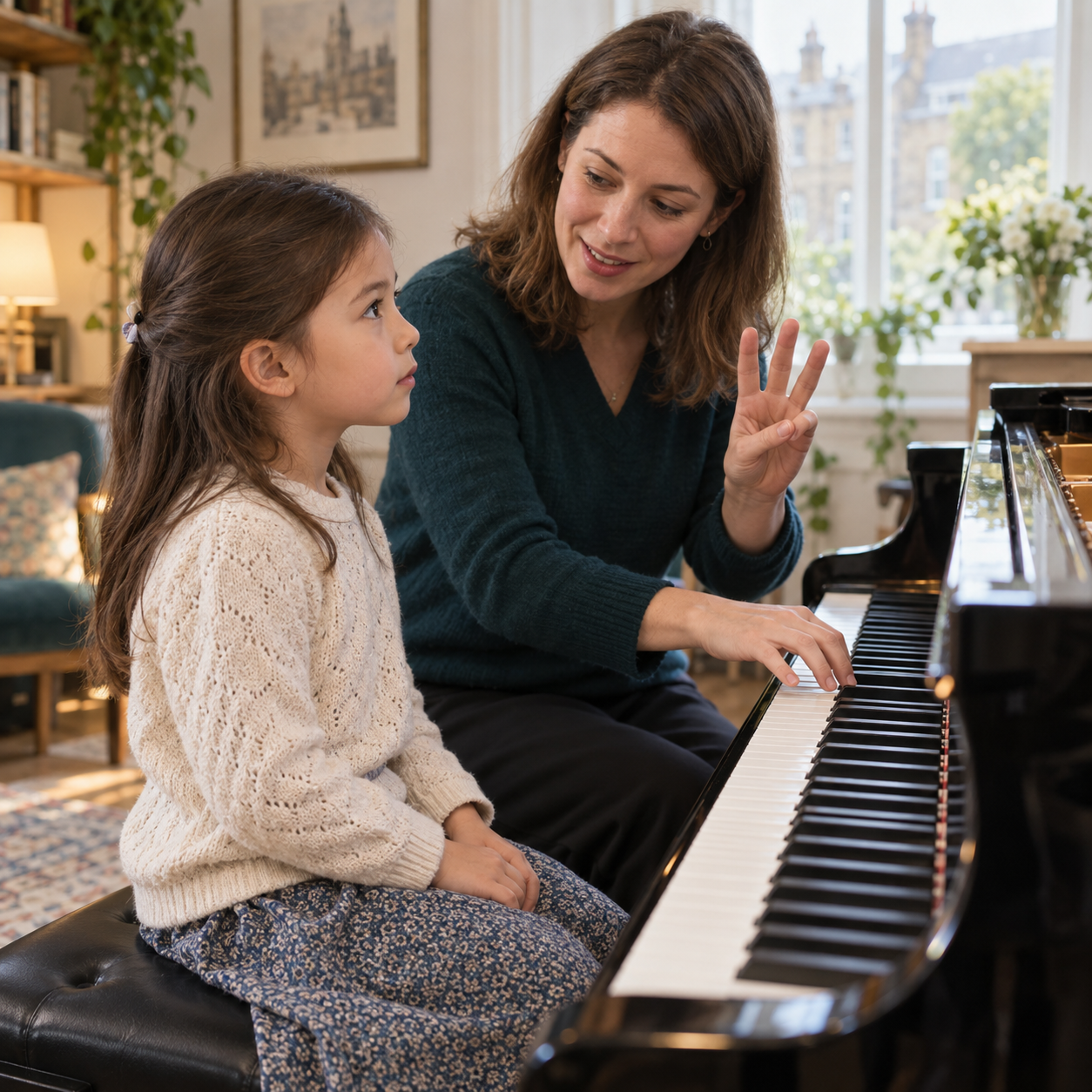
The strongest link between music and early literacy is active listening organised through meaningful pattern.
How a piano lesson can support early literacy
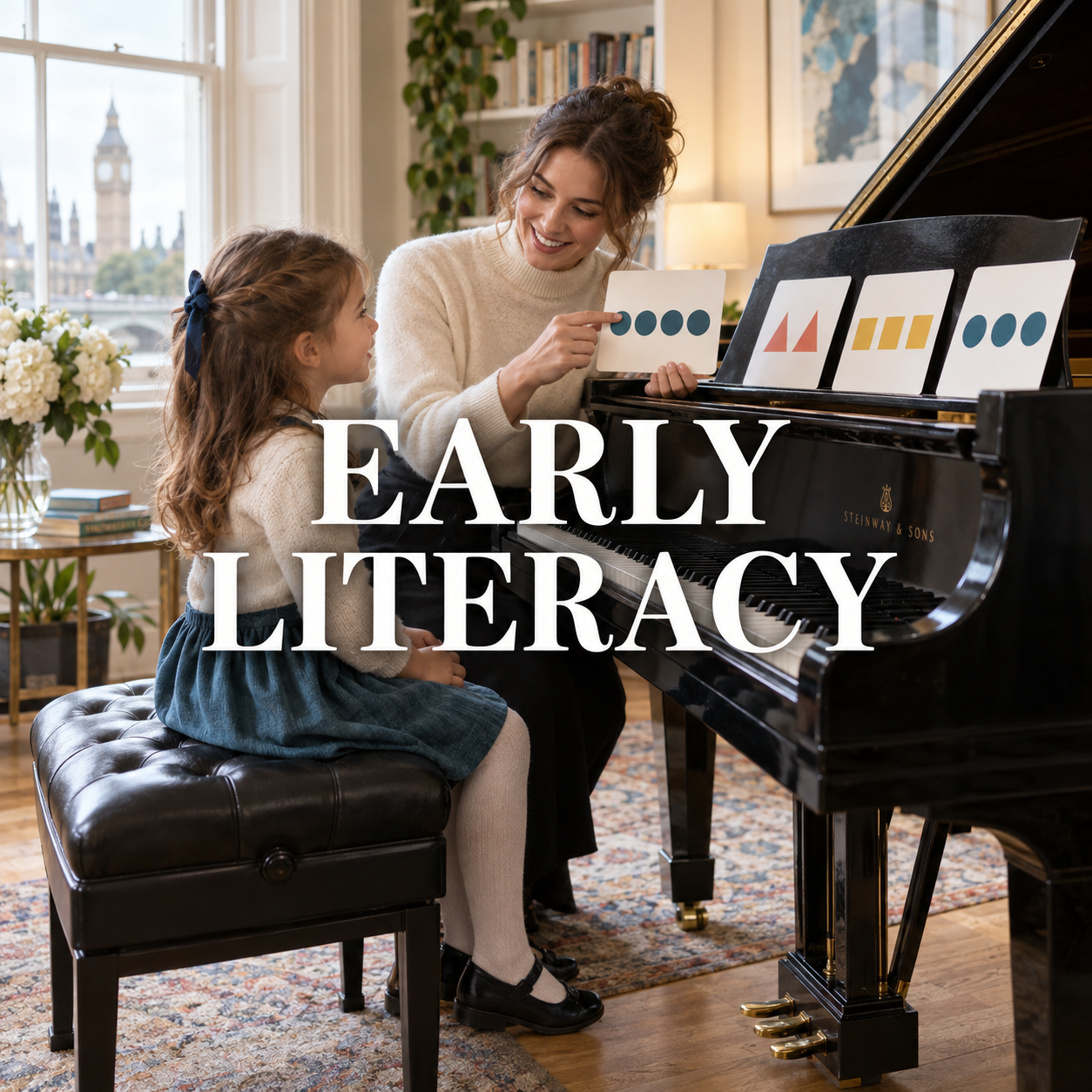
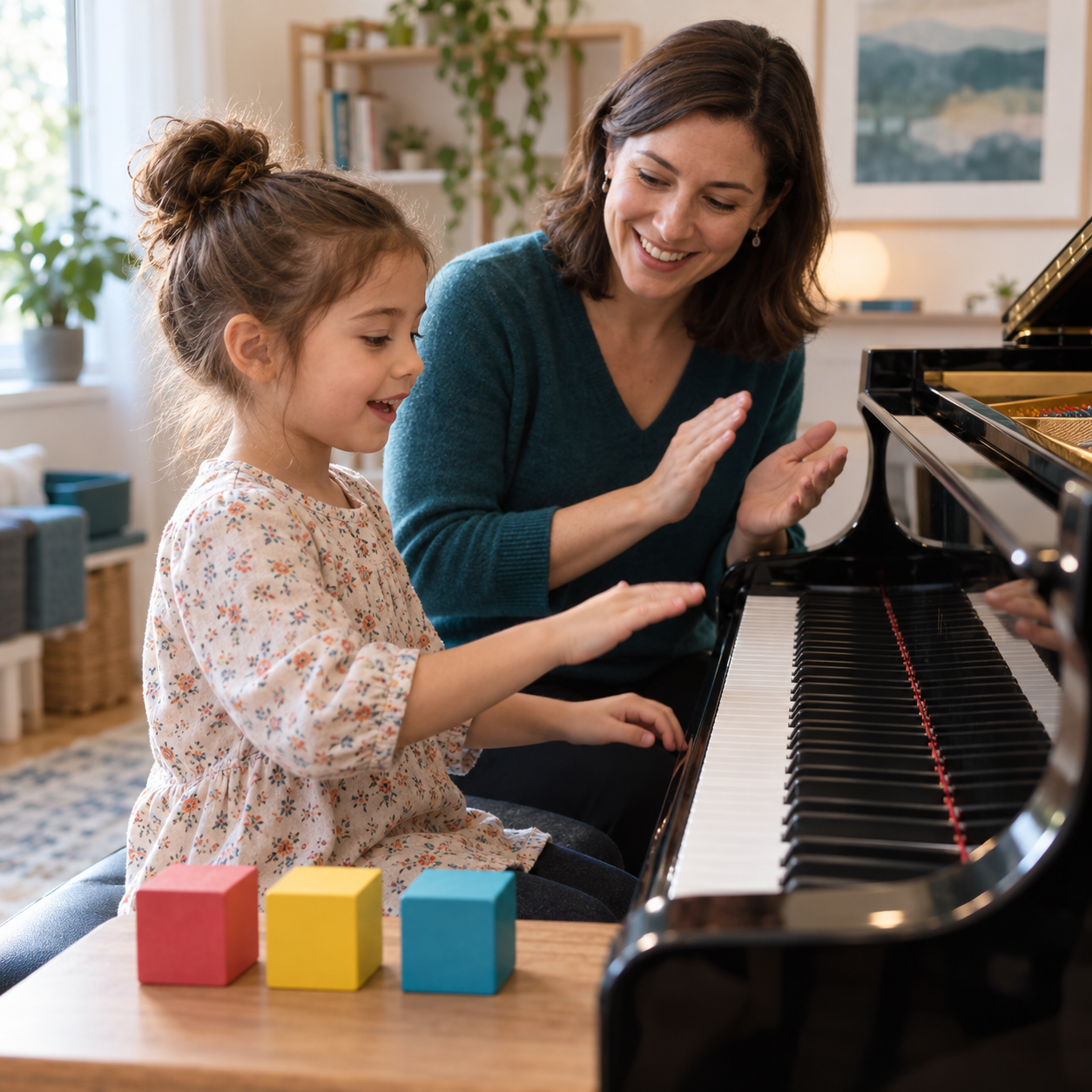
A teacher can clap a two-bar rhythm and invite the child to echo it, then change one ending. The child listens for sameness and difference rather than guessing. A sung phrase can be matched to a group of keys; a familiar name can be divided into syllables; high and low sounds can be traced with simple abstract shapes before conventional notation is introduced.
Early literacy also benefits from language around experience. A good teacher asks the child to describe whether a phrase sounded smooth, bouncy, quiet or unfinished. The answer need not be technical. Finding words for an audible event connects perception with expression and gives the lesson a conversational rhythm. Parents can continue this at home by asking one clear question after a short piece rather than testing every detail.
A practical guide for parents
Look for progress that belongs honestly to music: steadier pulse, more accurate echoes, longer attention, clearer singing and an emerging understanding that symbols guide action. These are valuable achievements. They may reinforce aspects of early literacy, but they should not be used to promise accelerated reading or to diagnose a child’s language needs.
WKMT’s face-to-face piano lessons for children in London let a teacher adjust sound, movement and difficulty immediately. If a child has persistent speech, language or reading concerns, parents should speak with the school and appropriately qualified specialists. Piano can remain a rich place to hear, coordinate, imagine and communicate while each professional keeps a clear role.
For a related WKMT perspective, read listening skills children develop beyond reading notes.
WKMT London
Give your child structured musical study in which rhythm, listening, symbols and confident response grow together.
Sources
- Education Endowment Foundation: early literacy approaches
- PMC: Does music training enhance literacy skills?
- PubMed: rhythmic training and language and reading skills
- PMC: music and language development in children
- Frontiers: phonics-integrated music rhythm intervention
- Royal College of Speech and Language Therapists: literacy
Sources for early literacy checked 12 September 2026. Educational guidance; individual learning and development vary.