
 TRIAL LESSON
Pianists, Piano Lessons
Yuja Wang in London: Virtuosity, Colour and the Art of Serious Piano Listening
Jul
Yuja Wang in London: Virtuosity and Colour | WKMT
WKMT London piano culture
Yuja Wang in London: Virtuosity, Colour and the Art of Serious Piano Listening
Yuja Wang has become one of the defining pianists of the present concert age. For London listeners, her playing raises a useful question: how do we hear brilliance without being dazzled away from the music itself?
By WKMT London. Published 5 July 2026.
Intro snapshot
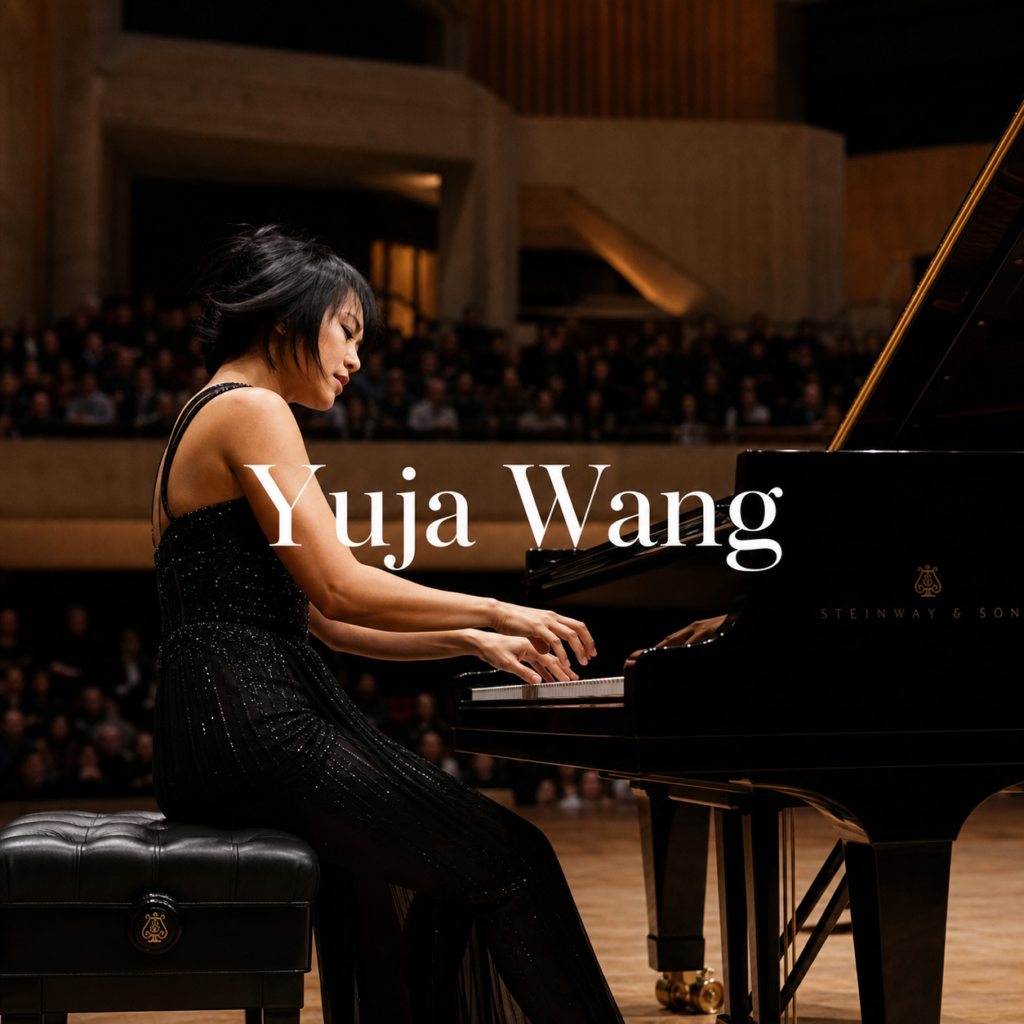
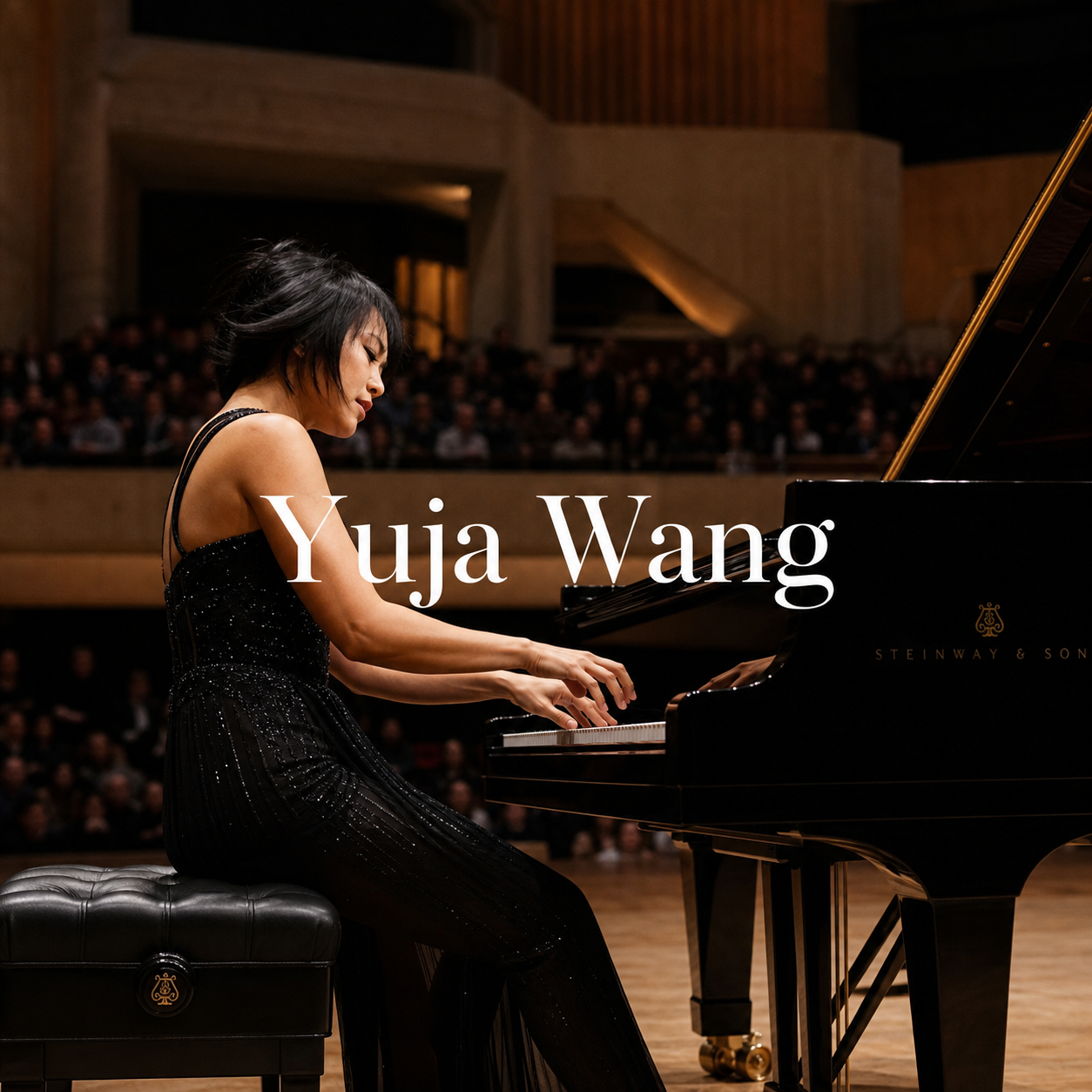
Yuja Wang is searched as a virtuoso, a recording artist, a fashion figure and a live-concert phenomenon. In London, the more rewarding path is to hear her as a musician of speed, colour, risk and structural command. This guide gives the facts, then turns them into listening habits.
At a Glance: Key Facts and Quick Listening Route
Beijing, 1987; piano studies began in childhood before advanced study in North America.
Central Conservatory of Music, Calgary’s Mount Royal College, then the Curtis Institute of Music.
High-definition virtuosity, flexible colour, fast reflexes and an unusual appetite for risk.
Rachmaninov, Prokofiev, Ravel, Scriabin, Ligeti and contemporary concerto repertoire.
Official biographies and label materials confirm the broad outline: Wang was born in Beijing, studied at the Central Conservatory, continued in Canada, and entered the Curtis Institute in Philadelphia as a teenager, where she studied with Gary Graffman. Deutsche Grammophon has presented her as one of its central contemporary piano artists, with recordings spanning solo recital, chamber music and major concerto projects.
For London audiences, the immediate appeal is obvious: Wang’s playing fills large halls without losing detail. Yet the public image can crowd the musical discussion. Serious listening begins by separating display from design. Speed is only interesting when it clarifies harmony, voicing, pressure, character and line.
Biography and Career Highlights
Yuja Wang’s career belongs to the modern international circuit, but its foundations are old-fashioned: early discipline, conservatoire training, intense exposure to repertoire and an apprenticeship with musicians who understood public performance as a demanding craft. Her Beijing childhood is usually described through precocity, but the more useful point is continuity. By the time she reached Curtis, she was not simply a fast pianist; she was being shaped into a musician who could absorb large concerto architecture quickly and play it with immediate stage authority.
Her breakthrough came through replacement appearances and major-orchestra engagements that asked for reliability under pressure. This matters because Wang’s mature career is often judged through extremes: velocity, glamour, repertoire difficulty, theatricality. The practical truth is sterner. A pianist who survives at this level must bring repeatable command to different halls, pianos, conductors, orchestras and acoustics.
The useful question is not whether Yuja Wang can play fast. The useful question is what the speed allows the listener to hear.
Her recording profile has expanded from Romantic and modern concertos to chamber collaborations and contemporary projects. The Deutsche Grammophon catalogue gives a clear picture of that range: Rachmaninov, Prokofiev, Ravel, Scriabin, Bartok, Messiaen and newer works sit alongside recital showpieces. That mix explains her particular place in current piano culture. She can play the canonical virtuoso literature, but she is also one of the few pianists whose public profile can draw a wide audience toward harder-edged twentieth-century and contemporary works.
There is also a London-specific reason to care. The capital’s piano audience is unusually varied: students, teachers, critics, orchestral subscribers, tourists, advanced amateurs and adult learners all sit in the same halls. Wang’s playing gives that audience a shared object of attention. A beginner may be astonished by the physical command; a professional may listen for inner voicing, pedal timing and risk management; a teacher may hear what must be trained slowly before it can appear spontaneous.
Repertoire and Artistic Profile
Wang is most strongly associated with repertoire where precision and volatility coexist. Prokofiev suits her because its motor energy, sarcasm and sudden lyricism ask for steel and wit. Rachmaninov suits her when the playing refuses to drown in perfume: the inner strands stay alive, climaxes are built with pressure rather than volume alone, and the melodic line remains vocal through dense textures. Ravel and Scriabin reveal a different gift: the ability to colour a chord so that it changes temperature while the pulse stays alert.
Her repertoire also tests the listener’s assumptions about virtuosity. In Liszt, the danger is decorative exhibition. In Wang’s best performances, the display is sharper: octaves, repeated notes and leaps become forms of rhetoric. In Ligeti, the difficulty is not simply speed but layered perception. The ear has to follow rhythmic planes, not merely count notes. That is why her contemporary and twentieth-century choices matter. They keep virtuosity attached to modern listening, not just nineteenth-century spectacle.
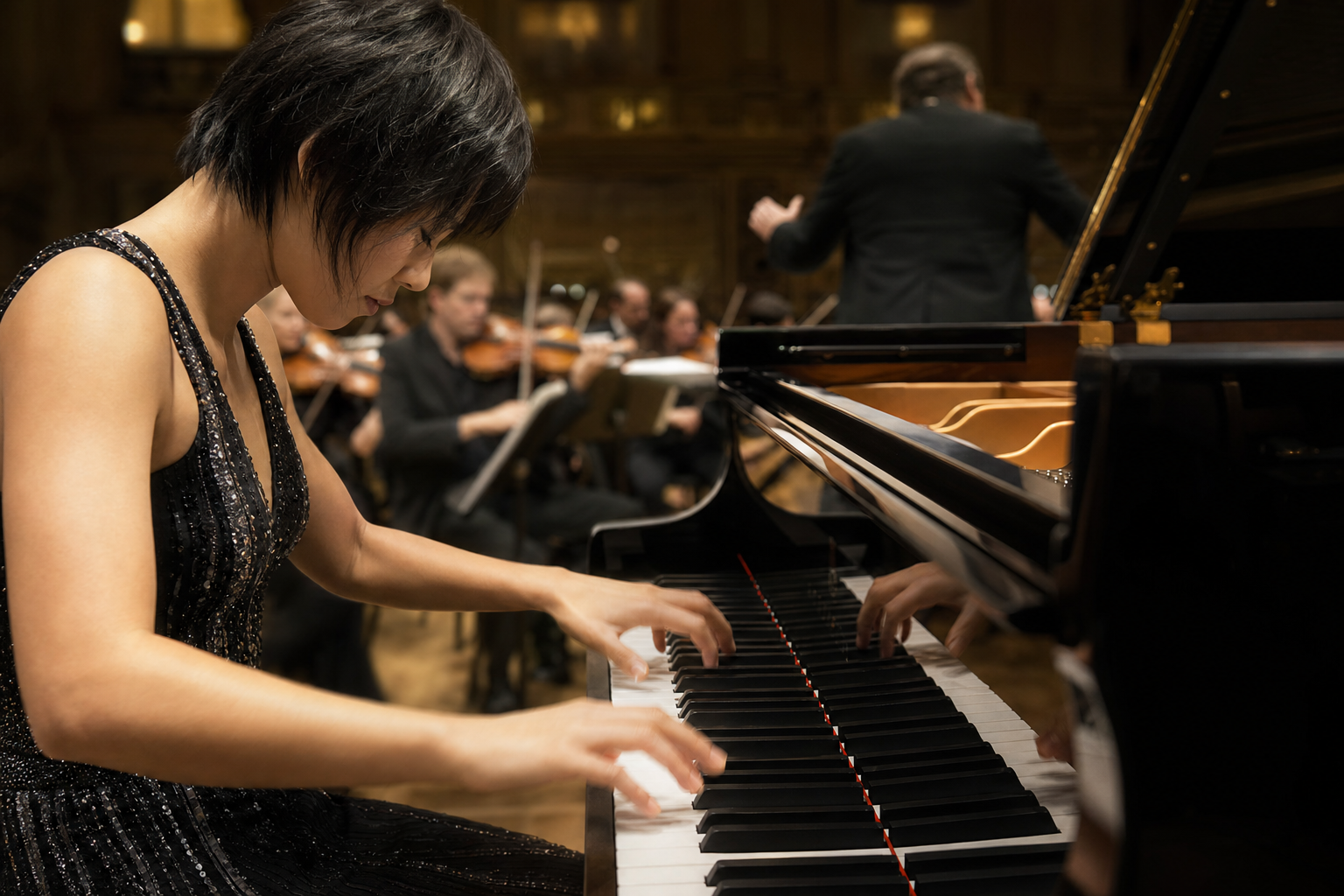
For students and adult pianists, the lesson is direct. A performance can feel free only when the craft underneath is exact. This is why WKMT’s wider classical piano study in London treats listening and technical work as one process. The hand learns pressure; the ear decides whether pressure has meaning.
How Yuja Sounds: A Listening Guide
Begin with tone. Wang’s sound is often bright, but brightness is not thinness. In good conditions she can make a treble line gleam without letting the bass become percussive noise. Listen for the instant before a large attack: the sound seems prepared, not thrown. That preparation is what allows very fast passages to carry shape.
Then listen to pedalling. In Ravel or Scriabin, some pianists use pedal to disguise harmonic difficulty. Wang often uses it as colouristic timing: a shimmer is released, then cleaned before the next harmonic event. The ear hears both atmosphere and edge. That is one reason her playing can sound modern even in Romantic repertoire.
Practice Insight
Adult learners should not imitate the speed first. Imitate the clarity of intention: decide which note carries the line, which note is colour, and which gesture must arrive without heaviness.
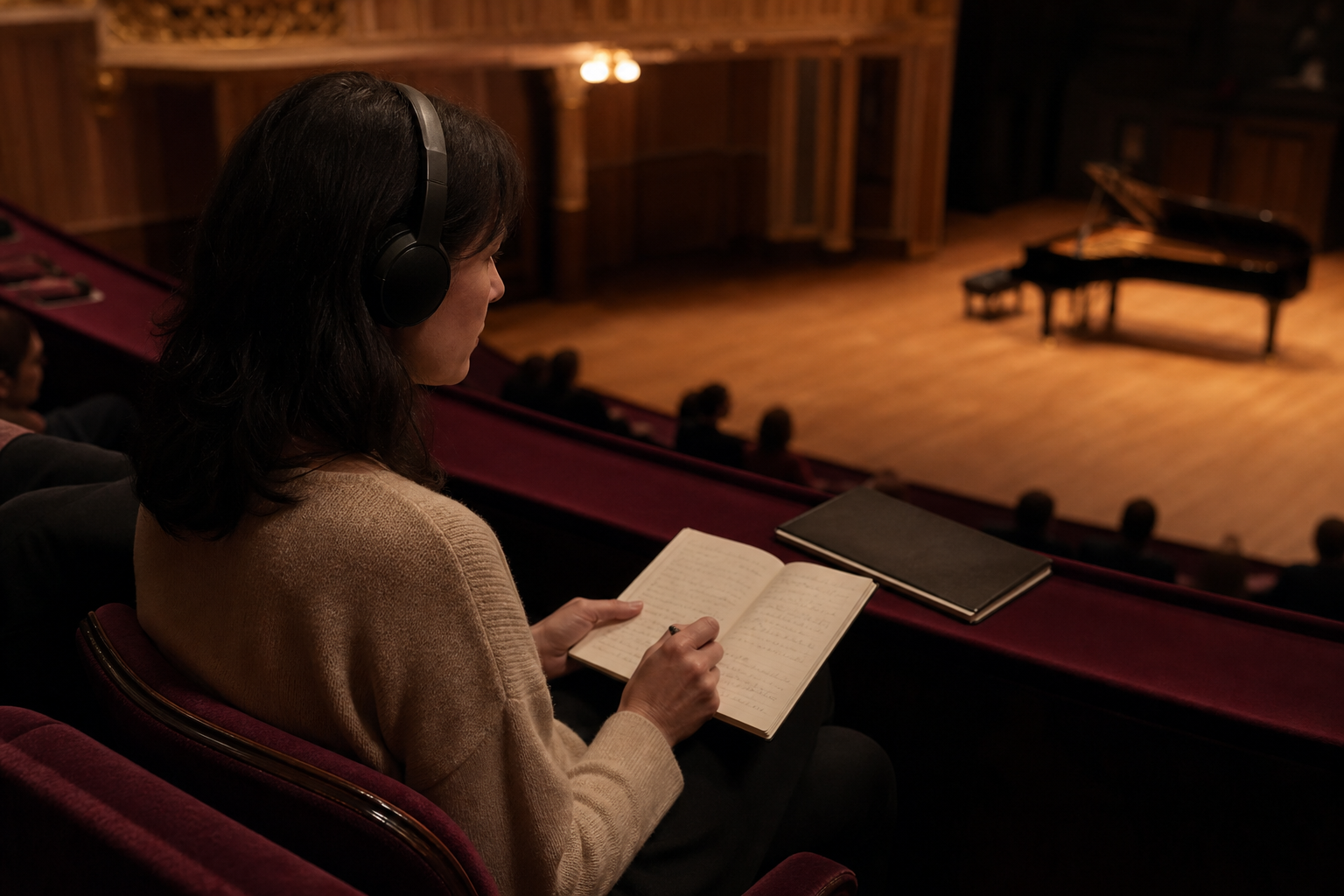
Five listening routes are especially useful. First, use a Rachmaninov concerto performance to hear how she balances mass and line. Second, choose Prokofiev’s Third Concerto for articulation and irony: notice how repeated-note figures speak as character, not mechanical display. Third, listen to Ravel for pedal colour and surface transparency. Fourth, approach Scriabin for harmonic perfume under precise finger control. Fifth, use Ligeti or another modern work to hear how rhythm can become architecture.
A listener who comes from the piano should also notice physical economy. The visual drama of performance can mislead; the real technical art is often in reducing unnecessary effort. Fast repeated figures stay alive because the body does not lock. Wide leaps work because the ear and arm prepare the destination before the hand arrives. This is the area where advanced students learn most from great performers: not the copy of a gesture, but the discipline that makes the gesture possible.
Yuja Wang in London: Performance History, Venues and Critical Reception
London has the right ecology for Wang’s artistry. The Royal Albert Hall rewards public projection and concerto spectacle; the Barbican and Southbank Centre reward structural concentration; Wigmore Hall, when relevant to a recital or chamber setting, rewards colour at close range. Each venue changes what the listener should prioritise.
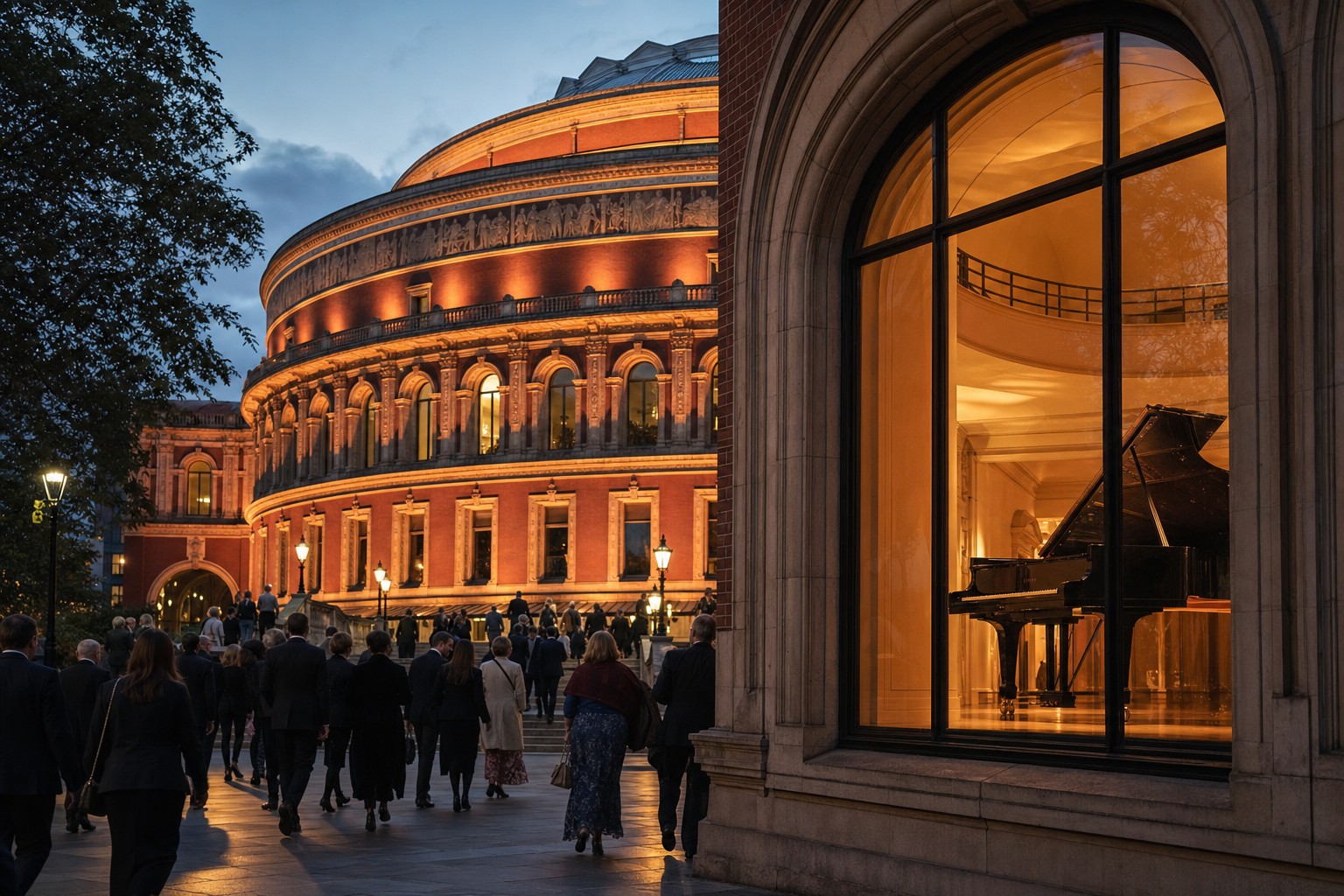
At the BBC Proms and Royal Albert Hall, the concerto listener should expect scale. In that room, a pianist must project through distance and air. The question is not whether the piano is loud enough, but whether its attacks and releases remain legible. At the Barbican, where London Symphony Orchestra programmes have often framed major international soloists, a more analytical listening mode helps: follow the exchange between piano and wind lines, or the way a conductor gives space before a piano entry. At Southbank Centre, the clearest listening often comes from balancing orchestral colour with the piano’s rhythmic bite.
Teacher’s Note
When listening in a large London hall, do not chase every note. Choose one parameter for a movement: bass line, orchestral balance, pedal clarity, tempo risk or phrase endings. You will hear more by narrowing your attention.
Critical writing on Wang often splits between musical analysis and public image. The better reviews attend to both without reducing the artistry to costume or persona. That balance is important. Stage image is part of the public event, but it should not replace questions of rhythm, colour, voicing and programme intelligence. For WKMT readers, the musical question remains the most durable one: what does a performance teach us about the piano?
Practicalities for London Audiences and Related Artists
For current dates, use official venue and artist listings first; time-sensitive concert pages were last checked on 5 July 2026. Large-hall concerto events can sell unevenly: the cheapest seats may give an excellent structural view but less piano detail, while premium stalls can favour impact over blend. For a concerto, side stalls or front circle often help the listener see communication between soloist and conductor. For a recital, choose clarity over glamour: a balanced mid-hall seat usually teaches the ear more.
Prepare with three short listening passes. First, hear the work once without reading. Second, read programme notes or a reliable label essay. Third, return to one movement and track the piano’s role: melody, percussion, orchestral partner, colour or antagonist. This is a simple way to turn concertgoing into musical education.
Check the official venue page, programme, conductor and orchestra. Avoid relying on resale snippets.
Choose one work and one parameter: colour, pulse, voicing or balance.
Compare one recorded performance. Ask what changed live: tempo, risk, tone or architecture.
Related artists help place Wang’s pianism. Martha Argerich is the obvious comparison for electricity and risk; Daniil Trifonov for poetic volatility; Lang Lang for public charisma; Igor Levit for intellectual programming; Hélène Grimaud for colour and philosophical profile. Comparisons should not flatten them into a ranking. They help listeners name what each pianist asks from the ear.
For serious piano study in London
If Wang’s playing sharpens your interest in colour, rhythm and interpretation, bring that listening into your own lessons. WKMT works with adult and advanced students who want concert listening to become practical musical growth.
Useful second steps on the WKMT site include advanced piano lessons in London, classical concerts in London by WKMT and the school’s London piano masterclasses. These links keep the article in the right place: cultural support for the homepage, not a replacement for WKMT’s main lesson page.
FAQ and Closing Perspective about Yuja Wang in London
What are the best Yuja Wang recordings to start with?
Begin with one Rachmaninov concerto performance, one Prokofiev concerto, one Ravel or Scriabin selection, and one modern work such as Ligeti. The point is range: singing line, rhythmic bite, colour and layered difficulty.
Is Yuja Wang mainly a virtuoso pianist?
Virtuosity is central, but it is not the whole story. Her strongest performances turn technical command into colour, formal tension and risk. Listen past speed and you hear decisions about balance, release and character.
How should London listeners prepare for a live performance?
Check the official venue page, listen once without reading, then return with a programme note. Choose one musical focus for the concert: tone, pedal, pulse, orchestral balance or phrase endings.
Yuja Wang matters because she forces the listener to refine judgement. The surface is brilliant, but the lasting value lies underneath: physical intelligence, colouristic nerve, disciplined risk and a refusal to make the piano sound merely polite.