
 TRIAL LESSON
Pianists, Piano Lessons
Arturo Benedetti Michelangeli in London: Precision, Debussy and the Art of Serious Piano Listening
Jun
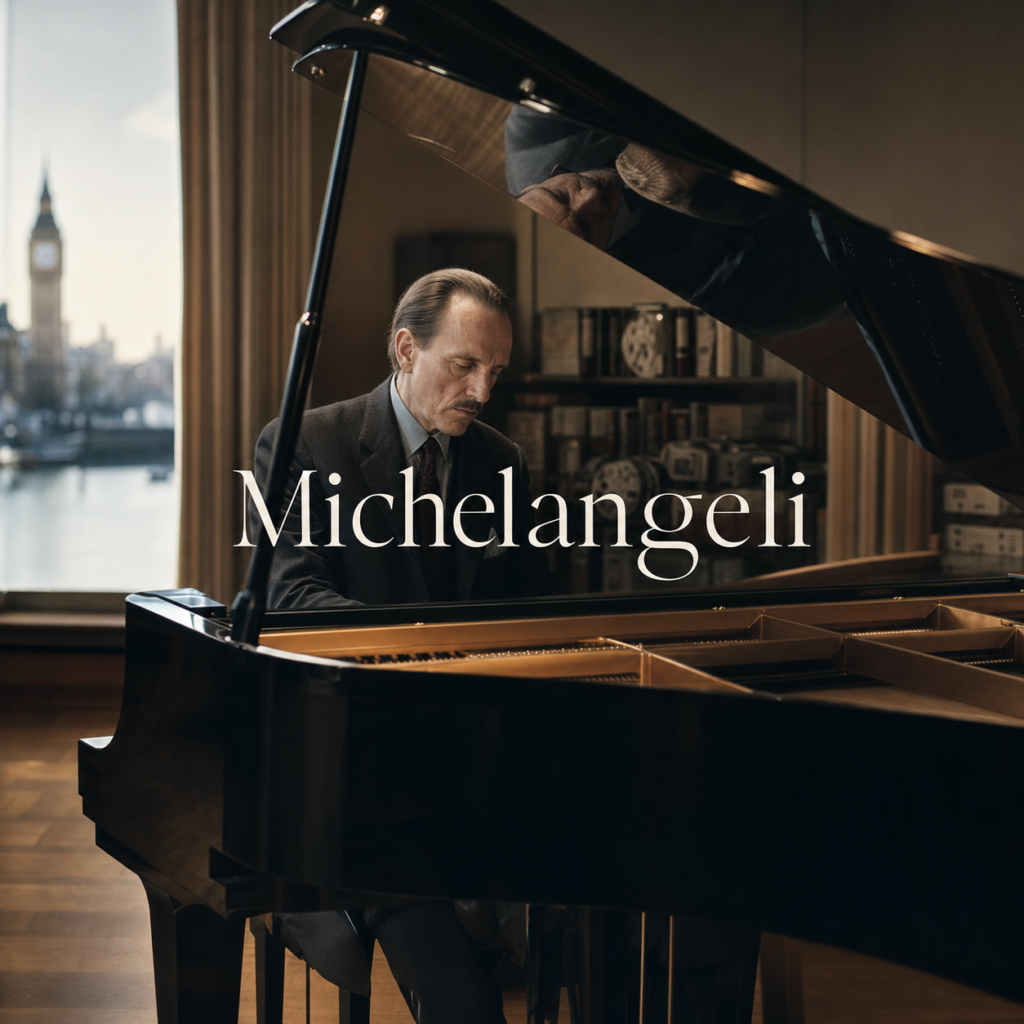
Arturo Benedetti Michelangeli in London
WKMT London piano culture
Arturo Benedetti Michelangeli in London: precision, colour and serious listening
Arturo Benedetti Michelangeli remains one of the pianists through whom serious listeners learn to hear the piano differently: with sharper attention to tone, silence, balance and the exact weight of every note.
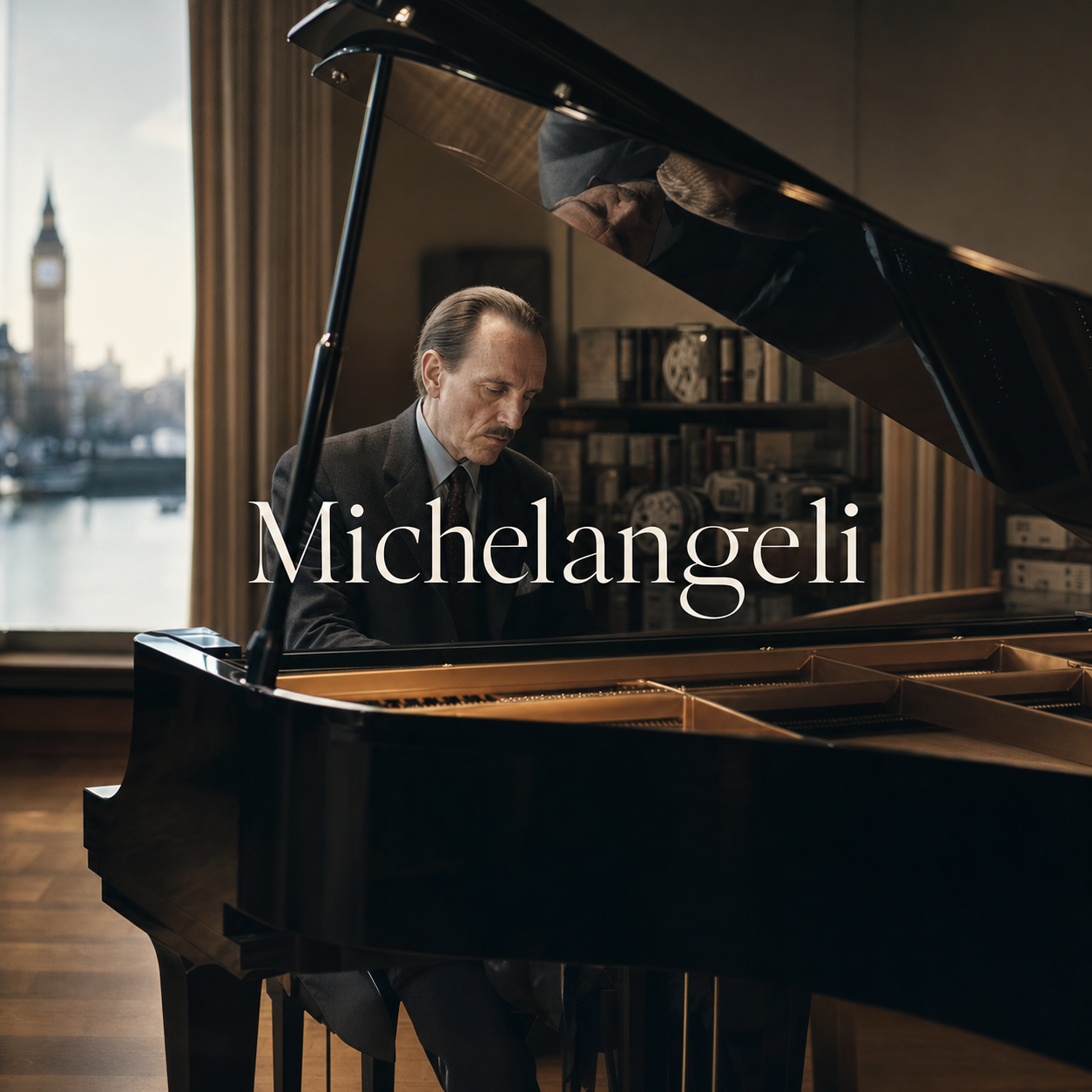
To search for Arturo Benedetti Michelangeli is to meet a paradox. The public memory of the Italian pianist is full of stories about cancellations, fastidious instruments and an almost forbidding reserve. Yet the musical evidence points to something more useful for today’s pianist: a performer who treated sound as an ethical matter. His best recordings ask the listener to stop consuming piano playing as speed and spectacle, and to begin hearing it as architecture, colour and responsibility.
That is why a London piano audience still has good reason to revisit him. Michelangeli’s first London appearance, recorded by the Queen Elisabeth Competition’s biographical archive, placed him with the London Symphony Orchestra at the Royal Albert Hall. The same archive notes the tension in the early reception: a critic was cool about the Franck, yet singled out his power, clarity, beauty of tone and exceptional legato. For a city built around high standards of listening, teaching and recital culture, that mixed response is precisely the interesting point.
At WKMT’s London piano studio, Michelangeli is valuable less as an idol than as a discipline. His career gives advanced listeners, adult learners and serious young pianists a way of asking better questions: what is the difference between clean and cold, controlled and lifeless, exact and truly beautiful?
The answer is not found by copying his reserve or reproducing his manner. It is found by listening to how little he wastes. A phrase enters with its harmonic purpose already prepared; a bass note supports without swelling; an inner voice can appear for a moment and then withdraw. This is why Michelangeli repays repeated listening. The first encounter often hears polish. The second begins to hear restraint. The third notices how much expressive weight is carried by proportion rather than by gesture.
Quick facts at a glance
Brescia, 5 January 1920
Milan Conservatory with Giovanni Anfossi
Seventh Prize, Queen Elisabeth piano competition
First prize at Geneva International Piano Competition
Royal Albert Hall, LSO, BBC and Royal Festival Hall associations
Debussy, Ravel, Chopin, Beethoven, Schumann, Brahms, Rachmaninov
Career overview and milestones
The Queen Elisabeth Competition lists Michelangeli as Seventh Prize laureate in the 1938 piano competition, a result that looks modest until one remembers the company: Emil Gilels won, Mary Johnstone, later Dame Moura Lympany, took second, and Jacob Flier took third. Its individual profile says Michelangeli studied violin as a child, began piano seriously around the age of ten at the Milan Conservatory and had earned his piano diploma by thirteen.
Warner Classics gives the familiar next step: in 1939 he won the Geneva International Piano Competition, where Alfred Cortot is associated with the phrase that a new Liszt had been born. That sentence can sound like publicity until one listens to the later recordings. Michelangeli did not play like a Lisztian showman in the crude sense. He played as if virtuosity was the minimum condition that allowed colour to become exact.
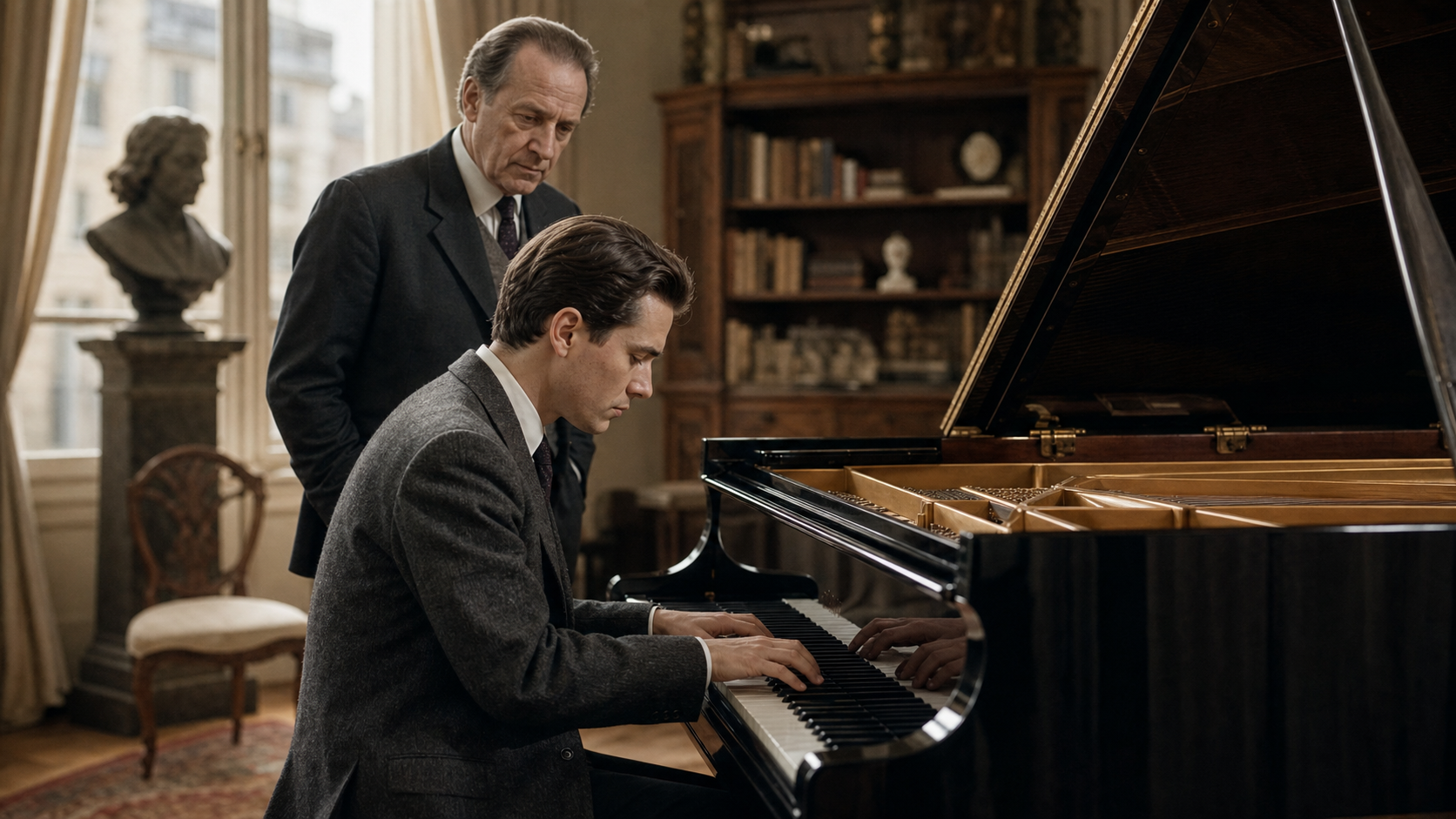
His teaching legacy was selective and demanding. Steinway notes that Michelangeli ran unconventional academies in Italy and later in Lugano, and names Martha Argerich and Maurizio Pollini among his notable students. Warner’s profile adds a sharper detail: serious estimates of his teaching stressed accuracy, sacredness of the score and the capacity to listen to one’s own playing. That is the point at which biography becomes practical for the modern pianist.
The popular caricature of Michelangeli as merely difficult misses this educational value. Perfectionism can become sterile when it is treated as a fear of mistakes. In Michelangeli’s case, the more interesting kind of perfectionism was a refusal to let the piano sound approximate. He reminds students that the instrument is never neutral. Each room, action, pedal response and register changes the musical problem. A London pianist moving between home practice, lesson room and recital hall can learn from that sensitivity without inheriting the anxiety around it.
“Michelangeli’s perfection is not a museum surface. It is a way of making the listener responsible for every colour the piano can produce.”
The Michelangeli sound: tone, technique and control
Michelangeli’s tone is often described through words such as crystalline, cold, luminous and severe. The danger is that these adjectives make him sound mechanical. The recordings suggest something subtler. His playing rarely courts warmth for its own sake; instead it shapes warmth through proportion. Chords are balanced from the inside. Pedal is clean without being dry. Melodic lines carry a vocal legato, but the surrounding texture stays disciplined.
Steinway’s profile points to the narrowness and intensity of his repertoire, with particular strength in Scarlatti, Beethoven, selected Chopin, Schumann, Brahms, Rachmaninov, Ravel and Debussy. That selectiveness matters. Michelangeli did not present himself as a pianist for all seasons. He cultivated a repertory in which touch, colour and structural control could be held to an almost punishing standard.
Debussy and Ravel are particularly revealing because they punish the wrong kind of clarity. Too little definition and the music turns decorative; too much definition and it loses atmosphere. Michelangeli’s playing sits close to the edge of that problem. It can sound cool because he refuses sentimental blur, yet the colours are rarely thin. The right hand does not simply sing over an accompaniment. It is placed inside a climate of resonance, with the left hand, pedal and register all shaping the listener’s sense of distance.
Teacher’s note
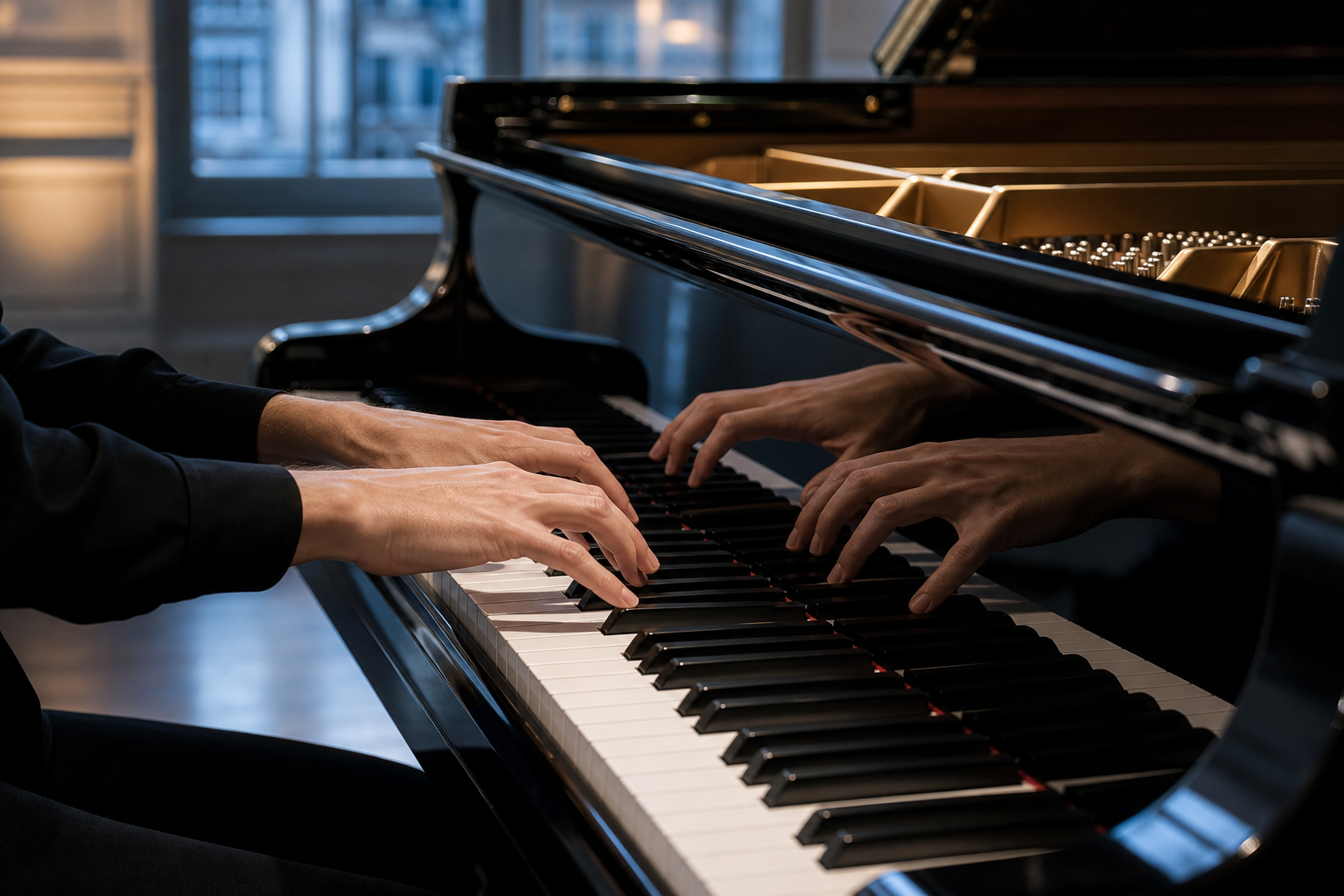
Adult learners often hear Michelangeli as “perfect” before they hear why. A better first question is: which note is carrying the phrase, and which notes are simply colouring it? That question can transform a practice session.
Definitive recordings and a focused listening guide
A useful Michelangeli listening path should be small. The aim is not to collect every release, but to hear the principles that make the playing distinctive. Warner Classics foregrounds his Debussy and Ravel recordings, while Deutsche Grammophon preserves a substantial official discography, including the later recorded legacy. Challenge Records also gives London listeners a special point of entry through The London Recordings Vol. 1, released in 2023 from restored BBC archive material.
Start with one work and listen twice. The first pass should be musical: follow the phrase, the drama, the surface beauty. The second pass should be technical: listen for bass length, pedal clearing, voicing at cadence points and the way a repeated figure changes weight. Michelangeli is not always the most affectionate pianist, but he is a formidable teacher of attention. Even disagreement with his choices can sharpen a pianist’s ear.
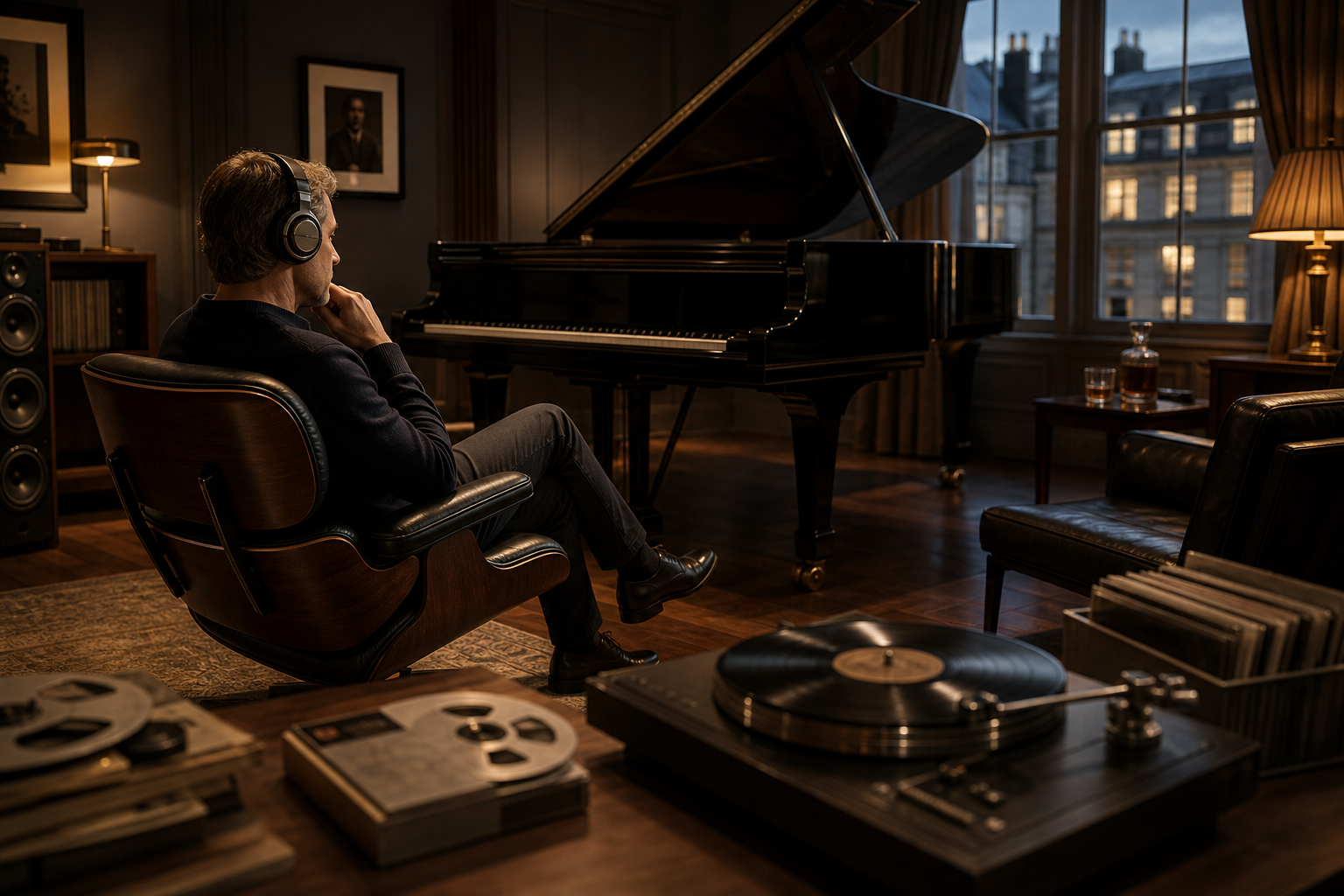
Michelangeli in London: performance, reception and archive memory
London is not a decorative detail in this article. The Queen Elisabeth Competition profile records his first London appearance with the London Symphony Orchestra at the Royal Albert Hall, with Liszt’s First Piano Concerto and Franck’s Variations symphoniques. It also preserves the useful contradiction of the review: the Franck was not warmly received, but the Liszt revealed unusual clarity and great power.
The London thread deepens in the Challenge Records release. Its notes describe historic BBC archive material, including a session in London studios on 30 June 1959 and a Royal Festival Hall evening on 8 April 1982 involving Michelangeli, the London Symphony Orchestra and Sergiu Celibidache. For a pianist so associated with perfectionism, the restoration story is fitting: the archive itself becomes part of the listening experience.
Those dates also help prevent a purely legendary view of the artist. Michelangeli was not simply a remote studio figure whose reputation floated above ordinary concert life. He entered the same institutional ecology that still shapes London’s classical music culture: orchestras, halls, broadcast archives, critics, teachers and demanding listeners. That makes him a useful subject for a London blog article, not because he belongs to London alone, but because London gives his art a concrete setting in which standards are tested in public.
Key listening point
When hearing Michelangeli in Ravel, attend to the second movement first. The slow line is the test: if the sound is too controlled, it becomes inert; if the control is right, time seems to widen.
For London students, this historical material also opens a local path. Concert culture, archive listening, London music events, specialist teaching and recorded self-review all belong together. A pianist who wants to understand touch needs more than scales. They need trained ears, the humility to compare recordings, and the patience to notice when the instrument is resisting rather than obeying.
A practical Michelangeli listening framework
Name the piano colour before judging the interpretation.
Ask which inner line is audible and which has been deliberately hidden.
Notice whether resonance clarifies harmony or merely blurs it.
Listen to the space after a phrase; Michelangeli often makes release part of the grammar.
Influence, legacy and why WKMT teachers study him
Michelangeli can be a difficult model because the surface of his playing is so complete. Imitating the surface is rarely helpful. The more valuable lesson is procedural: he teaches pianists to hear before they decorate, to balance before they dramatise, and to respect the score without making it lifeless.
This is especially useful for serious adults. In adult piano lessons at WKMT, the central challenge is often not motivation but refinement. Many adult learners already know what expressive playing should sound like. The hard part is turning that taste into technique: quieter thumbs, cleaner pedal changes, less anxious rubato, and a sound that carries without forcing.
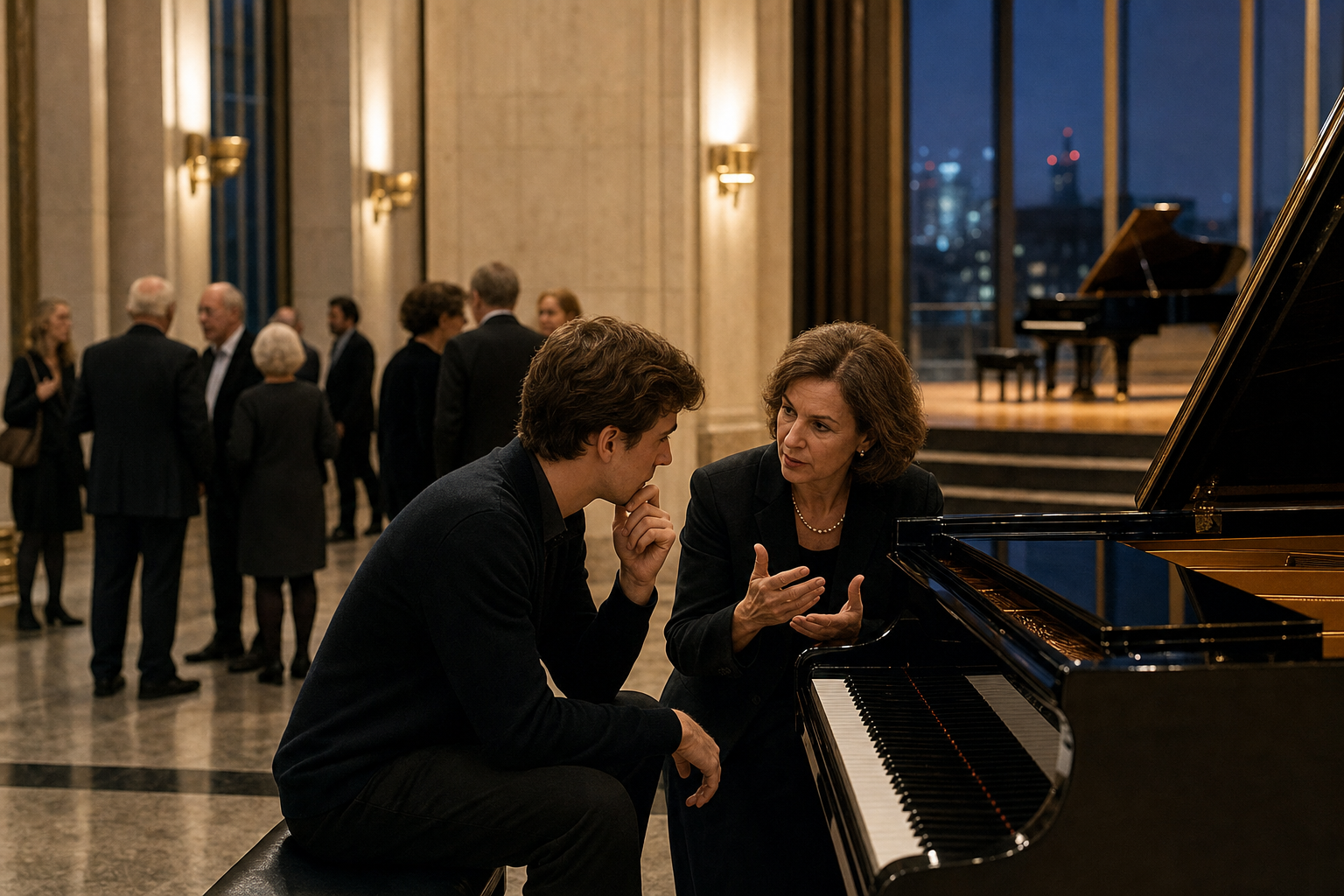
His legacy also connects naturally with piano masterclass study in London and with the habit of recording yourself playing the piano. Michelangeli’s example suggests that listening back is not vanity. It is the route by which a pianist discovers whether intention and sound have actually met.
For teachers, the caution is equally important. Michelangeli’s severity should not become a licence for harsh teaching. The productive lesson is exactness joined to imagination. A student can be asked for cleaner pedalling and still be encouraged to search for colour. They can be asked to slow down and still feel that music is moving forward. The standard is high, but the purpose is humane: to help the pianist make a sound that feels chosen.
Study classical piano with a more exact ear
WKMT’s London teaching is built for pianists who want culture, discipline and a practical route into better sound. Michelangeli’s art is severe, but the lesson is generous: learn to hear more, and the piano begins to answer differently.
Further reading and sources on Arturo Benedetti Michelangeli in London
These sources were last checked on 25 June 2026.
- Queen Elisabeth Competition, Piano 1938 laureates.
- Queen Elisabeth Competition, Arturo Benedetti Michelangeli laureate profile.
- Steinway & Sons artist profile: Arturo Benedetti Michelangeli.
- Warner Classics artist profile: Arturo Benedetti Michelangeli.
- Warner Classics, The Complete Warner Recordings.
- Deutsche Grammophon, Complete Recordings on Deutsche Grammophon.
- Challenge Records / The Lost Recordings, The London Recordings Vol. 1.