
 TRIAL LESSON
Pianists, Uncategorized
Emil Gilels in London: a listening guide to golden tone and Beethoven seriousness

Jun
Emil Gilels in London
WKMT serious listening guide
Emil Gilels in London: a listening guide to golden tone and Beethoven seriousness
Emil Gilels in London: a WKMT listening guide to golden tone, Beethoven, recordings and serious adult piano study.
Why Gilels Still Matters To London Listeners
Emil Gilels belongs to that small group of pianists whose recorded sound seems to enter a room before any biography is required. The usual shorthand is his golden tone, but the phrase is useful only if we hear what it contains: depth without heaviness, brilliance without hardness, and a sense that the piano is being made to speak in paragraphs rather than gestures.
For London listeners, Gilels is not merely a name from Soviet piano history. He appeared in the capital, broadcast for British audiences, and left recordings that still teach how Beethoven, Brahms, Grieg and Prokofiev can be shaped with breadth rather than display. A listener who comes to Gilels after Richter, Arrau or Horowitz quickly notices a different kind of authority. It is less theatrical, more architectural.
Essential Biography And Signature Repertoire
Emil Grigoryevich Gilels was born in Odessa in 1916 and trained first in the city’s musical environment before moving into the wider Soviet conservatoire world. He was still very young when competition success and public acclaim established him as one of the central pianists of his generation. Official biographies and reference accounts consistently place him among the defining Soviet artists of the twentieth century, alongside but distinct from Sviatoslav Richter.
His repertoire was wide, but the durable public image rests on Beethoven, Brahms, Mozart, Grieg, Prokofiev and selected Russian works. The recordings matter because they preserve a pianist who did not treat power as a theatrical event. Even in Prokofiev, the attack is controlled; in Brahms, inner voices are weighted with grave patience; in Beethoven, the line moves with structural purpose.
That is why Gilels remains useful to a London piano school. His playing invites a kind of adult study that is not about quick virtuoso imitation. It is about long-range hearing, disciplined tone and the capacity to let an interpretation feel inevitable.
The outline also explains why Gilels is a better subject than a simple list of famous pianists. His career passed through the pressures of Soviet musical institutions, wartime public performance, international touring and the increasingly powerful record industry. Those contexts shaped how listeners encountered him. The piano became both a concert instrument and a broadcast instrument; the artist had to project in large halls, survive close microphone scrutiny and preserve musical integrity under public expectation.
For students, this matters because the same repertoire can become superficial when separated from listening culture. Beethoven sonatas are not only examination or recital pieces. Brahms is not merely heavy writing. Prokofiev is not only attack and angular rhythm. Gilels lets the modern listener hear these composers through weight, patience and proportion.
Sound, Technique And Key Comparisons
To call Gilels a golden-toned pianist is accurate, but incomplete. The quality comes from the coordination of touch, voicing and time. Chords are often full without being blunt. Fast passages have a pearled surface, but they are never merely decorative. He can make a bass line feel orchestral while preserving the right hand’s singing edge.
Compared with Richter, Gilels often sounds less dangerous but more classical in outline. Richter can make the page feel newly exposed; Gilels tends to make the work feel deeply established. Compared with Arrau, he is usually leaner, less metaphysical in tempo, more concentrated on tensile structure. Such comparisons are useful only when they sharpen listening. They should not become a ranking exercise.
Even strong attacks retain a rounded edge; listen for the start of each sound.
The resonance supports harmony without blurring the line.
Large paragraphs feel built from the bass upward.
For a pianist studying in London, this is practical. Gilels shows that tone is not produced by beautiful intention alone. It emerges from a clear physical relationship with the key, a strict ear for balance, and the humility to let a phrase breathe at its own scale.
The lesson is especially important for adult pianists, who often return to the instrument with a mature ear but an impatient hand. Gilels offers a corrective. The hand can learn to move less theatrically; the ear can learn to wait; the phrase can be allowed to gather energy before release. Nothing in this requires copying his exact tempos or sonorities. The point is to borrow the priority order: first structure, then tone, then surface brilliance.
His Beethoven also teaches restraint in climactic writing. Many pianists make a climax by adding volume too early. Gilels often preserves headroom. He lets harmony, register and rhythm do part of the work, so the full sonority arrives as a consequence rather than an announcement. That kind of listening is central to high-level piano teaching because it connects analysis with touch.
Gilels In London: Concerts, Broadcasts And Reception
Publicly indexed archive references show Gilels within British listening culture across several decades. A Royal Festival Hall recital from 1967 survives in published release listings, including Beethoven, Prokofiev and other repertoire. BBC-related archive references also point to Maida Vale broadcast material from 1959. Proms material places him in the Royal Albert Hall orbit, including a 1979 appearance with the London Symphony Orchestra under Sir Colin Davis. These are the kinds of verified public markers that allow a London article to speak locally without inventing a mythology.
| Date | Publicly traceable context | Listening value |
|---|---|---|
| 1959 | BBC Maida Vale broadcast references | A studio lens on sound, balance and microphone-era pianism. |
| 1967 | Royal Festival Hall recital release listings | A London recital frame for Beethoven and Prokofiev listening. |
| 1979 | BBC Proms/LSO indexed concert context | Gilels as concerto artist in a major London public setting. |
Where contemporary press quotations are not easily accessible without paid archives, the responsible approach is restraint. Rather than fabricate review language, the better article uses the archival footprint and the recorded evidence. London’s role is not decoration; it is a way of placing Gilels before listeners who know the acoustics, institutions and habits of the city.
The Royal Festival Hall reference is particularly useful for modern listeners because the venue has long been associated with a clear, public style of piano listening: large enough for an international artist, intimate enough for detail to matter. A Gilels recital in that setting invites questions about projection, tempo breadth and how much tonal warmth survives in a dry or revealing acoustic. Those are not museum questions. They are live questions for any pianist preparing Beethoven in London today.
Broadcast culture adds a second layer. Studio and radio conditions expose a different pianist from the grand concert hall. They reduce the protective distance between performer and listener. In Gilels, that closeness often makes the tone seem even more disciplined because the musical line does not depend on spectacle. It holds under scrutiny.
The Gilels lesson is not simply to play beautifully; it is to make beauty answerable to structure.
Recordings And Listening Guide For Serious Listeners
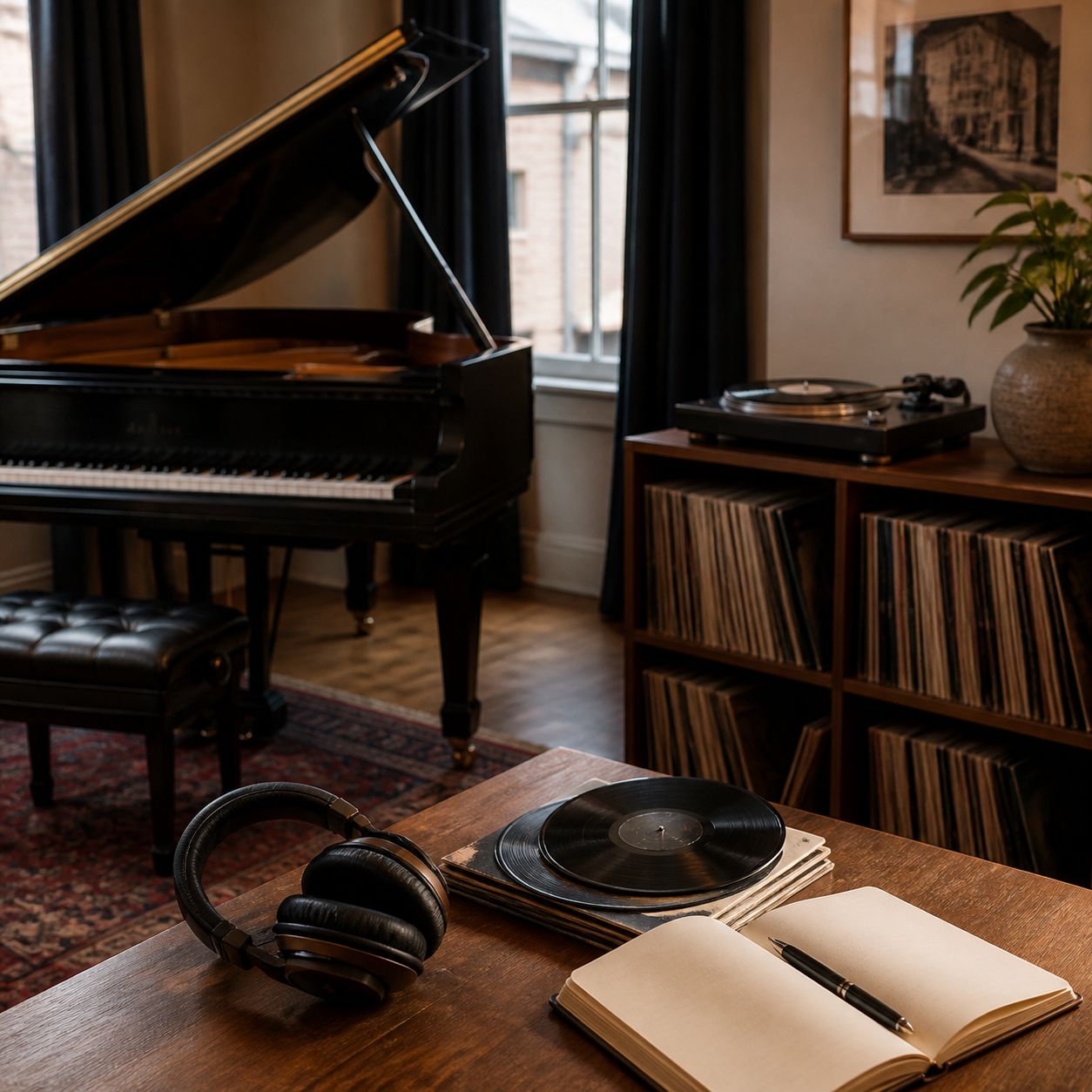
For a first route through Gilels, begin with Beethoven. His Deutsche Grammophon Beethoven sonata recordings are among the most widely available modern entry points, especially the late and middle-period sonatas. Then move to the Grieg Lyric Pieces for poetic compression, the Brahms concertos or chamber collaborations for weight, and Prokofiev for harder-edged brilliance.
| Recording area | Why listen | What to notice |
|---|---|---|
| Beethoven sonatas | Central Gilels territory; clear structure and noble tone. | Bass architecture, phrase length, non-percussive power. |
| Grieg Lyric Pieces | Miniatures reveal colour without sentimentality. | Pedal control, rubato proportion, soft tone variety. |
| Brahms | Gravitas and depth suit his broad musical temperament. | Inner voices, harmonic patience, refusal to rush climaxes. |
| Prokofiev | A sharper register of the same disciplined musicianship. | Motor rhythm that remains musical, not mechanical. |
A second route is to compare Gilels with another pianist in the same work. Try one Beethoven movement with Gilels, then Richter or Arrau. Keep the comparison narrow. Do not ask who is greater. Ask who gives more time to the bass, who risks silence, who clarifies the harmonic arrival, and who makes the transition feel most inevitable. This turns record listening into a form of musicianship.
Recording technology also deserves attention. Mid-century piano recordings can exaggerate brightness, soften bass detail or place the instrument in an artificial acoustic. Gilels’ reputation for golden sound survives across these conditions, which suggests that the quality was not only a microphone effect. Still, audiophile listeners should compare remasters carefully and avoid treating one issue as the whole truth. A dry transfer can reveal articulation; a warmer remaster can clarify breadth.
Legacy, Pedagogy And How To Listen
Gilels is a valuable model because he discourages impatience. His playing rarely gives the impression that the performer is trying to win the room by force. It asks the listener to hear proportion, and it asks the pianist to build tone from steadiness, balance and intention.
This is why the article naturally supports classical piano study in London. WKMT’s broader teaching authority is strengthened by articles that treat great pianists as serious musical evidence rather than as decorative celebrity names. The secondary adult link is equally natural: mature pianists often need listening frameworks more than lists of pieces. For adult learners, adult piano lessons at WKMT can turn this kind of listening into technical and interpretive decisions at the keyboard.
Gilels also helps teachers explain the difference between taste and discipline. Taste says a phrase should be beautiful. Discipline asks how the beauty is made audible: where the bass leans, how the pedal clears, how much time the cadence needs, and whether the melodic top line remains alive when the texture thickens. This is the level at which listening becomes a technical tool.
For a London adult learner, the practical outcome is simple. Take one recorded example into the lesson room. Sing the phrase shape away from the keyboard. Then play only the bass. Then add the upper line without middle texture. Gilels’ recordings encourage this patient separation of musical layers because his own playing makes those layers audible.
Deepen serious piano listening in London
WKMT teaches classical piano through tone, interpretation, disciplined technique and real musical understanding.
Practical London Resources And Sources on Emil Gilels in London
London listeners can use this article alongside the WKMT concerts page, the British Library sound collections, BBC Proms archive pages, record-label catalogues and public discography listings. Availability changes, so archive and catalogue details should be checked at the point of listening or purchase.
- Deutsche Grammophon artist and catalogue references for Emil Gilels.
- BBC Proms archive and concert references for London orchestral context.
- British Library sound collections guide for archive-listening context.
- Classical-music.com guide to Emil Gilels and recommended recordings.
- Wikipedia biographical overview for cross-checking dates and outline facts.
- WKMT page and post sitemaps for verified internal links.