
 TRIAL LESSON
Piano Lessons
Broadwood piano history in London: how a maker shaped modern technique for today’s pianists
Feb
Broadwood piano history Complete Guide
Broadwood piano history — how a London maker shaped modern technique
Broadwood piano history is, at heart, the story of how a louder, deeper, more sustaining instrument quietly trained the hands—and the imagination—of everyone who played it.
Origins — from Burkat Shudi to John Broadwood (1728–1800)
The early workshop and London context
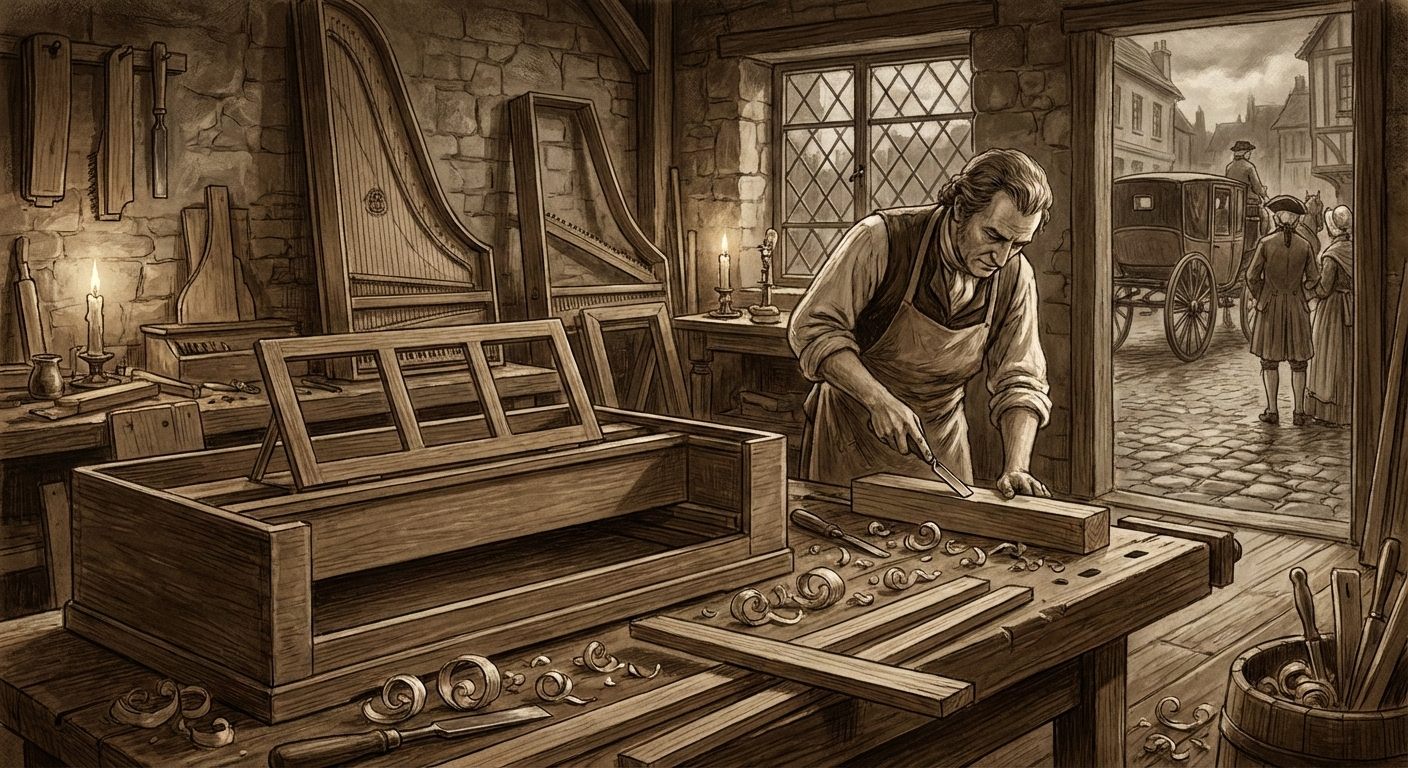
John Broadwood entered the London workshop of Burkat Shudi in 1761. Shudi, a Swiss harpsichord maker, had built a business whose lineage reached back to 1728. Broadwood married Shudi’s daughter in 1769, tying family life to trade life in the manner of serious 18th-century craft. When Shudi died in 1773, Broadwood took over the firm.
Royal connections were already part of the company’s public identity: the workshop held the Royal Warrant from 1742 onward, serving monarchs and the cultural elite. This mattered not just as marketing. A firm that maintains court instruments and the demands of high society develops habits of reliability, finish, and long-term service—precisely the qualities that later support export and reputation.
Transition from harpsichord to pianoforte
Broadwood’s first piano appeared in 1773, a straightforward “square” instrument following Johann Zumpe’s design. By 1781 the firm built its first grand piano. These early London instruments gained notice for a full, rich tone, often contrasted with the lighter Viennese models described in later technical writing. The continuity is the point: a harpsichord workshop’s finesse, re-aimed at the emerging pianoforte’s appetite for power, created a recognisably London tradition.
Broadwood’s succession of Shudi’s workshop created a continuous London line—from harpsichord craft to early grand-piano force—backed by courtly trust and demanding clientele.
Technical innovations and manufacturing methods
Action and mechanism advances (what changed in playability)
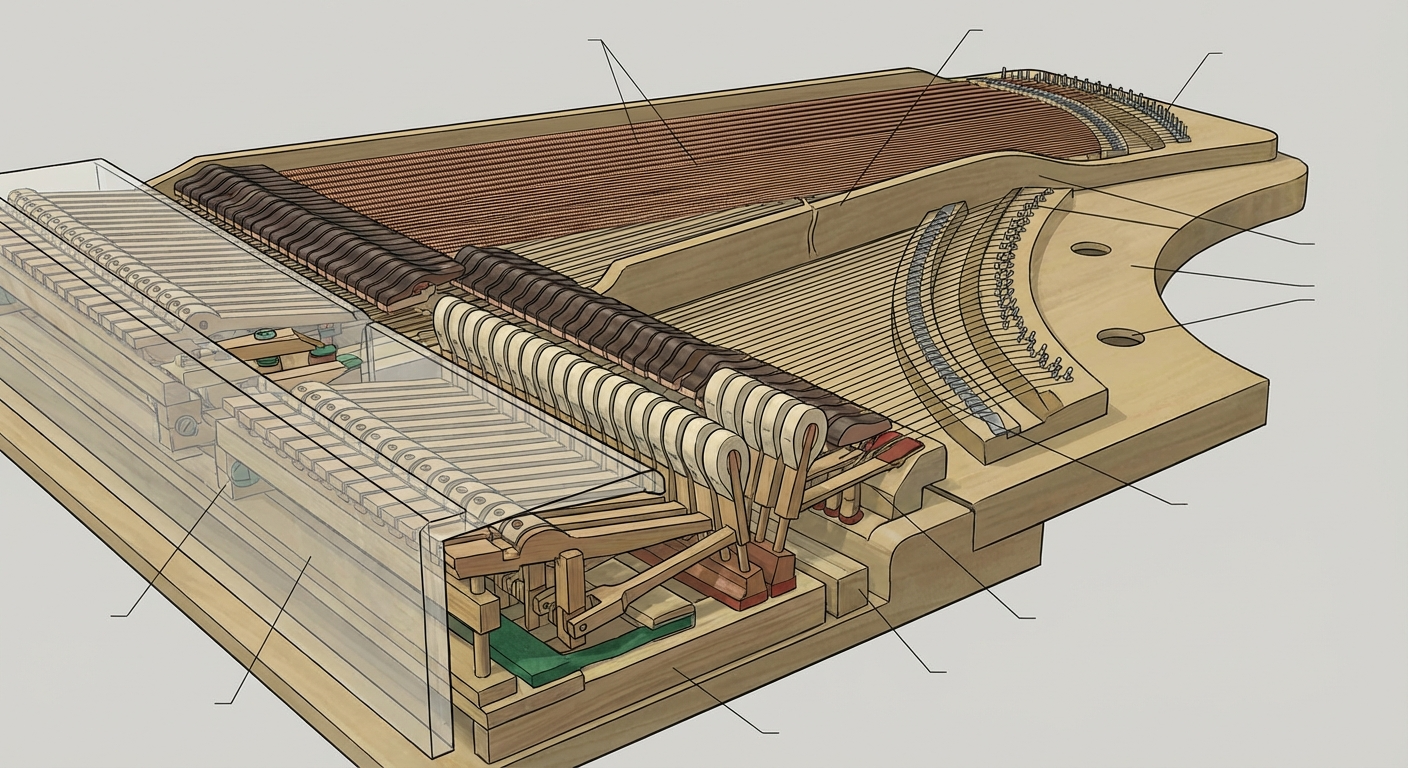
Broadwood and his sons introduced a sequence of changes that can be read as answers to one practical question: how to stabilise and control an instrument built for more sound. In 1783 Broadwood secured patents for a brass under-damper, intended to stabilise pedal action, and for an enhanced English double action mechanism. Later descriptions of the English grand action—adapted from Zumpe’s design—stress its pivoted escapement jack and its deeper, heavier touch: a mechanism that tends to reward weight and control with louder sustain, even if it sacrifices the most rapid repetition associated with other traditions.
It is worth stating this without romance. Broadwood actions did not incorporate the 1821 Erard-style double-escapement. Where rapid repeats were required, performers had to solve the problem in the fingers, not in the mechanism. The instrument asked for technique to rise to meet it.
Range expansion and keyboard design
If action shapes touch, compass shapes imagination. A significant chapter in broadwood piano history is the steady widening of the keyboard. Responding to the pianist Jan Ladislav Dussek, Broadwood extended the range of its grands: by 1794, they spanned six octaves (FF–f³). That expansion aligned with other structural choices: robust scaling, and specifications that often meant triple-stringing, with the lowest strings copper-wound to maximise resonance.
One can see the principle in surviving instruments. A 1797 Broadwood square piano is documented with 68 notes (FF–c⁴), leather-topped hammers, and double-strung bass. It is not simply “more notes”; it is more design attention given to the instrument’s lower end and its sustaining body, encouraging a bass that can underpin larger musical spans.
Materials, voicing and tonal choices in Broadwood pianos
Broadwood’s design decisions emphasised depth, stability, and long resonance. In 1788 the firm introduced the “divided bridge” on grands, separating bass and treble sections to bolster the bass tone. Combined with copper-wound low strings and heavier action geometry, the result was a sound that contemporary descriptions treat as rich and carrying—an English profile with real consequences for voicing, balance, and pedalling.
None of this is accidental. A piano designed for projection and sustain does not merely allow expressivity; it encourages a particular kind of musical rhetoric: longer lines, weightier climaxes, and a willingness to treat the bass as a resonant foundation rather than a lightly sketched accompaniment.
Divided bridge, extended compass, and heavy English action formed an English model that favoured power and dynamic breadth—even when it demanded more from the player’s control and repetition technique.
Broadwood and London’s musical life (18th–19th centuries)
Relationships with leading composers and performers
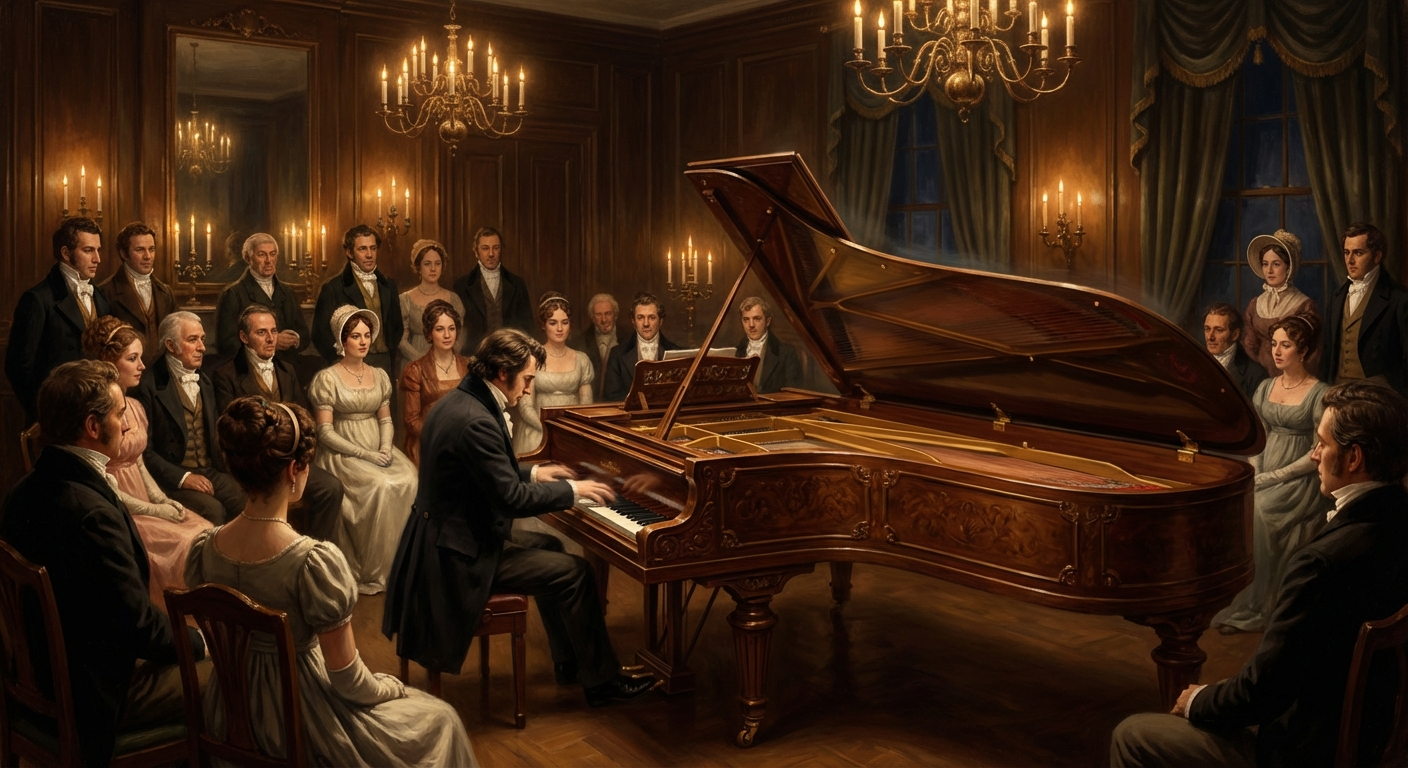
Broadwood pianos became part of London’s musical infrastructure, not just its private drawing rooms. Joseph Haydn played an 1794 Broadwood grand during his London visits of 1793–94. The instrument’s sustaining, wide-ranging sonority mattered to what he wrote: accounts note that his late sonatas were composed expressly for the English piano, exploiting its range and resonance.
The most famous international endorsement came in 1817, when Broadwood gifted Ludwig van Beethoven a six-octave London grand, equipped with separate damper pedals for treble and bass. Beethoven praised its tone, and the instrument is frequently linked—through its power and damper effects—to the more expansive sound world of his late writing. This is not a vague story of “inspiration”; it is a practical relationship between available mechanics and compositional choice.
Royal warrants, salons and concert life in London
Royal association remained visible on the instruments themselves. Many bore the label “By special appointment to His Majesty King George III”, a line that signals both patronage and a kind of public guarantee. The firm also exported to the continent and America; by 1799, John Jacob Astor was selling Broadwoods in New York.
Broadwood’s London presence—courtly, concert-facing, and export-ready—helped turn a local design philosophy into a European and American point of reference for composers and players.
Case studies — notable Broadwood instruments and owners
The Beethoven Broadwood (1817) — provenance and significance
A grand piano built in London in 1817 and sent by Thomas Broadwood to Beethoven remains the firm’s best-known individual instrument. Beethoven used it until his death in 1827. It later passed via the dealer C.A. Spina to Franz Liszt, who in 1887 donated it to the Hungarian National Museum.
John Jacob Astor’s Broadwood (1796) — the American thread
Broadwood’s international reach is unusually well illustrated by a single square piano: a 1796 instrument imported by the trader John Jacob Astor in 1799. He sold it that same year to a New York family, and it eventually reached Vassar College by 1898. It is a tidy provenance trail, and a reminder that English instruments were part of the early American domestic soundscape.
Sterndale Bennett’s Broadwood (1850) — a Victorian working instrument
Broadwood’s story did not stop with the Classical era. A concert grand built in 1850 (serial no. 17633) was lent by the company to composer-pianist Sir William Sterndale Bennett from 1850 to 1875. After Bennett’s death, it was acquired by the Museum of Music History (London) in 2003 and, as of 2022, displayed on loan at the Royal Academy of Music Museum.
These surviving instruments—Beethoven’s celebrated grand, Astor’s early American import, and Bennett’s Victorian concert piano—make Broadwood piano history concrete: objects with traceable lives, not abstract “influence”.
How Broadwood shaped technique — what pianists adapted, and why it matters now
Practice lens (using Broadwood piano history as technique study)
Approach Broadwood-era repertoire as a dialogue with resistance and sustain: weight-led attack, careful release, and pedalling that respects a bass designed to carry. The instrument’s demands clarify what “control” meant before later repetition aids.
Touch, articulation and repertoire implications
Broadwood pianos are often described in technical literature as having a deep-touch English action and a resonant, bell-like sonority. Those qualities pull technique in specific directions. The heavier touch encourages weight transfer and controlled attack; the sustaining body rewards legato illusions and long phrasing; the robust bass changes balance decisions in the left hand, particularly where Classical textures can otherwise sound thin on lighter actions.
Beethoven’s 1817 instrument adds another layer: independent damper-lift for bass and treble. Whatever a modern pianist thinks of such a system aesthetically, it invites clear experiments in resonance and clarity—prolonging sonority without blurring everything at once. That is not merely an engineering curiosity; it is a practical clue to pedalling choices in late repertoire linked to these instruments.
From square to grand: practical effects on technique
Even within the firm’s own output, the move from square models to grands is a story of expanding ambition. The square pianos show how Broadwood consolidated a reliable domestic instrument; the grands show how the same workshop pushed towards projection, range, and bass authority. For performers today, playing a restored Broadwood—square or grand—is a reminder that “Classical style” is not a single touch or a single sound. It is often an adaptation to the particular physics under the fingertips.
Broadwood’s heavier action, strong bass, and pedal options shaped phrasing and articulation by making sustain and dynamic breadth feel natural—while leaving fast repetition as a technical, not mechanical, achievement.
Manufacturing footprint — workshops, key figures, and business evolution
By the 19th century, Broadwood was no longer merely a respected maker; it was a major London manufacturer. In 1836 James Broadwood’s son Henry Fowler joined the business. By 1840 Prince Albert had a Broadwood square at Buckingham Palace. The Westminster factory on Horseferry Road produced approximately 2,500 pianos per year by 1842, employing hundreds of craftsmen and ranking among the largest London workshops of its era.
Broadwood is also presented as the world’s oldest continuous piano firm, now re-established in Grantham (UK). Whatever one makes of “continuity” as a concept, the historical arc is clear: a Soho-rooted craft workshop became an industrial-scale operation whose design ideas travelled far beyond London.
Broadwood’s influence was amplified by scale: a large factory could standardise an English approach to power and sustain, then export it as a practical norm.
Broadwood today — legacy, collections, restoration and replication
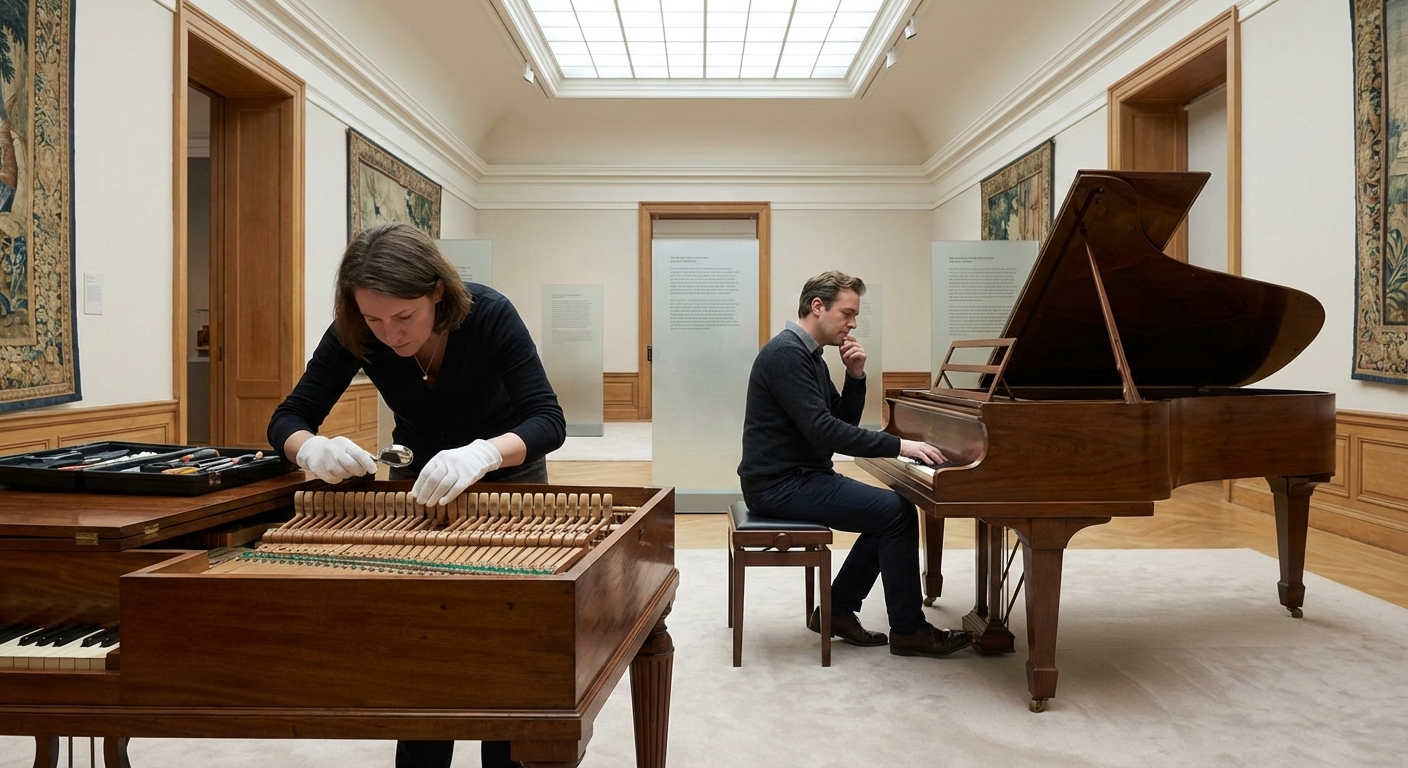
Historic design choices create modern responsibilities. Restorers working on Broadwoods tend to prioritise original features—leather hammer heads, iron tension braces, and period stringing decisions—to recreate authentic touch and tone. The goal is not nostalgia; it is accuracy. If the English action is heavier and the bass more fundamental than later expectations, then the repertoire linked to those instruments needs that resistance and resonance to speak in proportion.
For pianists, replicas and facsimiles also play a role in research and performance, offering a route into Broadwood-era sound without placing all wear on fragile originals. The point is consistent: broadwood piano history remains musically useful when it is treated as engineering with consequences, not merely heritage.
Visiting and research resources in London
London remains one of the most practical places to study Broadwood in context. The Victoria & Albert Museum (South Kensington) holds Broadwood instruments within its keyboard collection and is open daily, with later hours on Fridays (check the museum’s official site for current details). The Royal Academy of Music Museum exhibits historic UK pianos and, as noted above, has displayed the Sterndale Bennett Broadwood on loan (check opening hours before visiting). For archival research, the British Library (St Pancras) provides access to Broadwood-related materials such as letters and ledgers; its opening times vary by day and should be confirmed online.
If your interest is practical rather than purely historical, WKMT can help you take the next step with living experience: attend a concert series, join a masterclass, or enquire about our piano scholarship programme. For collectors and institutions, our London team can also advise on lessons, historical consultations, or instrument appraisals.
Conclusion: a London workshop that changed the way we play
Broadwood’s contribution was not a single invention but a coherent set of choices: heavier action, stronger bass architecture, extended range, and mechanisms designed for stability and projection. In London, those choices met a thriving musical life—royal patronage, public concerts, and visiting composers—and the results travelled outward, shaping writing and technique from Haydn’s late sonatas to Beethoven’s final works and beyond.
Broadwood piano history is therefore not merely a chapter in industrial craft. It is an explanation of why certain kinds of sound and certain kinds of touch came to feel natural—first in London, and then in the modern piano’s long shadow.
Explore Broadwood-era sound in modern London
To connect Broadwood piano history with your own playing, consider hearing period-informed repertoire in performance, studying pedalling and touch in masterclass settings, or discussing repertoire/technique questions with a London-based teacher.
Explore the WKMT site for concerts, masterclasses, and scholarship details, or enquire about lessons and consultations.
Sources on Broadwood Piano History
History of John Broadwood & Sons Pianos
Keyboard instrument – English Action, Mechanics, Sound | Britannica
John Broadwood & Sons – Square Piano – British – The Metropolitan Museum of Art
Broadwood & Son Grand Piano | National Museum of American History
The Sterndale Bennett Broadwood Grand Piano – Museum of Music History
Museum and Collections | Royal Academy of Music
Visit us – opening times, facilities, access – British Library