
 TRIAL LESSON
Piano Lessons
Hand Coordination Exercises on Piano in London: Gentle Practice for Mobility, Memory and Confidence
Jan
Hand Coordination Exercises Piano in London – Guide on London Piano Practice • Adults & Older Beginners
Hand Coordination Exercises on Piano in London: Gentle Practice for Mobility, Memory and Confidence
Hand Coordination Exercises for Piano — Gentle, Effective Practice (WKMT London)
Hand coordination is the secret sauce behind expressive piano playing, yet coordinating both hands can feel like patting your head and rubbing your stomach at the same time. For older beginners especially, tackling a hands-together piece may feel daunting—or physically uncomfortable. The good news is that coordination can be learned at any age if you treat it as a skill (not a test), and if you build it with calm, well-guided movement rather than punishing drills.
This article sets out what hand coordination actually is, why it matters for musical fluency and brain health, and how experienced teachers—including WKMT London’s faculty—build it through relaxed technique principles associated with the Scaramuzza tradition. You’ll also find a conceptual progression plan, common pitfalls (and how teachers fix them), and practical adaptations for older pianists (50+) who want to practise without strain.
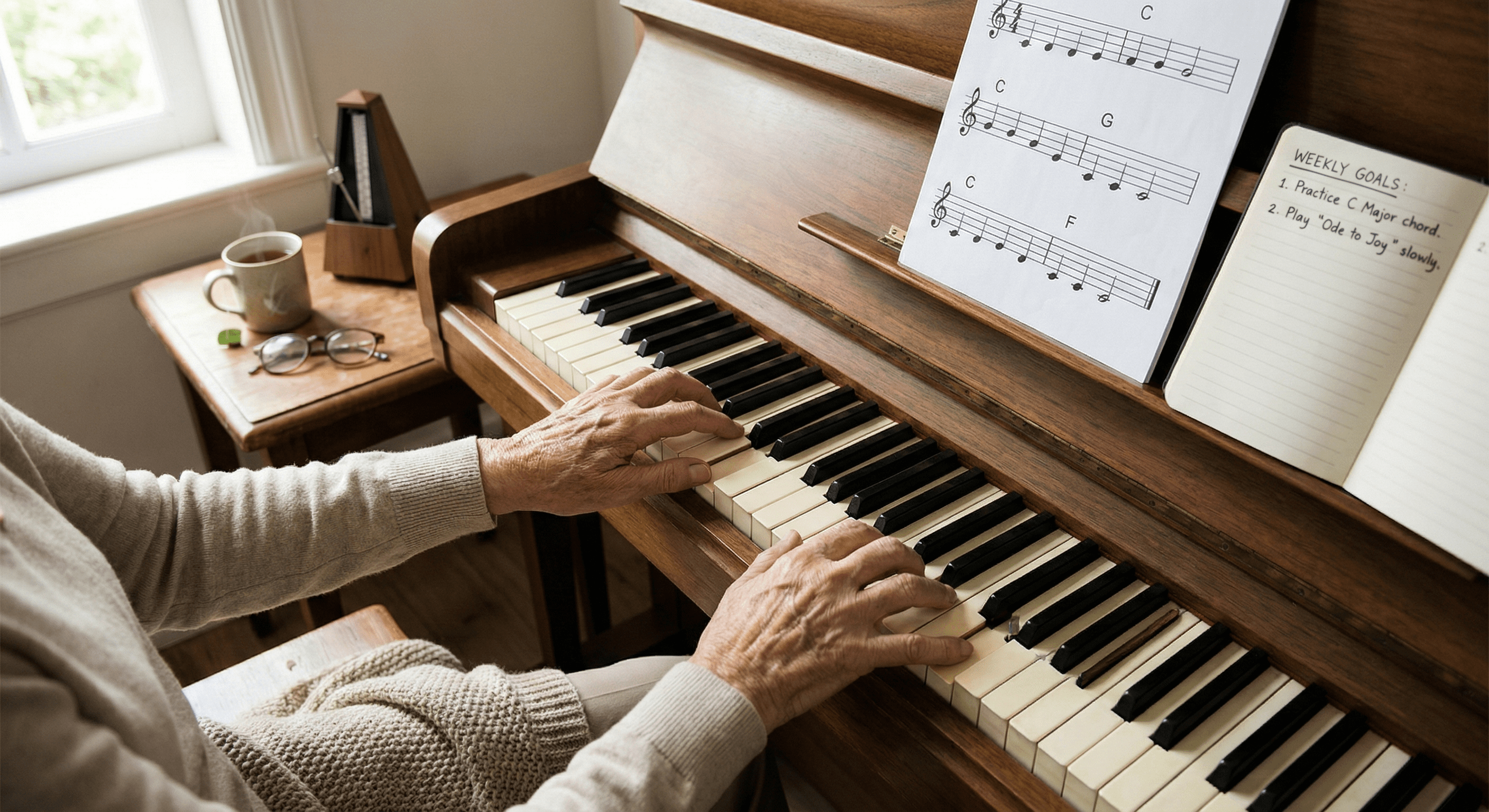
Coordination is timed, learnable movement. If your hands won’t cooperate yet, that’s not a verdict—it’s simply the next skill to build, slowly enough for the body to stay relaxed.
Why Hand Coordination Matters
Motor skills, independence and musical outcomes
Piano is unusual in what it asks of the body. Each hand may play different notes, rhythms and dynamics at the same time, often at speed, and usually while the ear is trying to judge balance and phrasing. This is why hand independence is not a luxury; it is the gateway to repertoire. Without it, a student quickly meets a ceiling: the left hand cannot accompany cleanly, the right hand cannot sing, and musical texture collapses into a polite struggle.
Yet coordination is not only a musical matter. Studies on older adults learning piano report improvements in fine motor control, hand dexterity and synchronisation skills, alongside broader cognitive effects linked to the brain’s capacity for neuroplastic change. Researchers describe piano playing as a demanding “dual-task” activity: two hands, rhythm, sound, and attention—all negotiated in real time. Done sensibly, it is an exercise for the hands and the mind.
Common coordination problems (timing, independence, uneven tone)
Most coordination issues look like “my hands won’t go together”, but the causes are usually specific. The common ones are straightforward:
- Timing drift: one hand rushes or drags against the other.
- Rhythm confusion: different rhythmic values (say, dotted figures or triplet feel) destabilise the pulse.
- Uneven tone: one hand dominates in volume, often because of tension or over-effort.
- Coordination collapse during leaps: the hands lose their “map” of the keyboard and arrive late—or not at all.
Notice how few of these are solved by “try harder”. They are solved by better cues, cleaner movement, and a calmer tempo that gives the brain time to organise itself.
When to seek professional advice (physio / teacher assessment)
Coordination practice should not hurt. If you feel sharp pain, numbness, swelling, or persistent symptoms in the wrist or fingers, stop and seek professional advice. Overuse injuries—tendonitis in particular—are common among musicians and can affect amateurs more than professionals, partly because the body is not conditioned yet. A teacher can correct mechanics and pacing; a physiotherapist or occupational therapist can assess tissue irritation, mobility restrictions, and recovery needs. The earlier you respond, the easier the path back to comfortable playing.
How Teachers Approach Coordination — Principles, Not Just Drills
Gradual complexity, rhythm anchors, posture/ergonomics, metronome use
When an adult beginner struggles with hands-together playing, a good teacher does not reach for a bag of mindless drills. They diagnose, simplify, and rebuild. Coordination is often restored by checking the basics: bench height, shoulder tension, wrist freedom, and whether the student is trying to “press” the instrument rather than play it.
At WKMT London, this is reinforced by a technique culture informed by the Scaramuzza method—an approach grounded in anatomy and natural motion. Rather than obsessing over isolated finger strength, the emphasis is on arm weight, forearm alignment, wrist flexibility, and gentle rotational movement where appropriate. In practice, this means distributing effort efficiently so that the hands are not fighting the body. Coordination improves as a by-product of freedom: when the mechanism is calm, the brain can do its work.
Piano Teachers also use rhythm anchors—counting aloud, stable pulse work, and metronome practice at a truly modest tempo—because coordination is, at heart, timed movement. There is a wry truth many pianists learn: anyone can play independently if it is slow enough. The teacher’s job is to find the speed at which accuracy becomes possible, then expand it without panic.
Measuring progress (milestones for months 1–6)
Adults tend to like evidence that effort is producing results. Teachers therefore measure progress in outcomes rather than bravado:
- Month 1: short hands-together passages at a slow, steady tempo without stopping.
- Months 2–3: a basic accompaniment pattern can run under a melody with consistent timing and controlled tone.
- Months 4–6: coordination holds during small leaps, dynamic shaping, and more varied rhythmic textures (without relying on the pedal to hide problems).
These are not deadlines. They are markers that allow practice to remain calm and realistic—especially for older learners balancing time, energy, and comfort.
Types of Coordination Work
Search for “hand coordination exercises piano” and you’ll find plenty of step-by-step patterns. Useful, sometimes. But the deeper question is what each type of coordination work trains, when it should be introduced, and how it transfers into real repertoire. That is where teachers earn their keep.
Alternating hands and rhythmic independence — what it trains and common variations
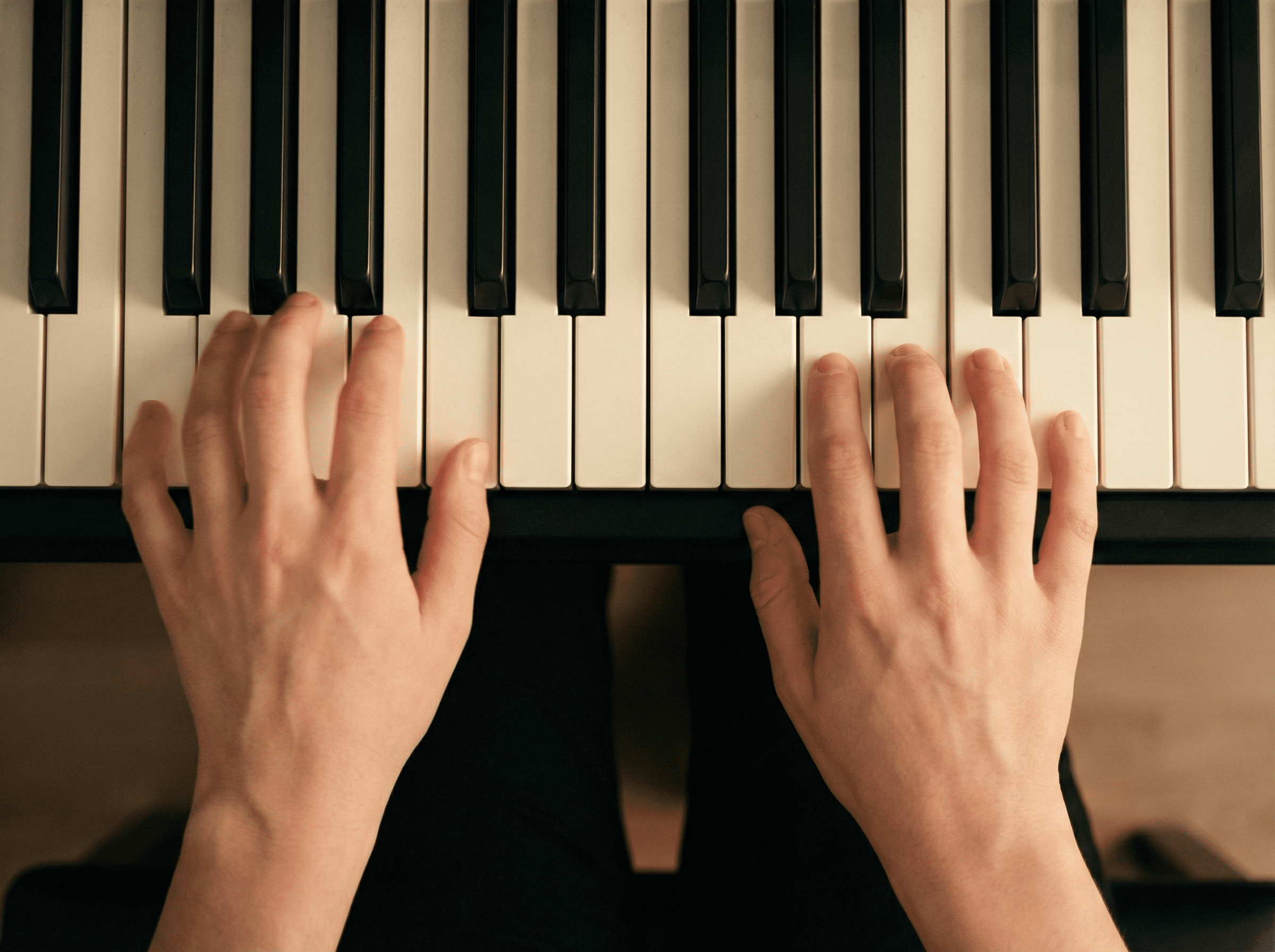
Alternating-hand work trains the brain to switch attention cleanly while preserving pulse. It is a bridge between one-hand certainty and two-hand complexity. Teachers often use “Right, Left, Together” tapping patterns away from the keyboard (on the fallboard or a table) to strip coordination back to timing. The principle is simple: if the body cannot organise the rhythm without pitch, it will not suddenly behave once you add notes.
These tasks also help with “role clarity”: knowing which hand leads, which supports, and where both must align. In music, the alignment points matter as much as the material between them.
Hands-together vs hands-separate strategies — pedagogic use cases
Hands-separate practice is not a beginner’s crutch; it is how pianists of every level reduce overload. Each hand learns notes, fingering, and the feeling of the movement without interference. Then hands-together work becomes an act of combining two familiar actions rather than inventing them under pressure.
The key is sequencing. A teacher will often insist on hands-separate fluency first, then introduce hands-together at a slower tempo than seems necessary. Done well, this approach feels almost too easy—and that is exactly the point. Coordination is not built by surviving chaos; it is built by repeating success until it becomes normal.
Broken chords / arpeggio patterns — musical contexts where they apply
Many coordination problems surface as soon as the left hand stops playing block chords and starts moving. Broken-chord accompaniment patterns (the Alberti bass is the classic example) require steadiness, evenness and a reliable sense of pulse while the right hand phrases a melody. They are common in Classical-era repertoire and in many popular-song accompaniments.
Teachers use these patterns because they reveal whether the student can keep a motor pattern running “in the background” while the other hand shapes something expressive. If the accompaniment becomes erratic, the issue is rarely “left hand weakness”; it is usually that the movement is not yet automatic, or the player is tensing to control it.
Polyrhythm and syncopation — when to introduce and why
Polyrhythms (two against three, for example) and syncopated coordination are often treated as party tricks. In truth, they are advanced timing problems that can be introduced gently once a student has a stable pulse and can count aloud without feeling faint. Teachers typically translate them into simple verbal cues or subdivision logic so the student has something concrete to hold on to, rather than mysticism.
Just as importantly, teachers choose the moment. Introduce complex rhythm too early and you get tension and discouragement; introduce it too late and the student’s repertoire becomes rhythmically bland. The right moment is when the student can be accurate slowly and remain physically relaxed.
Repertoire that builds coordination (Bach Two-Part Inventions, simplified studies, popular accompaniments)
The most persuasive coordination work is musical. Teachers often curate a pathway of pieces where each one introduces a slightly new coordination demand: simple melody with sparse bass notes, then chordal accompaniment, then broken chords, then two independent lines where the left hand occasionally takes thematic material.
Bach’s Two-Part Inventions have a special place here: they were designed to train clean two-part playing and genuine hand independence. Not every adult beginner needs to rush to Bach, but simplified contrapuntal textures (and carefully chosen studies) can teach the ear to separate layers—a musical skill as much as a physical one.
Alongside this, teachers often use familiar accompaniment patterns found in popular music to keep motivation intact. Adults practise more consistently when they understand the purpose and enjoy the sound they’re making. Coordination, after all, is easier to repeat when it feels like music rather than physiotherapy.
Proprioception and memory — the quiet coordination skills
Some of the most useful coordination gains are not visibly dramatic. Proprioception—your sense of where your hands are without looking—develops gradually as the keyboard becomes familiar. Teachers may occasionally use careful “no-looking” work on very easy material, or ask a student to memorise one hand so that attention can shift to the other without cognitive overload.
This is not theatrical. It is practical. The less visual micromanagement you need, the more mental bandwidth you have for rhythm, tone, and musical character.
Adapting Practice for Older Adults and Mobility Concerns
Ergonomics, warm-ups, pacing, and accessibility considerations
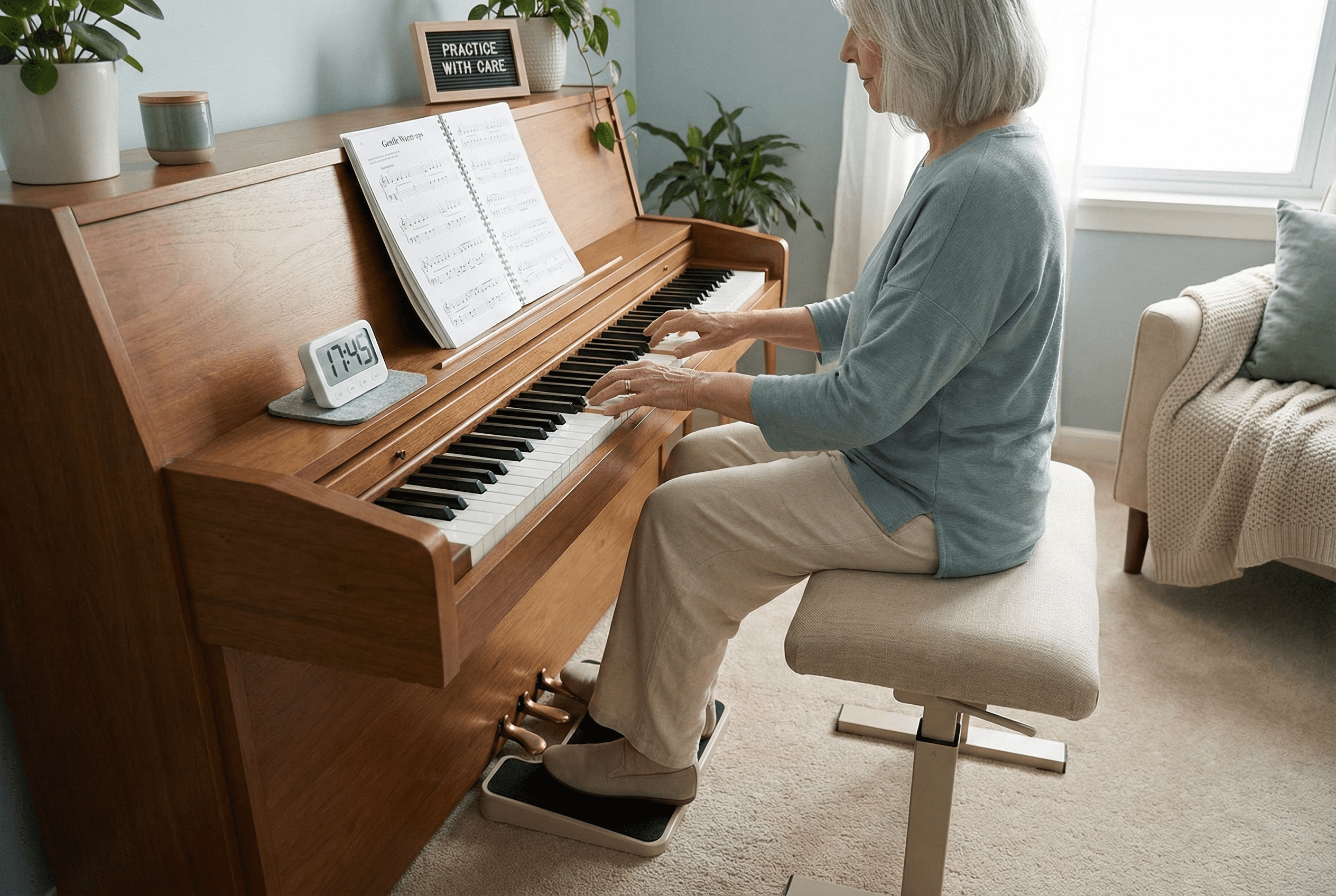
Older beginners (50s, 60s, 70s+) can make excellent progress in hand coordination, but the approach must respect recovery and comfort. Shorter, more frequent sessions tend to beat long, heroic ones. A pair of focused 15–20 minute sessions is often more productive than an hour of grinding that ends in fatigue and sloppy movement.
Warm-ups matter too. Gentle wrist rotations, relaxed five-note patterns, and simple chord shapes help blood flow and reduce the risk of strain. Medical advice aimed at musicians repeatedly comes back to the same principle: build gradually and avoid sudden increases in load.
Ergonomics can make or break coordination. Bench height should allow a neutral wrist and relaxed shoulders; good lighting prevents the body from contorting to see the score. If pedalling causes ankle or knee strain, pedal extenders can reduce unnecessary compensation elsewhere in the body. Coordination is hard enough without wrestling the furniture.
Collaborating with health professionals (PT/OT): what to communicate
If you work with a physiotherapist or occupational therapist, give them specifics: how long you practise, which movements cause symptoms (octave stretches, repeated arpeggios, prolonged chord work), and whether discomfort appears during or after playing. This information allows them to connect musical tasks to tissue load. Likewise, tell your teacher about any pain or stiffness, so they can adjust fingering choices, simplify textures temporarily, and correct tension patterns early.
Sample Progression Plan (Conceptual)
Below is a conceptual roadmap rather than a drill sheet. Think in phases, not weeks; older adults, in particular, should feel free to extend any stage.
Goals, session length, frequency, and how to escalate complexity safely
- Phase 1: Single-hand certainty — Each hand can play its material with a steady pulse, relaxed wrist, and consistent fingering. Sessions stay short and focused.
- Phase 2: Simple hands-together alignment — One hand plays a sparse role (held notes or basic chords) while the other plays a melody. The goal is calm synchronisation, not speed.
- Phase 3: Independence under control — A repeating accompaniment pattern runs evenly while the melody shapes phrase and dynamic. Work is broken into small musical units so success is repeatable.
- Phase 4: Range, balance, and rhythm variety — Coordination is tested by small leaps, changes in register, and more nuanced rhythmic textures. Expression is introduced even at slower tempos, because musical shaping is itself a coordination task.
The rule that keeps this safe is simple: complexity increases only when the body remains relaxed and timing remains stable. If either fails, you step back and rebuild.
Common Pitfalls and How Teachers Fix Them
Tension, ignoring rhythm, overreliance on the pedal
Most coordination problems are predictable, which is reassuring: if they’re common, they’re solvable.
- Excess tension — Teachers intervene early: posture reset, breathing, softer playing, and technique principles that use arm weight rather than finger force. Freedom is not an aesthetic; it is a mechanical requirement.
- Rhythm treated as optional — If the pulse is unstable, teachers return to counting, clapping, tapping, and metronome work. Often the hands are not “uncoordinated”; they are simply unanchored.
- Pedal as camouflage — Pedal can make a blurred performance feel smoother than it is. Teachers often reduce or remove it in early stages so timing and balance become honest, then reintroduce it when the hands can already coordinate cleanly.
And one quiet culprit: overpractice. If coordination worsens with repetition, fatigue has arrived. The fix is not discipline; it is rest.
Local Resources in London and How WKMT Helps
Lesson formats (in-person, online), accessibility, and teacher matching
If you’re learning in London, local support can accelerate coordination because it gives you feedback on the two things you cannot easily self-diagnose: movement quality and tension. WKMT (West Kensington Music Team) offers adult-focused piano lessons with a consistent technique culture informed by the Scaramuzza tradition, and a practical teaching style built around clear goals and manageable weekly tasks.
Lessons are available in person across WKMT’s London studios—West Kensington (40 Kensington Hall Gardens, W14 9LT), Camberwell (79 Brisbane St., SE5 7NJ), and near Bermondsey (242 Lucey Way, SE16 3UG)—as well as online. Many adult learners start with a trial lesson: a straightforward assessment of posture, rhythm habits, coordination bottlenecks, and the most efficient next steps.
If you value a careful, injury-aware approach to technique and a clear progression through repertoire, you can explore WKMT’s adult piano lessons in London and book a trial session.
FAQs
Can a 60- or 70-year-old really improve their piano hand coordination?
Yes. Adult brains retain meaningful neuroplasticity, and studies on older adults learning piano report improvements in fine motor control and hand synchronisation alongside cognitive benefits. The difference is not whether progress is possible, but how it is managed: calm pacing, ergonomic setup, short focused sessions, and a technique that avoids brute force.
How long does it take to play hands together comfortably?
It varies, but many beginners can manage a simple hands-together piece within a few weeks if the material is truly level-appropriate and practised slowly. More robust independence—different rhythms, more active left-hand patterns, reliable balance—tends to develop over months. The most dependable predictor is not talent, but consistency without strain.
What if I feel pain or stiffness when practising coordination?
Stop and assess. Mild fatigue can happen, especially early on, but sharp or persistent pain is a warning sign. Check for tension, shorten sessions, warm up gently, and avoid sudden increases in practice load. If symptoms recur, consult a medical professional (ideally someone familiar with musicians) and tell your teacher so technique and repertoire can be adapted while you recover.