
 TRIAL LESSON
Music Theory Resoucers
Tonic, Pre-Dominant and Dominant: The Three Harmonic Functions Every Pianist and Composer Should Know
Nov
Harmonic Functions in Music Complete Guide on Tonic, Pre-Dominant and Dominant
Tonic, Pre-Dominant and Dominant: The Three Harmonic Functions Every Pianist and Composer Should Know (with Piano Examples and exercises)
A practical guide for pianists and composers, inspired by William Caplin’s functional thinking on harmonic functions in music.
Introduction: Why Understanding Harmonic Functions in Music Matters
For pianists and composers alike, harmony is far more than a collection of chords — it is the very grammar through which music speaks. Every progression tells a story of stability, movement, and resolution. By understanding how each chord fulfils a function within that story, musicians gain control over both expression and structure.
At the keyboard, this knowledge helps pianists interpret phrasing and tension with clarity and sensitivity; for composers, it provides the blueprint for shaping musical architecture, guiding listeners through expectation and release. William Caplin’s theory of harmonic function — Tonic, Pre-Dominant, and Dominant — reveals how these three essential pillars interact to create coherence across styles, from Classical sonatas to jazz standards, film scores, and contemporary pop. Before exploring practical exercises, let us first define these functions and understand the role each plays in the harmonic language of tonal music.
This article applies that lens to the keyboard for pianists, and the writing desk for composers. Harmonic functions in Music Complete Guide.
1. Tonic Harmony (T)
Definition:
The Tonic function expresses stability, repose, and tonal identity. It establishes the home key and gives the listener a sense of arrival or rest. It neither creates nor demands motion, but rather defines where the music belongs harmonically.
Typical chords:
- I (major or minor) — the principal representative.
- vi (submediant) — shares two common tones with I, often prolonging the tonic area.
- iii (mediant) — a weaker substitute, sometimes prolongational.
Functional role:
- Begins and ends most tonal phrases or sections.
- Prolonged through repetition or substitution (I–vi–I, I–iii–I).
- In performance, it feels calm, centred, and resolved.
- In composition, it provides identity and closure to phrases.
Roman numeral examples:
C major → I = C, vi = Am, iii = Em
2. Pre-Dominant Harmony (PD)
Definition:
The Pre-Dominant function prepares the approach to the dominant. It introduces contrast and a sense of forward direction, bridging the stability of the tonic and the tension of the dominant. Harmonies in this group create expectation but not yet resolution.
Typical chords:
- ii (supertonic) — the most common PD, often leading directly to V.
- IV (subdominant) — broad, open preparation for motion.
- iv (minor subdominant) — a borrowed colour from the parallel minor, darker in tone.
- ♭II (Neapolitan) — a chromatic PD, usually in first inversion.
- V/V — the dominant of the dominant, heightening tension.
Functional role:
- Acts as a connector or preparatory harmony.
- Intensifies the harmonic rhythm, leading the listener toward the dominant.
- Often appears before cadences (e.g., ii–V–I or IV–V–I).
- In performance, it sounds expectant; in composition, it builds tension and contrast.
Roman numeral examples:
C major → IV = F, ii = Dm, iv = Fm, ♭II = D♭, V/V = D major
3. Dominant Harmony (D)
Definition:
The Dominant function embodies tension and resolution. It leads strongly back to the tonic through the presence of the leading tone (7th degree), which naturally resolves upward by a semitone. This function represents the point of maximum harmonic energy before release.
Typical chords:
- V (dominant triad) — purest form of tension.
- V7 (dominant seventh) — adds a fourth factor (the 7th) that resolves downward, intensifying pull toward I.
- vii° (diminished) — shares leading-tone quality, often used in first inversion (vii°6).
- V/V — dominant of the dominant; creates secondary tension.
- iii (mediant) — occasionally used as a substitute when V is avoided (e.g., V–iii–vi).
Functional role:
- Creates drive and climax within a phrase.
- Precedes cadential resolutions (V–I, V7–I, vii°6–I).
- In performance, it feels unstable and forward-moving; in composition, it culminates and resolves energy.
Roman numeral examples:
C major → V = G, V7 = G7, vii° = Bdim, V/V = D, iii = Em
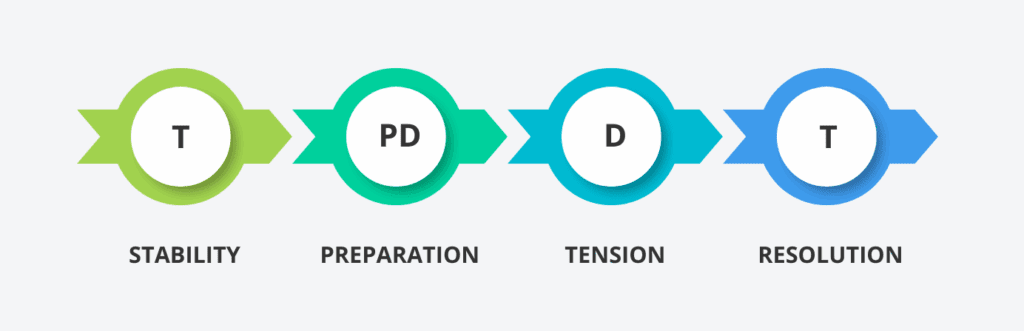
| Function | Definition | Typical Chords | Role / Effect |
| Tonic (T) | The point of rest and tonal centre represents stability and resolution. | I, vi, iii | Establishes home key; sense of peace and closure. |
| Pre-Dominant (PD) | The bridge between tonic and dominant; prepares tension and motion. | IV, ii, iv, ♭II, V/V | Builds anticipation and harmonic direction. |
| Dominant (D) | The source of harmonic tension that seeks resolution to tonic. | V, V7, vii°, V/V | Drives the phrase to its cadence; climax and release. |
Three Harmonic Functions in Music in Detail
Tonic Function
The Tonic represents stability, identity, and recognition. It anchors the listener’s sense of key.
In Caplin’s syntax, it often appears in the presentation phrase or at the end of a cadence.
The Tonic function is represented most strongly by the Tonic chord. Then, the second would be the SubMediant (vi) and in some cases the iii or Mediant can serve as well.
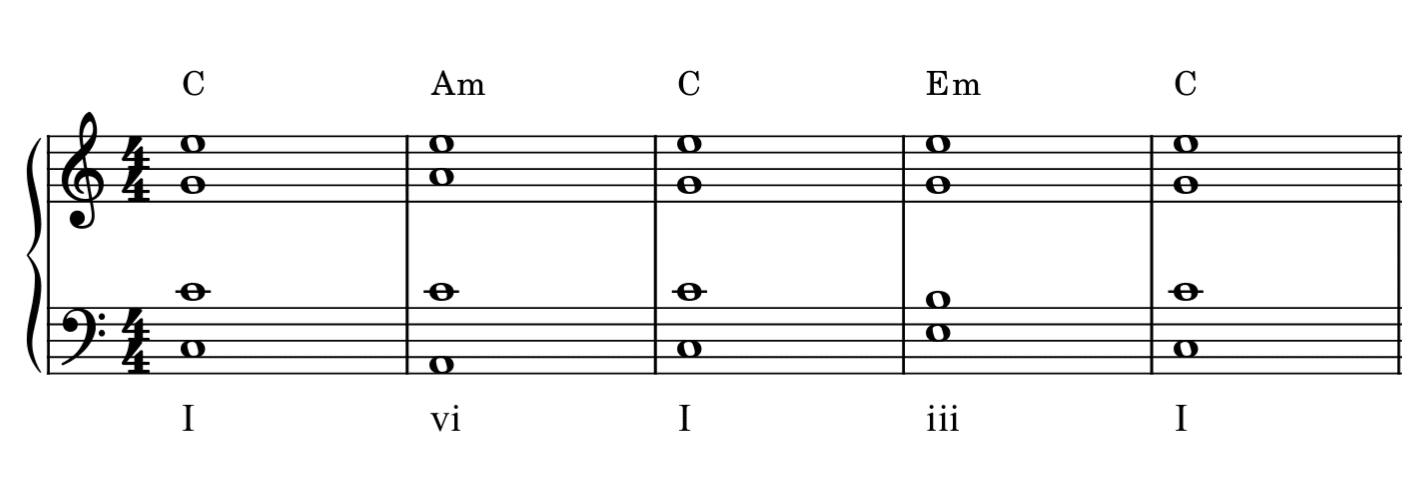
Here are some examples in Major Mode of Tonic harmonies in C major:
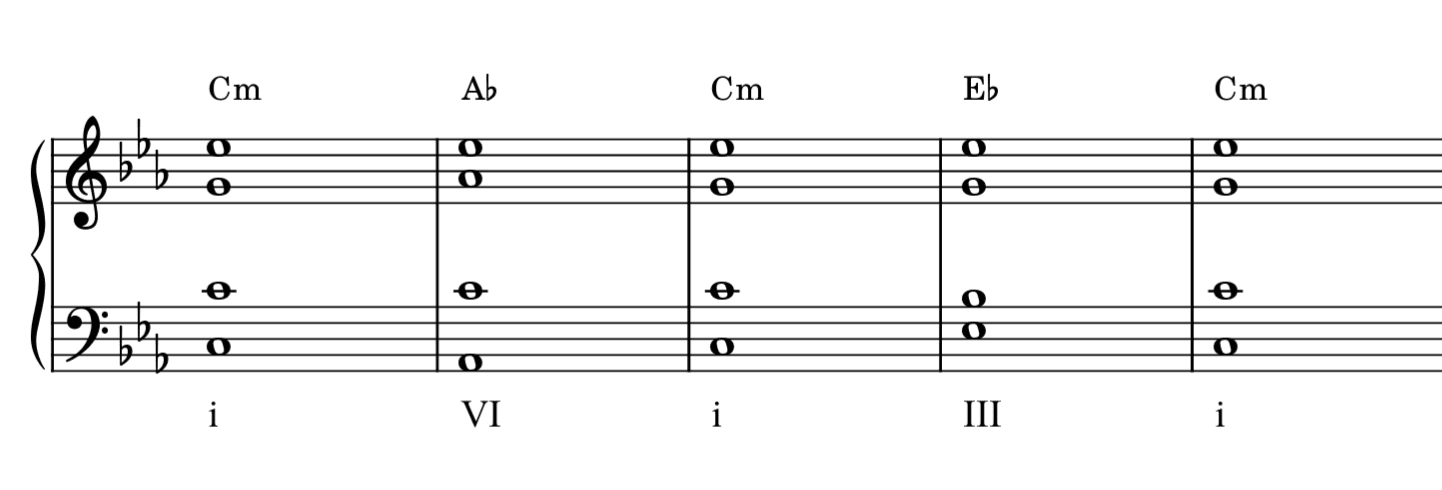
And now in C minor mode:
Examples For Pianists
How can we apply these examples to the piano? Keyboard harmony allows us to apply the concepts to the practicality of the instrument. For example, Tonic harmonies can be played on the piano as follows:
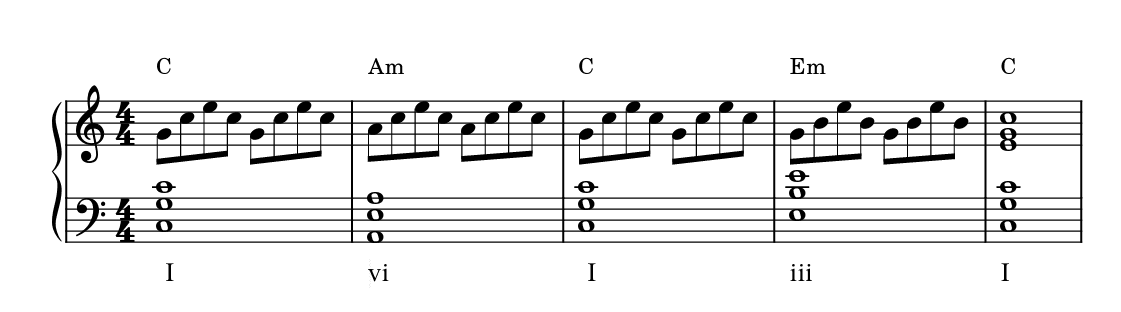
- C Major Example: I-vi-I-iii-I
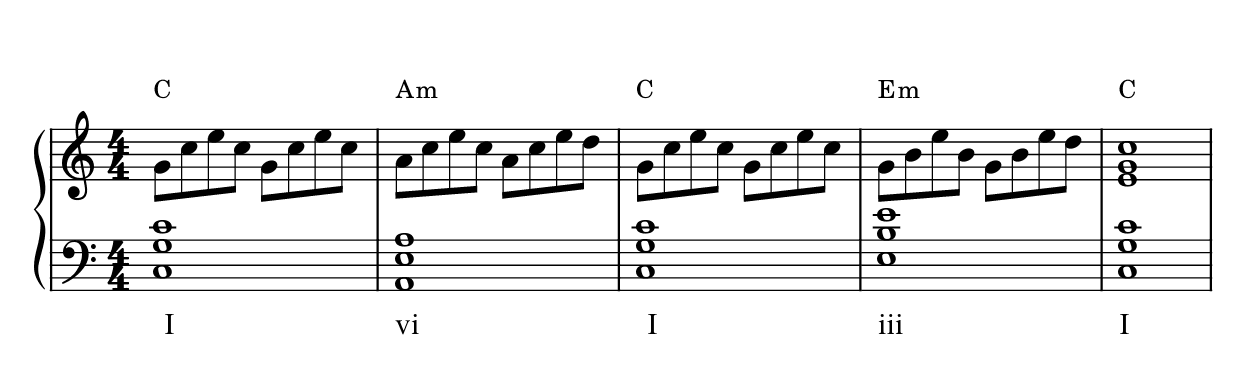
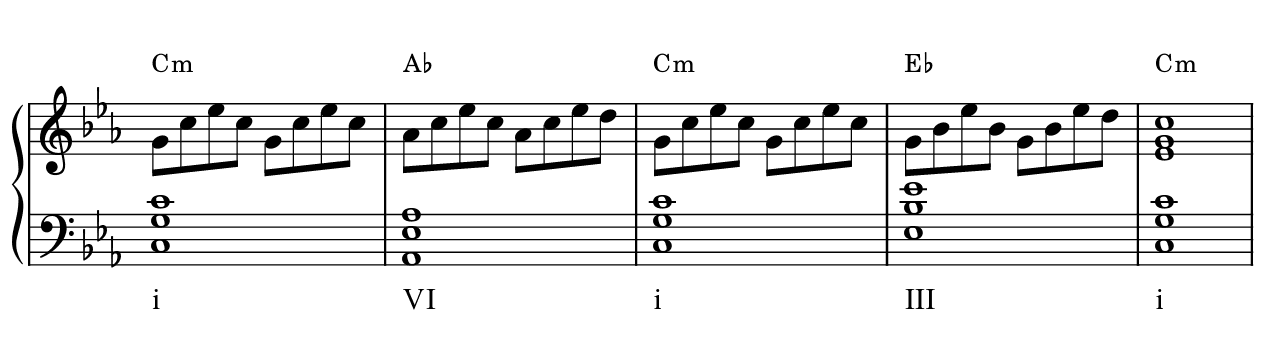
In the example above, there is a pattern on the left hand (from low to high) the root of the chord, the fifth and the root again) this pattern is idiomatic to the piano, while the right hand expresses the harmony through an arpeggiated pattern. Notice that the notes of the chords are designed not to jump from chord to chord, but to smoothly connect keeping the repeated notes on the same voice (the same pitch) adjusting the notes which don’t repeat as near as possible; this is called “Voice Leading”. We consider every note of the chord as voices. We can imagine every note on the piano as a voice singing each note.
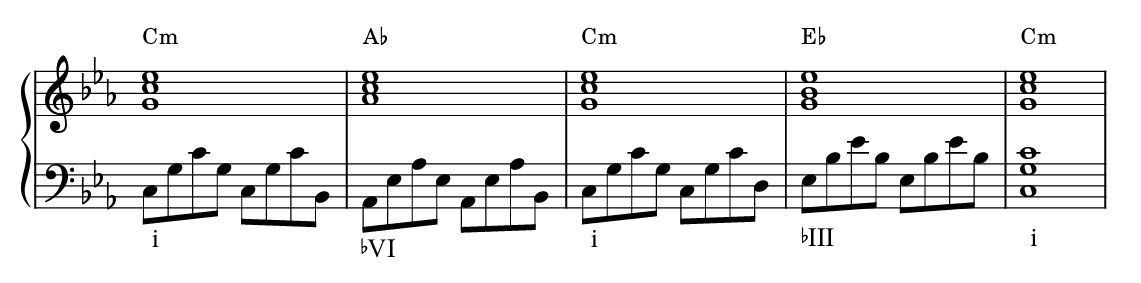
- C Major Example: i – ♭VI – i – ♭III – i
Examples for Composers
How to apply it compositionally:
- State your motive over I or its substitutes (vi, iii).
- Prolong the tonic to form unity before introducing any contrast.
- Avoid introducing strong leading tones (B → C) or subdominant pull (F → E) too soon, or you will imply motion away from home.
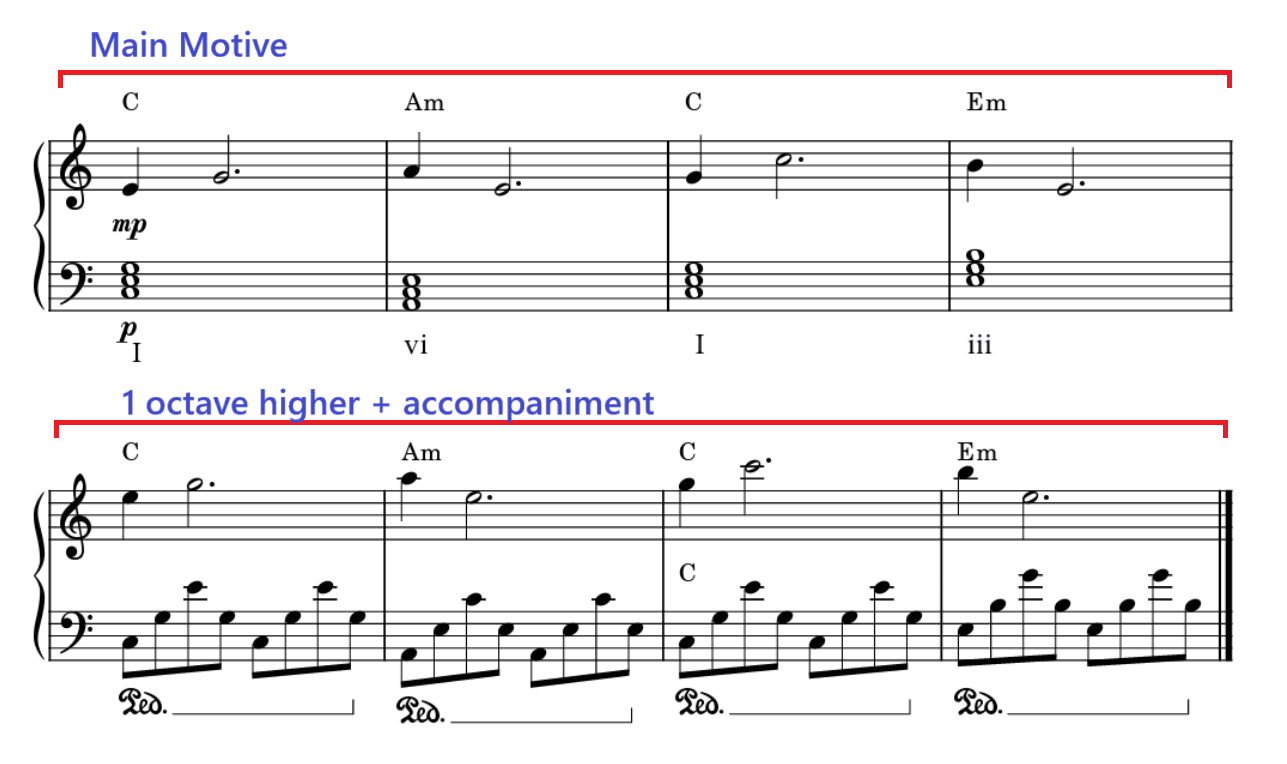
We can apply the same harmonies to a simple motive using only notes belonging to each chord or “Chord Tones” on the right hand, keeping the same rhythm and changing the intervals to adapt to the new chords for 4 bars, stating the main motive, then, on the next 4 bars we apply some ornamental changes such as changing the motive one octave higher for a brighter result, and adding some movement on the accompaniment (the left hand) notice that the pattern is root-5th-3rd-5th on every chord. In this way, we have accomplished our first 8-bar phrase using only tonic harmonies.
Example in C Major:
Example in C Minor:
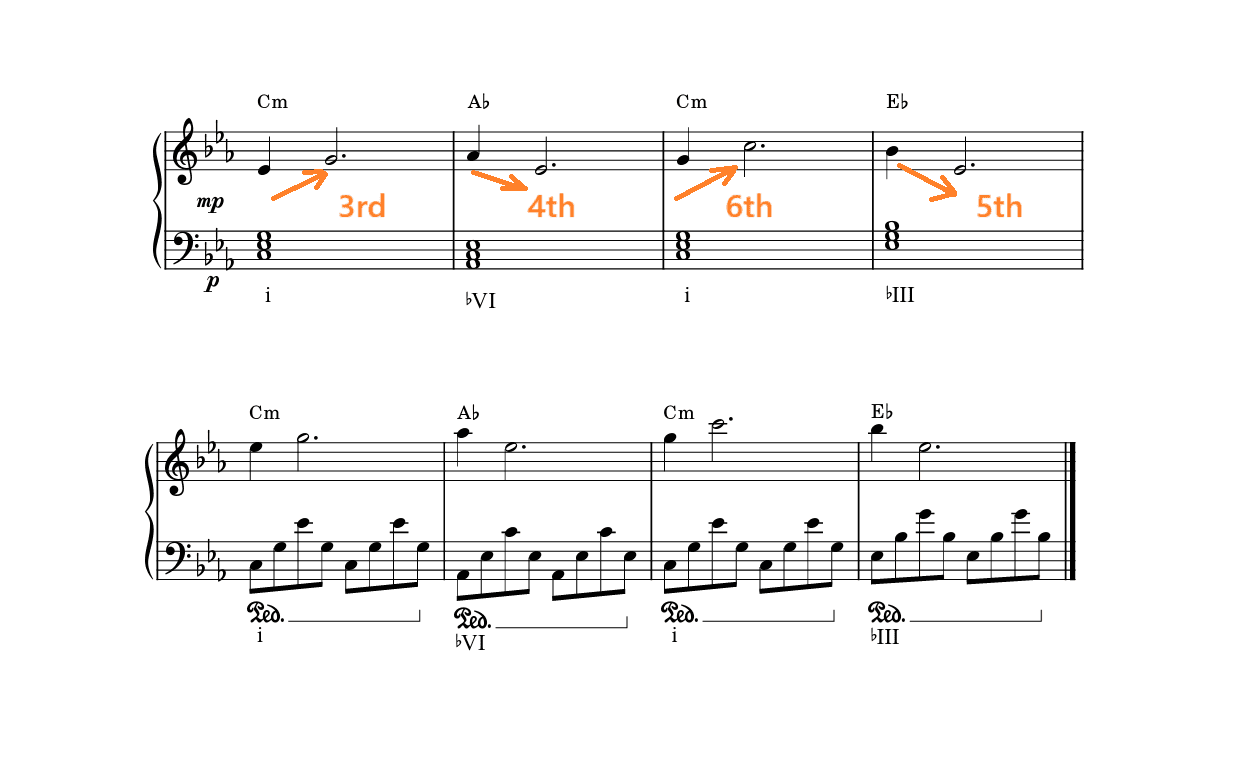
As we can see, it doesn’t take very complex themes to create a motive, it is all about being efficient with few elements. In this case, we only used one single rhythmic pattern (a crotchet and dotted minim), changing the intervals on every bar. An ascending third from E to G on the first one, a descending fourth on the 2nd bar, an ascending fourth on the third reaching the climax (a C dotted minim note) and finally a descending fifth to an E (same note with which we started the motive). The difference between an accompaniment and a motive is that the motive keeps changing something, keeps offering something new (in this case, the interval direction) while the first example neither changed the rhythm nor the direction of the intervals.
Composition Example: Runaway – Kanye West
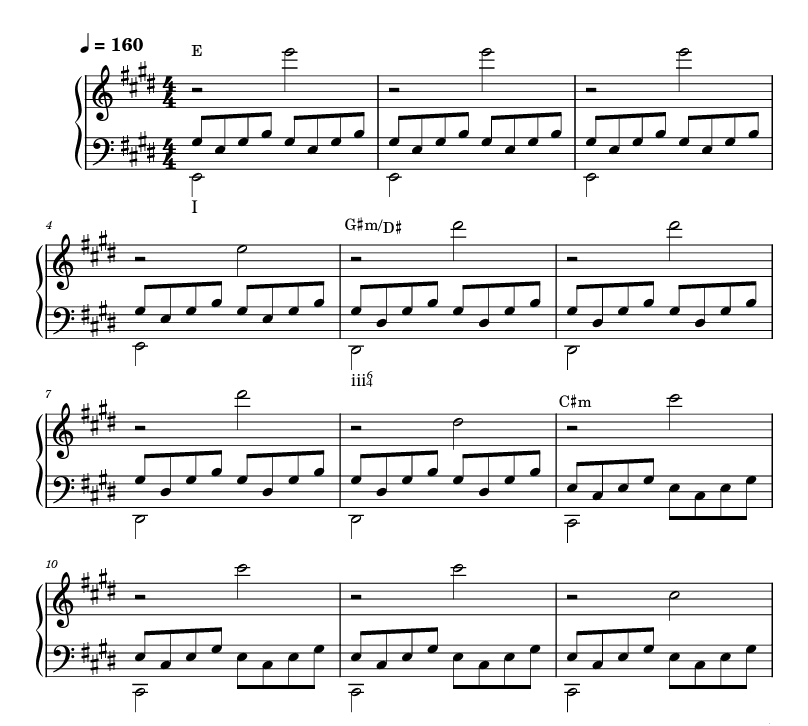
Below we can see a perfect example of a song almost entirely composed over tonic harmonies. The key is on E major and the progression is: I – iii – vi. Each chord lasts for 4 bars. Here we see that the composer lays a very stable progression to then change to the IV or subdominant to give an end to the progression that will be repeated throughout the song. The example only shows the tonic harmonies with the melody:
The Pre-Dominant Function (PD)
For Pianists
The Pre-Dominant is the “launch pad”. It prepares movement towards tension.
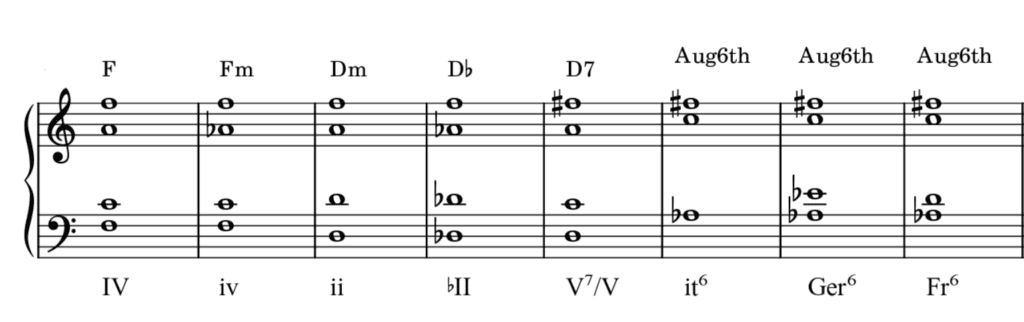
Typical chords are ii, IV, iv, ♭II (Neapolitan), and occasionally V/V and Augmented Sixth chords which also function as secondary dominants towards the V degree, the dominant.
Below are examples in the Key of C (applicable to both modes):
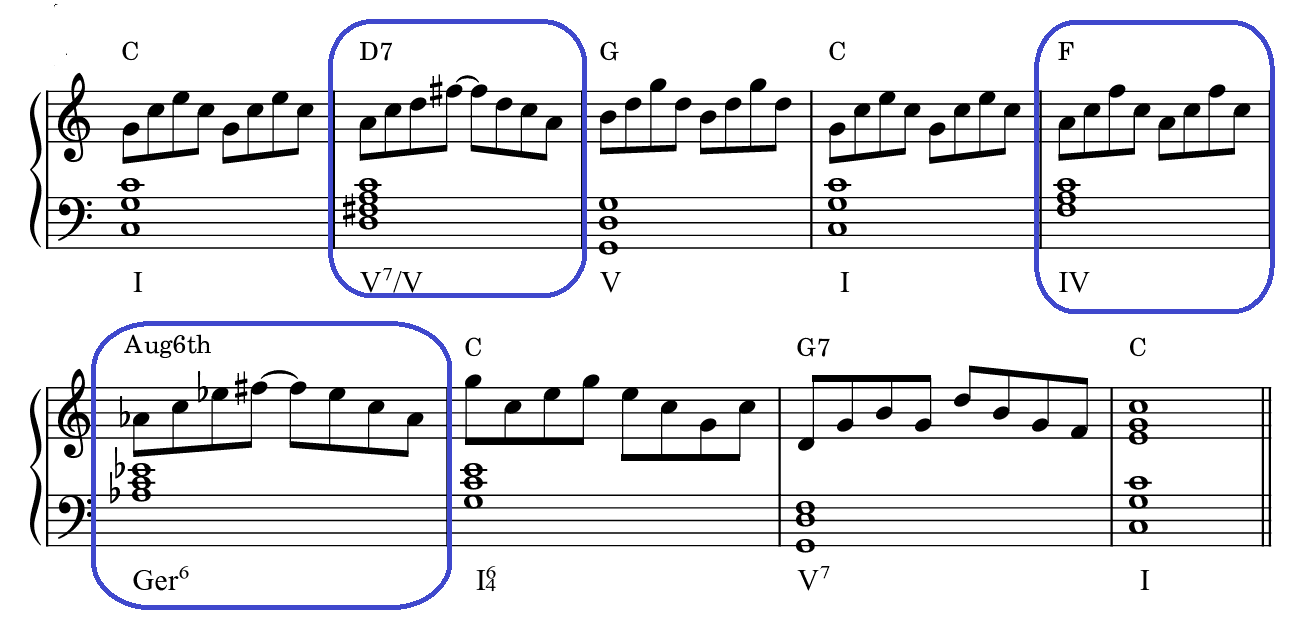
Below we have an example of a phrase with a combination of Pre-Dominant function chords: The dominant of the dominant (D7), the subdominant (F) and finally, to increase the tension, a German Augmented Sixth chord that leads to the final cadence:
How to use it in performance:
- Use PD (Pre-Dominant) to shape anticipation.
- When you move from I to IV or ii, slightly intensify dynamics or articulation.
- Balance your voicing so the 3rd and 6th resolve inward or outward towards the upcoming dominant.
Pre-Dominant Connectors – Exercises
- Goal: Learn how the Pre-Dominant prepares the Dominant.
- Play:
- | F | Dm | G | → IV–ii–V
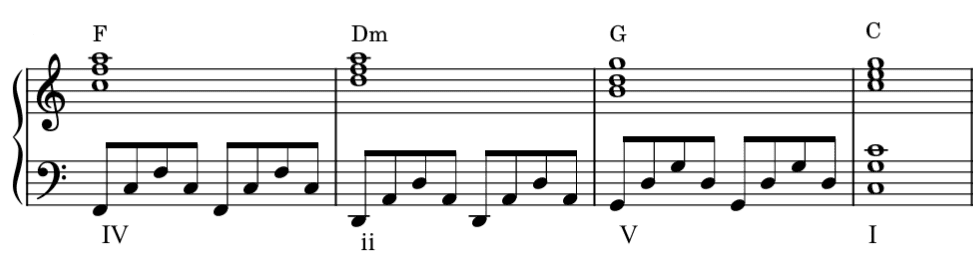
Voice-leading hint: In Right Hand, move A→G between Dm and G to hear the pull into V.
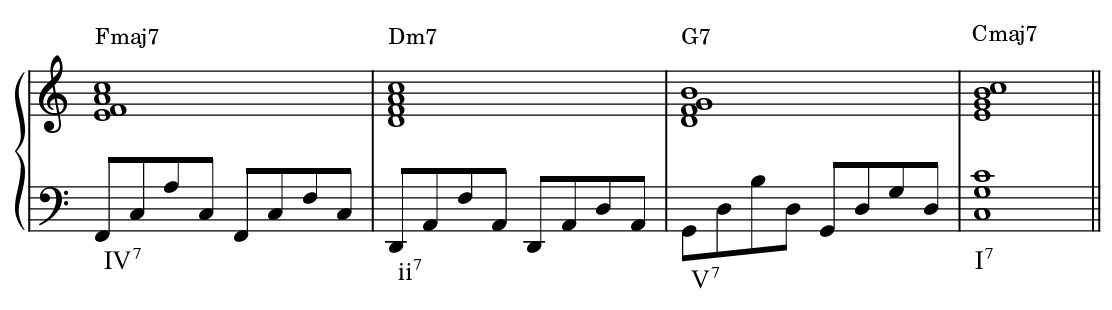
- Add sevenths tastefully: | Fmaj7 | Dm7 | G7 | → IV^7–ii^7–V^7
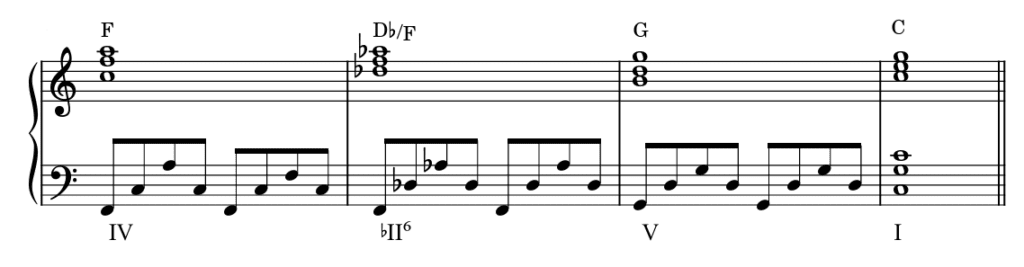
- Modal interchange: Replace ii with a Neapolitan flavour: | F– D♭(F–A♭–D♭) | G | C → ♭II⁶–V – I | (use first inversion for smoothness).
Goal: Tastefully colour Tonic and Pre-Dominant using borrowed chords from parallel minor.
Play & Compare (C major):
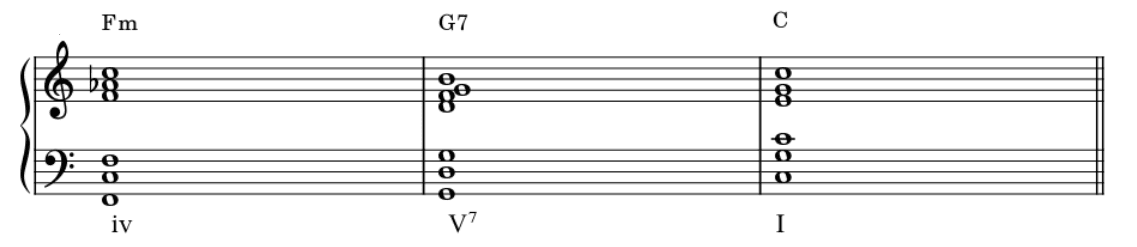
- iv: | Fm | G7 | C | → iv–V7–I (filmic, bittersweet Pre-Dominant)
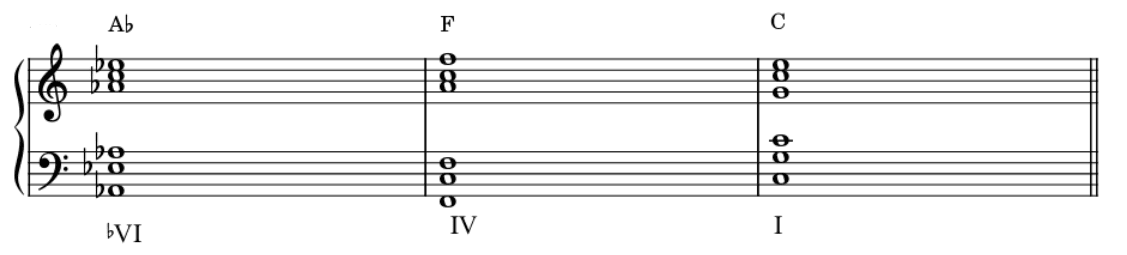
- ♭VI→IV→I: | A♭ | F | C | → ♭VI–IV–I (plagal-tinted landing)
- ♭VI→♭VII→I: A♭ | B♭ | C | → ♭VI–♭VII–I (anthemic lift)
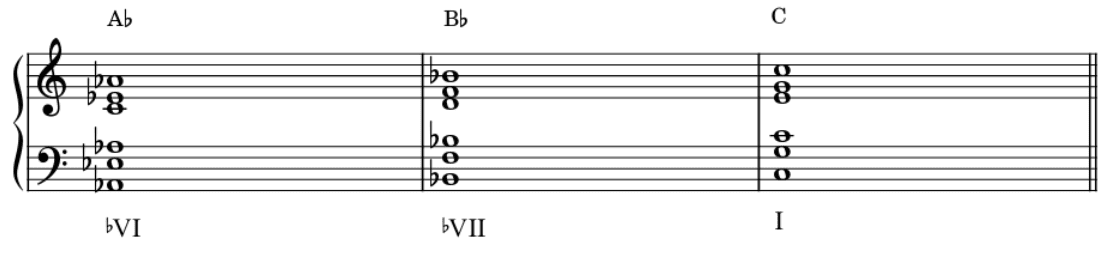
Ear target: Hear how iv (minor) darkens Pre-Dominant; how ♭VI enriches a plagal move.
Where to Learn More:
You can find more information about this topic in my previous two articles and videos:
Modal Interchange Explained With Real Music Examples:
https://www.piano-composer-teacher-london.co.uk/modal-interchange/
How to Use Modal Interchange? A Composer’s Guide:
https://www.piano-composer-teacher-london.co.uk/how-to-use-modal-interchange-a-composers-guide/
How to harmonise Jazz Melodies using Modal Interchange and Chord Substitution:
For Composers
In composition, the Pre-Dominant connects the stable tonic to the tension of the dominant. It often begins with the continuation phrase or the approach to a cadence.
How to apply it compositionally:
- Introduce contrasting harmony (usually with F or D as bass tones in C major).
- Widen texture, intensify rhythm or harmonic rhythm (chords change more quickly).
- Experiment with modal interchange: borrowing iv or ♭II from the parallel minor gives a richer PD palette.
- Example: in C major, Fm–G–C (iv–V–I) offers a dark, filmic colour.
- Example: D♭–G–C (♭II–V–I) evokes Romantic or cinematic brightness.
- Example: in C major, Fm–G–C (iv–V–I) offers a dark, filmic colour.
Genre Mini-Studies
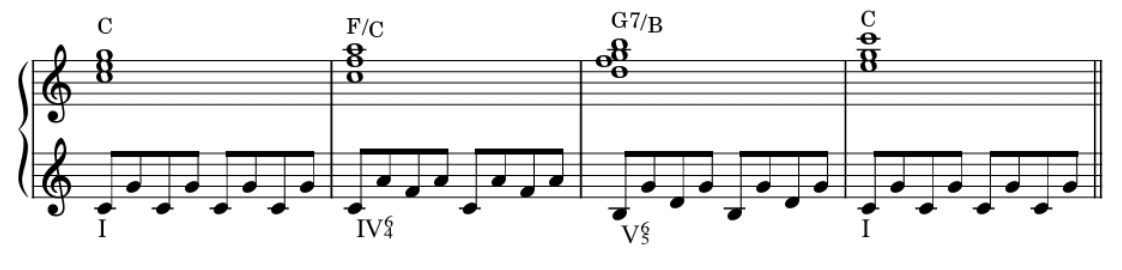
(a) Classical: Alberti T–PD–D–T)
- | C | F | G7 | C | → I–IV–V7–I
- Right Hand: Voice Leading into an ascendant scale towards the tonic: G-A-B-C
- In the case of Classical music, the most noticeable texture is the Alberti Bass.
- Notice how the only chord in root position is the tonic and the Subdominant chord is in second inversion, the dominant is on first inversion with its leading tone resolving on the tonic. This is how in composition we establish the hierarchy of the tonic chord, making it stronger than the subdominant and dominant chords.
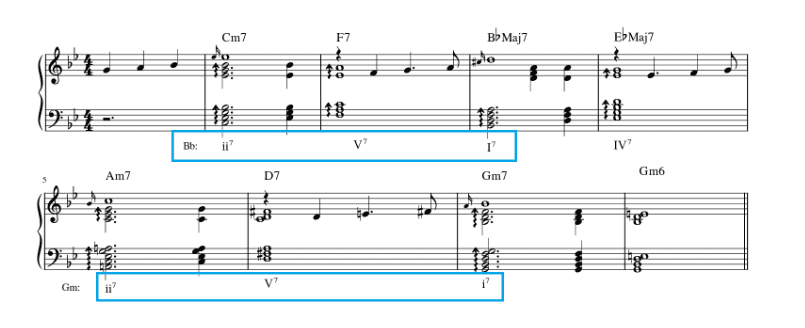
(b) Jazz: Shell ii–V–I with guide-tones
- | Dm7 | G7 | Cmaj7 | → ii7–V7–Imaj7
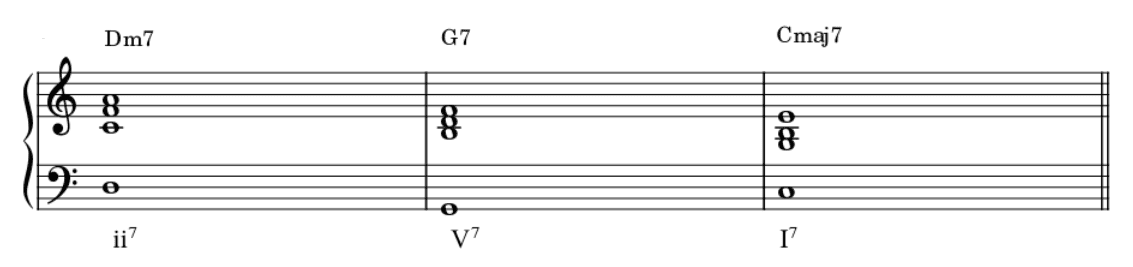
- LH: roots; RH: 3rds & 7ths (F–C → B–F → E–B).
- The technique for writing chords is the “Triad over root” in which we use the root of the chord on the left hand and the triad on top. For example, the first chord Dm7 can also be read as F major with the D on the bass or F/D. In the case of the G7 would be G over B diminished chord or Bdim/G and lastly, for the Cmaj7, an E minor over C or Em/C.
- Add iv colour: | Fm7 | G7 | Cmaj7 | → modal-mixture PD.
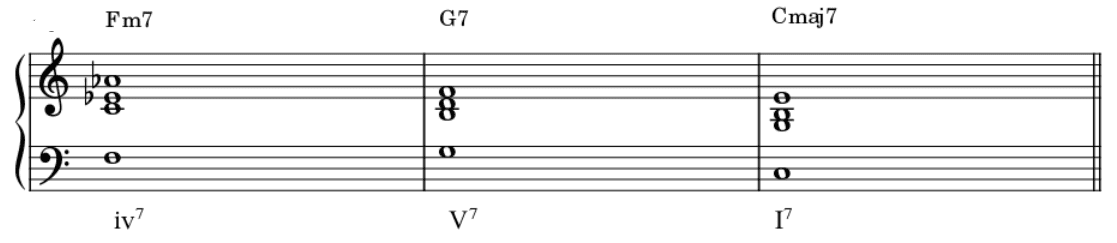
- We can see how this progression is applied in the Standard “Autumn Leaves”, where we see the progression ii7-V7-Imaj7 in B flat major first and in bar 5 the same progression now transposed to G minor key.
(c) Film: Ostinato + colour PD
- LH ostinato on C–G–C; RH cycles
| Fm | Gsus4 G | Cm | → iv–Vsus–V–i (suspense → release).
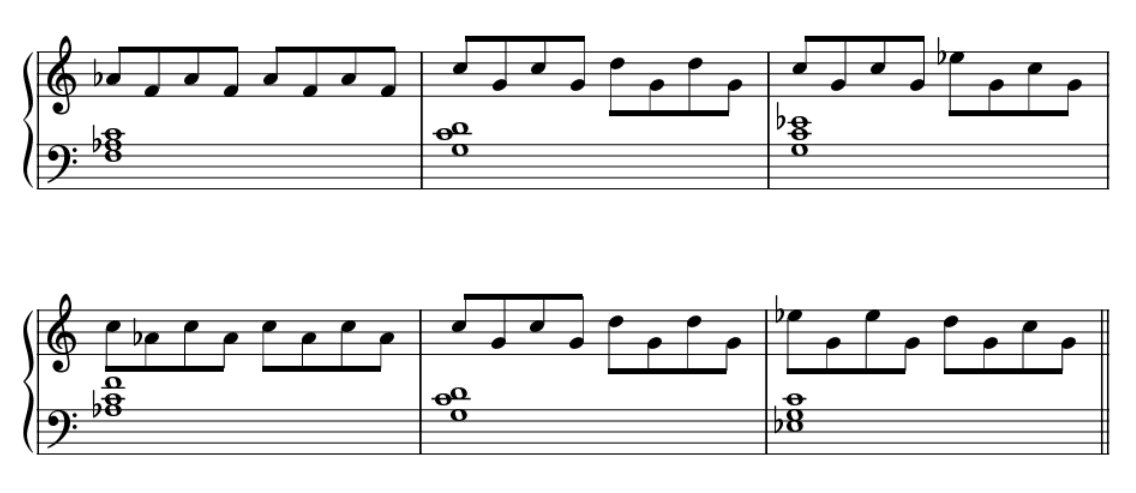
The ostinato or drone creates a cyclical nature perfect for films as we can extend this progression for long periods and adapt it to the duration of the scene.
Here we have an F minor, a G suspended on fourth and C minor which is repeated on the second line in different inversions, you can also change the arpeggio on the right hand slightly to create a smooth variant but without taking too much attention from the audience; that will be counter effective.
(d) Pop: Four-Chord Frame
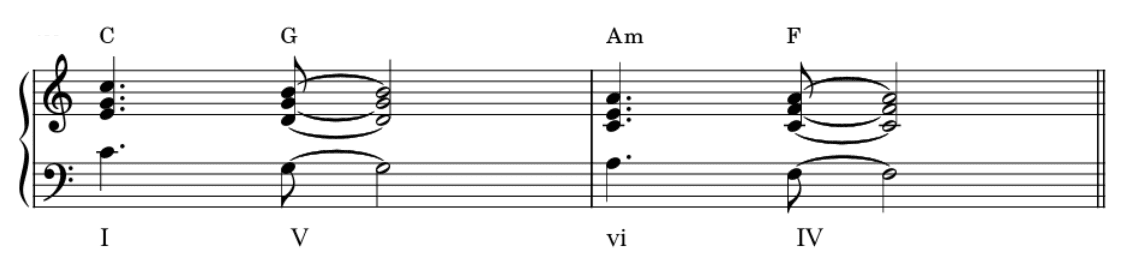
- | C | G | Am | F | → I–V–vi–IV
- In Pop Music, these syncopated rhythms are common accompaniments. In this case, the progression I-V – vi -IV is used in the chorus of the song “Someone like you” from Adele.
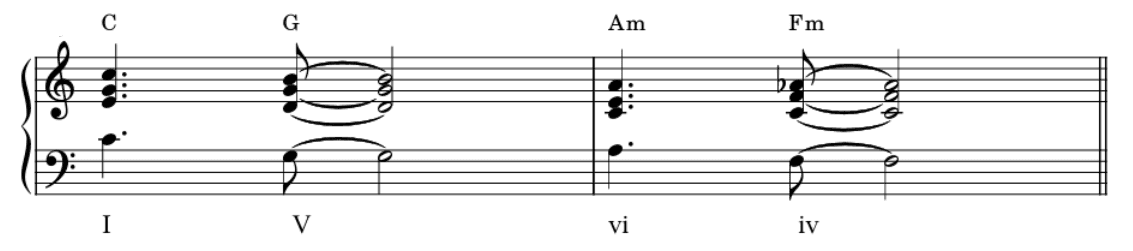
- Swap in iv (Fm) on bar 4 for a darker pre-chorus: | C | G | Am | Fm |.
- If we want to add a darker hue to the pre dominant function, use modal interchange to change to the minor subdominant, in this case, the F minor.
The Dominant Function (D)
For Pianists
The Dominant is the harmonic tension point. It demands resolution.
Principal chords are V, V7, vii°, and occasionally V/V or iii (as dominant substitute).
The Dominant function includes the V and VII (usually in first inversion) chords in their various positions. Iii (the submediant, usually in first inversion) can function as a dominant substitute in some contexts (as in the progression V – iii – vi ).
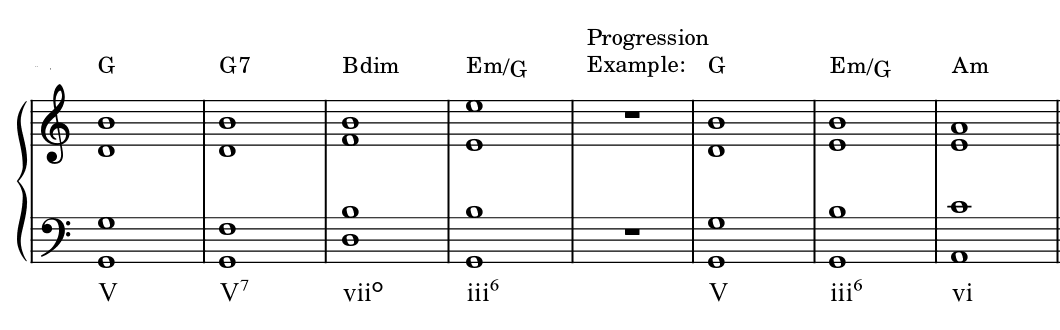
Function = tension / climax / resolution. (on the tonic chord)
How to use it in performance:
- Emphasise its leading-tone energy (B → C in C major).
- Slightly increase intensity or articulation on Dominant chords.
- Feel the pull towards the next Tonic chord.
Example 1 – Classical:
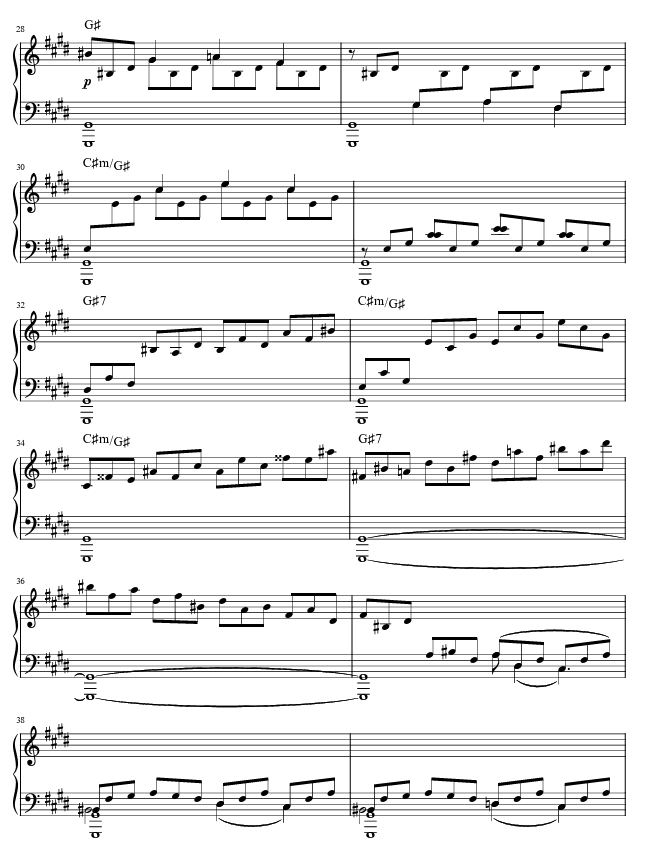
In Beethoven’s “Moonlight” Sonata, first movement, each long arpeggiated V7–i⁶4 resolution (G#7–C#m/G# minor) creates that characteristic yearning tension from bar 28 to 39. The tonic in second inversion is an unstable chord which functions here not as tonic (Stable) but as an ornament of the dominant function, prolonging the harmonic tension:
Example 2 – Pop / Film:
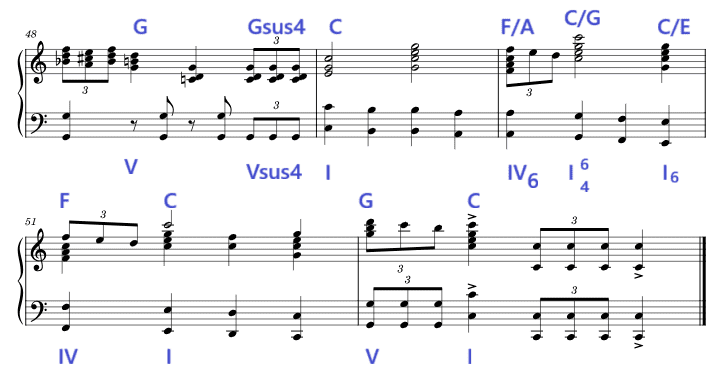
In John Williams’s “Star Wars” Main Title, brass fanfares emphasise V7–I (G7–C) cadences that express triumph and closure.
https://musescore.com/official_scores/scores/6950984
For Composers
Dominant function provides the climax of a phrase and sets up cadences.
It may serve as:
- The culmination of a continuation phrase (Caplin’s syntax), or
- The half cadence point if the phrase ends unresolved.
How to apply it compositionally:
- Heighten melodic intensity—leading tones, chromatic approach notes, rhythmic drive.
- Strengthen voice-leading: the 7th of V resolves down (F → E in G7–C); the 3rd of V (B) resolves up (B → C).
- Allow the Dominant to dwell briefly before the Tonic, enhancing arrival.
Example – Romantic Music:
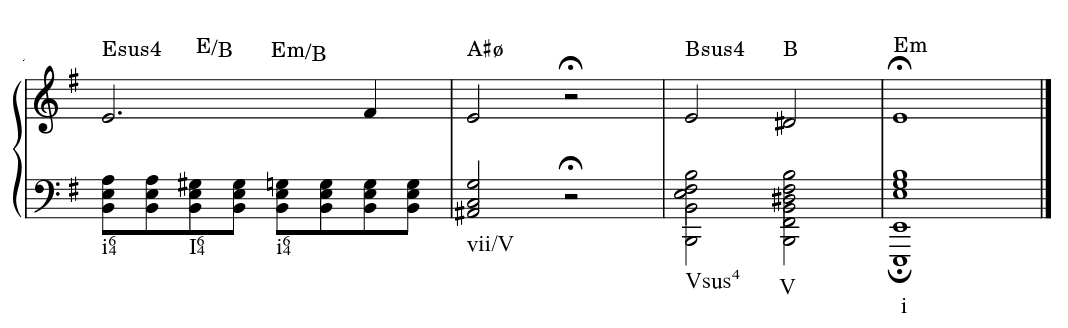
In Chopin’s Prelude in E minor Op. 28 No. 4, the final dominant B7 delays resolution until the very last moment—heightening pathos.
Combining Harmonies
These functions are combined all the time in music to create different tensions.
| Function | Typical Chords | Role | Expressive Use |
| Tonic (T) | I, vi, iii | Rest / stability | Opening and closure; lyrical calm |
| Pre-Dominant (PD) | ii, IV, iv, ♭II | Preparation / contrast | Builds energy, introduces colour |
| Dominant (D) | V, V7, vii°, V/V | Tension / resolution | Peak of phrase; closure or suspense |
- Pianists should hear and feel each function: T as rest, PD as lift, D as resolution.
- Composers should structure their phrases accordingly: begin and end with T, contrast with PD, and climax with D.
- Across all genres—Classical, Jazz, Film, and Pop—these three functions form the harmonic backbone of musical storytelling.
We can find very early examples in pieces such us Canon in D by Johann Pachelbel, a Baroque composer from the 18th century in which he set up a 4-bar progression on which the whole piece is built upon: I – V – vi – iii – IV – I – IV – I, using all the harmonic functions:
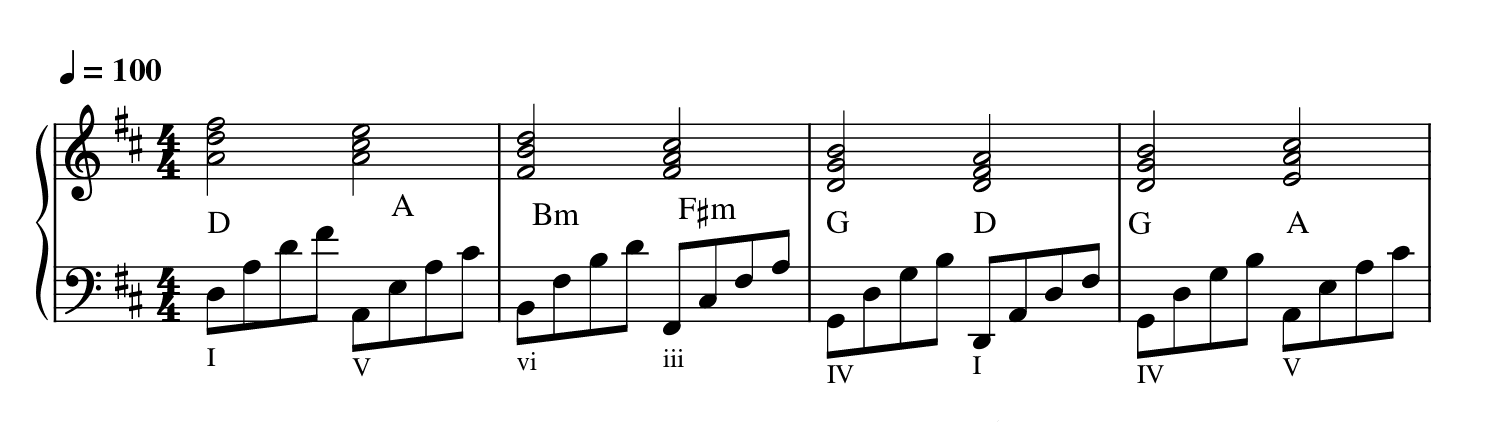
| D | A | Bm | F#m | G | D | G | A |
I–V–vi–iii–IV–I–IV–V → a T–D–T–PD–T–PD–D cycle—a continuous alternation of rest and motion that feels endlessly balanced.
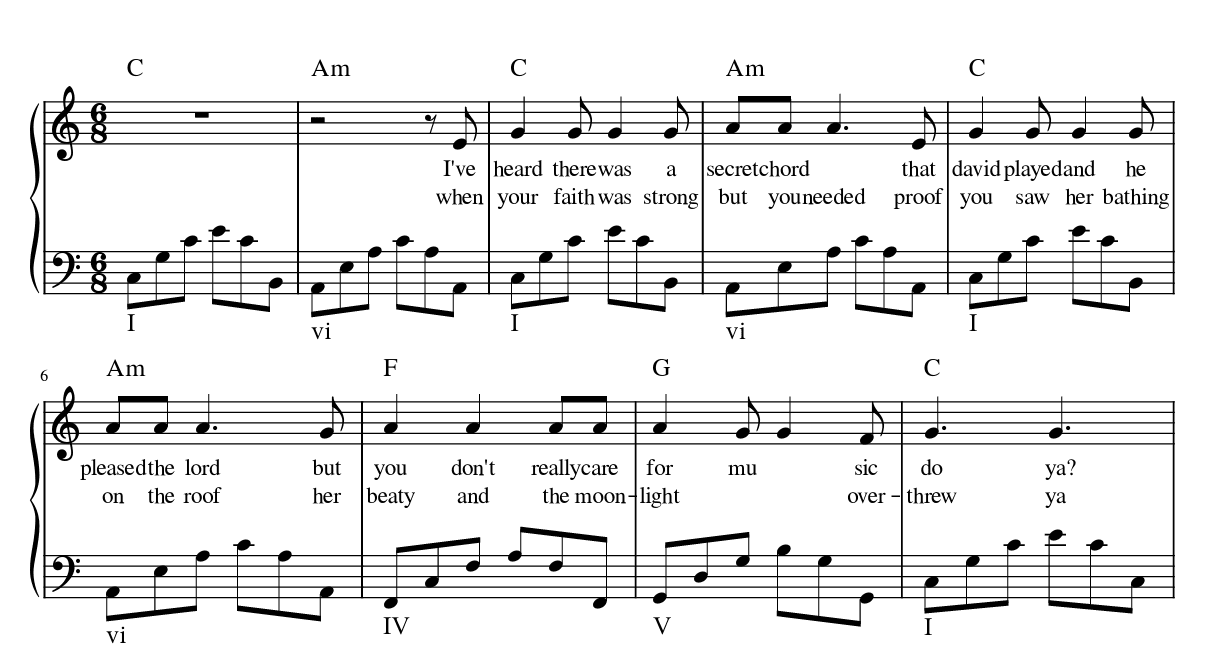
Not only in Baroque music we can see combinations of harmonic functions, but also in modern examples such as in Leonard Cohen’s ” Hallelujah”. Observe that the first 6 bars of the song is an interchange from the tonic or C major (I) to the Submediant or A minor (vi); this makes the beginning very stable, only going to the Subdominant degree, the F major (IV) of the 7th bar, culminating in the Dominant, the G major (V) providing a closure to the first phrase:
Understanding the Uses of the Three Harmonic Functions in Practice
(for Pianists and for Composers)
In tonal music, every chord has a purpose—not only a name. According to Caplin’s functional theory, harmony behaves like musical grammar: the Tonic establishes identity, the Pre-Dominant creates preparation, and the Dominant demands resolution. Harmonic functions in music complete guide.
The Tonic Function (T)
For Pianists
The Tonic is the point of rest and stability—the harmonic “home”. When you play a tonic chord, it should sound complete and at ease.
How it is used in performance:
- To start and end most phrases.
- Use it to convey calmness, repose, or emotional release.
- Explore tonic prolongation by alternating related chords that share tones with I (e.g. vi or iii) to maintain a gentle sense of continuity.
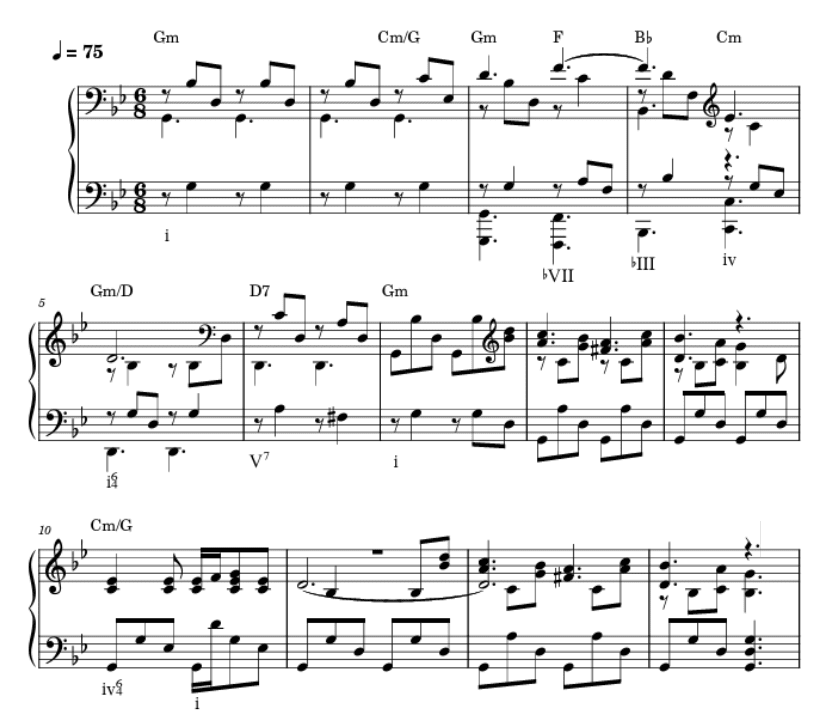
EXAMPLE: Mendelssohn Songs Without Words Op.19 No.6 in G Minor
Observe how the Introduction (bars 7) gives a sense of stability and then the melody unfolds gently above a prolonged tonic chord in bar 8, with an upbeat from bar 7 (with the occasional subdominant and dominant to offer and ending to each subphrase)
Progressive Keyboard Drills
Work in C major first, hands together at ♩=60–72, then transpose to G, F, and A minor. Keep the LH as a steady pattern (root–5th–root or root–5th–3rd–5th). Aim for smooth voice-leading in the Right Hand (small intervals, retain common tones).
- Goal: Strengthen the sense of home (T) without sounding static.
- Play:
- | C | Am | C | Em | → I–vi–I–iii
- Repeat with passing/neighbor notes in the left hand (only diatonic to C major).
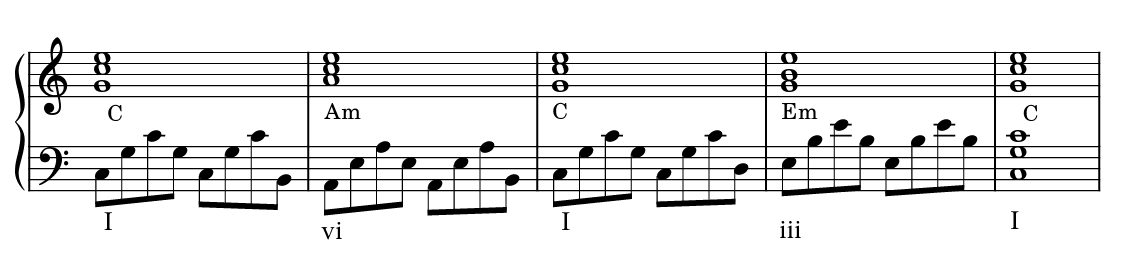
- Listen for: a calm, grounded sonority; RH lines that connect common tones (e.g., E in C and Am).
- Variations: In C minor, try | Cm | Ab | Cm | Eb | → i–♭VI–i–♭III.
- Tip: Keep the Right Hand within an interval of a 6th; avoid big leaps.
For Composers: From Motif to Phrase (T–PD–D–T)
How to use this section
Write an 8-bar sentence or period at crotchet = 72. Keep a short two-beat motif (M). Constrain yourself to chord tones on strong beats; add stepwise passing/neighbor notes on weak beats.
Motif-First: Tonic Prolongation Build (Bars 1–4)
- Choose a key (C minor)
- Motif or basic idea (2 bars)
- Harmonise only with T function for 4 bars:
- |Cm | Ab | Cm | Eb | → i–♭VI–i–♭III.
- Keep one element constant each bar (rhythm), vary interval direction (↑, ↓).
- |Cm | Ab | Cm | Eb | → i–♭VI–i–♭III.
- Checkpoint: Does each bar feel “at home”? No PD/D yet.
Add Direction: PD Set-Up (Bars 5–6)
- Choose one PD route:
- Diatonic: | F | Dm | → IV–ii
- Colour (modal-mixture): | Fm | D♭⁶ | → iv–♭II⁶ (we are using this option here)
- Diatonic: | F | Dm | → IV–ii
- Keep the rhythm of the basic idea very similar; adapt pitches to chord tones introducing passing tones. We can add certain non harmonic notes on the 5th bar to increase tension. (see the red coloured notes)
- Voice-leading rule of thumb: At PD entry, introduce A♭ (if using iv) or A natural (if using Dm) clearly in the melody.
Drive and Release: Dominant → Tonic (Bars 7–8)
- Cadence options:
- | G7 | C | → V7–I (perfect)
- | G | C/E | → V–I⁶ (imperfect, lighter)
- | G7 | Am | → V7–vi (deceptive; continue next sentence)
- Plagal colour close: Add IV before I: | F | C |.
- | G7 | C | → V7–I (perfect)
- If you used iv or ♭II: show it leading into V (e.g., iv–V–I, ♭II⁶–V–I). as shown in this example.
Borrowed-Chord Toolkit
- iv in major → PD with darker hue: iv–V–I (Fm–G–C).
- ♭VI–IV–I → plagal-coloured landing (A♭–F–C).
- ♭VII–I → bold return (B♭–C).
- When to use which? See your guide “How to Use Modal Interchange—A Composer’s Guide” and your YouTube walkthrough for context, voice-leading cautions, and genre placements.
https://www.piano-composer-teacher-london.co.uk/how-to-use-modal-interchange-a-composers-guide/
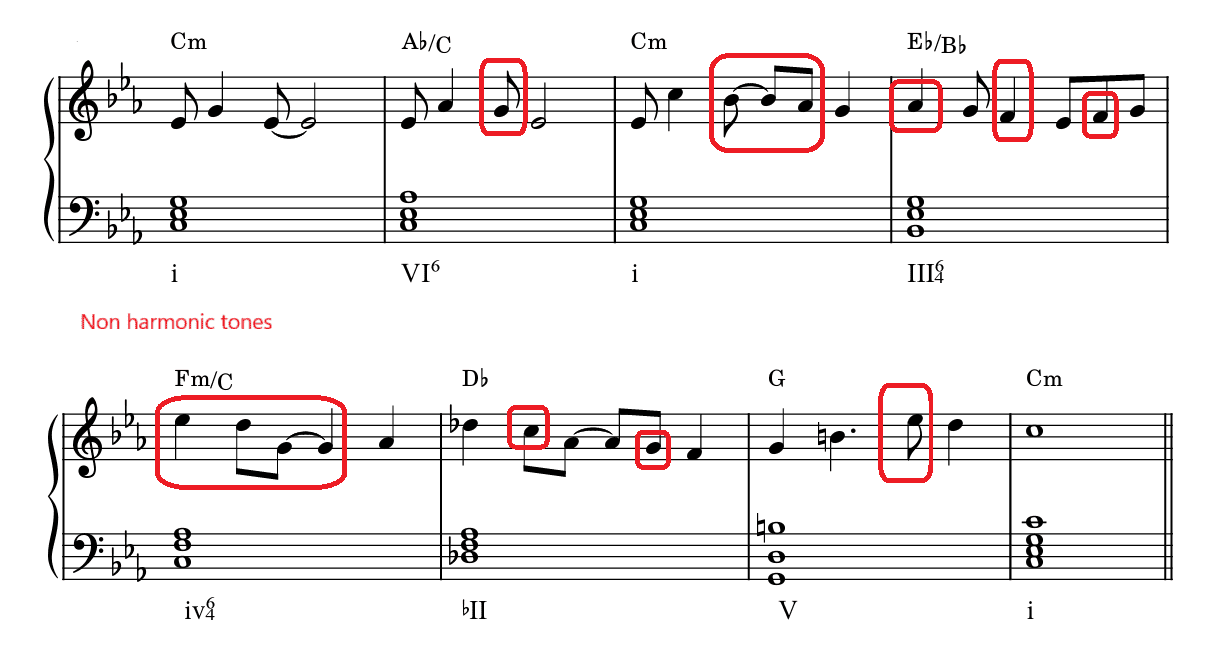
Here we have an 8-bar sentence at 72 bpm.
The Basic Idea takes two bars above a Tonic Prolongation Build (Bars 1–4) in C minor. We kept the same basic rhythm with some slight changes, varying the melodic direction mainly for consistency.
The chord progression is
|Cm | Ab | Cm | Eb | → i–♭VI–i–♭III.
We added Direction with Pre-Dominant Set-Up (Bar 5–6)
with modal-mixture: | Fm | D♭⁶ | → iv–♭II⁶
We can add certain non harmonic notes on the 5th bar to increase tension. (see the red coloured notes)
Lastly, the Drive and Release: Dominant → Tonic (Bars 7–8)
| G | C | → V–I (a perfect cadence)
As we used ♭II: we showed it leading into V (♭II⁶–V–I) as shown in this example.
Common Pitfalls & Fixes
- Everything sounds like T: add a clear A or A♭ at PD; sharpen the leading tone (B) near D.
- Cadences feel weak: lengthen V (add 7th or suspension), tighten RH to chord tones on strong beats.
- Borrowed chords feel random: treat iv and ♭II as PDs that must move to V (or a strong IV→I plagal frame).
COMPOSITION EXAMPLE: Mozart Sonata in F major K. 332 (Bars 50-65)
With this example, we can see how everything comes together:
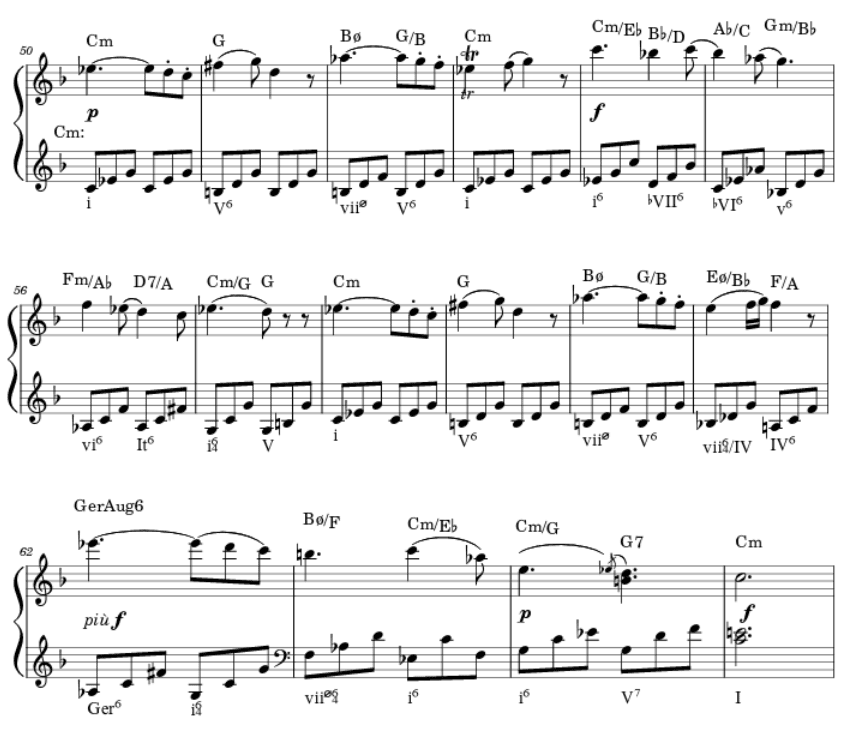
In Caplin’s Book “Analyzing Classical Form” he explains in detail how this works (page 7) – Harmonic functions in Music Complete Guide.
“The opening four bars prolong tonic harmony in root position by means of a subordinate dominant in first inversion ( V6), which functions as a neighbouring chord. The next bars (m. 54 to the downbeat of m. 56) bring a stepwise- descending sequential progression, which is followed by an incomplete half-cadential progression, initiated by the pre-dominant IV6 (further embellished by the Italian augmented sixth). Note that the IV6 at m. 56 is a linking harmony: it both ends the sequential progression and initiates the half-cadential one.
The opening tonic prolongational progression (mm. 29–32) is well projected by the tonic pedal in the bass voice, within which various embellishing dominant and subdominant harmonies.
The following sequential progression (mm. 33–34) features a descending-fi ft h (“circle-of-fi ft hs”) series of roots, aft er which an authentic cadential progression completes the theme. Though it would be possible to see the root-position tonic at the end of m. 34 as linking the final two progressions, the overall musical context (and especially the piano dynamic at m. 35) suggests that this harmony belongs more to the sequence than to the cadence.”
Where to learn more about Form and Structure from Caplin’s ideas:
“Compose a Period”
https://www.piano-composer-teacher-london.co.uk/composing-a-period/
“Compose a Sentence”
https://www.piano-composer-teacher-london.co.uk/composing-a-sentence/
“The Sentence”
https://www.piano-composer-teacher-london.co.uk/analysing-classical-sonatas-the-sentence/
Conclusion for Pianists
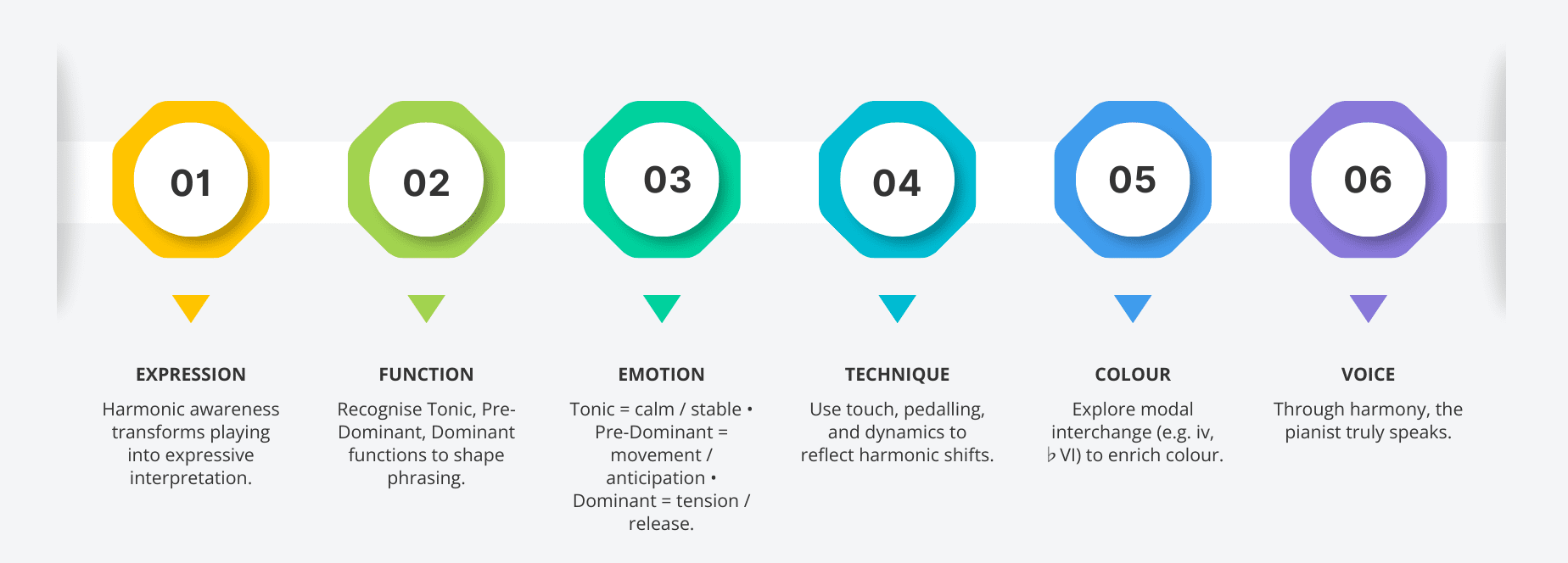
For the pianist, understanding harmonic function transforms the act of playing into a form of intelligent expression. Recognising whether a passage lies within the Tonic, Pre-Dominant, or Dominant realm allows one to shape phrasing naturally — to breathe with the harmony rather than merely execute notes. The tonic chords invite calmness and poise; pre-dominant harmonies suggest forward motion and anticipation; dominants demand release through carefully voiced resolution. Each function carries a unique emotional weight, and by voicing it consciously, pianists give life to the architecture beneath the music.
To explore further, experiment at the keyboard with your favourite pieces: identify how composers transition from stability to tension, and notice how touch, pedalling, and dynamics can reflect these changes. Delve into modal interchange and observe how a single borrowed chord, such as a iv or ♭VI, can alter the entire atmosphere of a phrase. The deeper your awareness of harmonic purpose, the more meaningful your interpretations will become — for it is through harmony that a pianist truly speaks. Harmonic functions in Music Complete Guide.
Conclusion for Composers
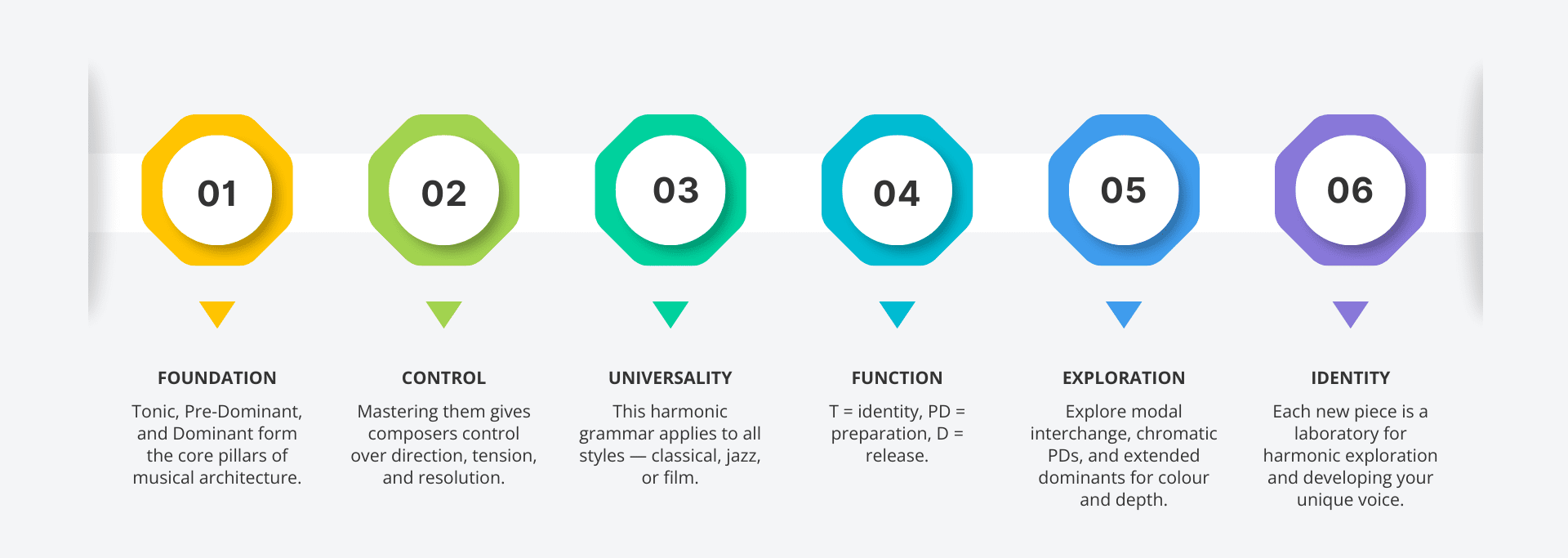
For the composer, the mastery of Tonic, Pre-Dominant, and Dominant functions is the foundation upon which musical architecture stands. These three pillars not only support form — they create direction, expectation, and resolution. By learning to control harmonic function, you learn to control narrative: the listener’s sense of where the music begins, where it strives, and where it finally comes to rest. Whether writing a short piano miniature, a jazz progression, or a cinematic cue, the same grammar applies — T defines identity, PD prepares motion, and D delivers release.
As you continue composing, experiment beyond the diatonic palette. Explore the expressive richness of modal interchange, chromatic pre-dominants, and extended dominants. Study how Classical masters, jazz musicians, and film composers alike manipulate these functions to shape emotion and structure. Each new piece you write becomes a laboratory for discovery — a chance to speak with the timeless language of harmonic function while developing your own voice within it. Harmonic functions in Music Complete Guide.
Final Reflection on Harmonic Functions in Music: A Shared Path of Exploration
Whether performed at the keyboard or conceived on the page, harmony is the meeting point where sound becomes meaning. Pianists and composers ultimately pursue the same goal: to understand how each chord functions so that musical expression becomes intentional rather than accidental. The study of Tonic, Pre-Dominant, and Dominant harmonies opens the door to interpreting and creating music with purpose — revealing the invisible architecture that unites Classical tradition, jazz improvisation, film scoring, and contemporary song writing. Harmonic functions in Music Complete Guide.