
 TRIAL LESSON
Piano Lessons
11+ Music Audition: Piano in London — A Refined Guide for Young Pianists
Jan
11+ music audition piano London Complete Guide
11+ Music Audition Piano in London: Complete Guide for Parents & Candidates
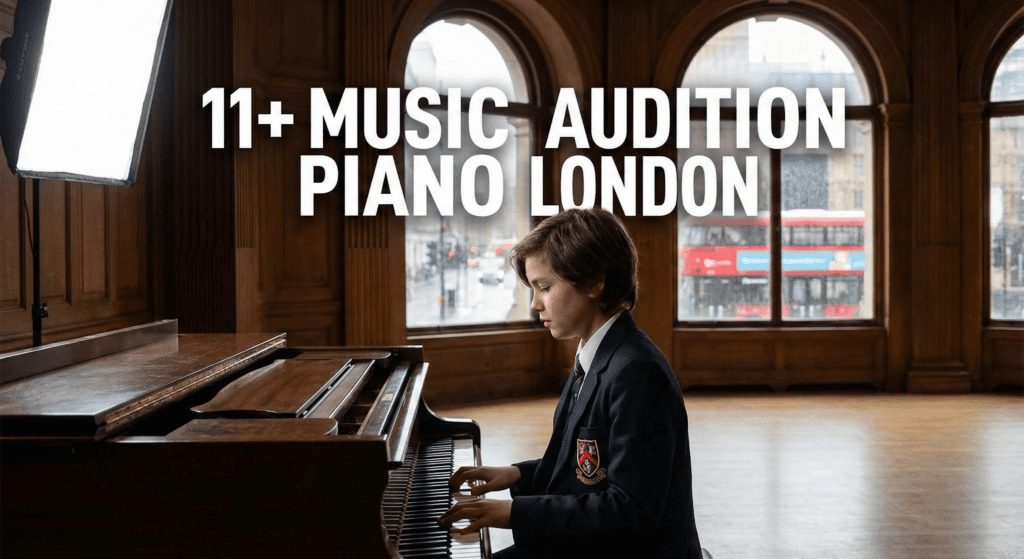
There is a particular atmosphere to an 11+ music audition in London: the polished school hall, the upright or grand set slightly too far from the panel, the quiet rustle of score paper, and a child trying to do two things at once—play well, and look as though playing well is perfectly normal. For parents and candidates, the uncertainty is rarely about talent. It is about expectations: how long you will be asked to play, what counts as “good enough”, and what schools actually mean by “musicianship”.
This guide is written for families preparing for an 11+ music audition piano in London. It sets out what selective London schools typically test, how to build a focused 10–15 minute programme, how requirements vary by school, and how to plan your preparation without turning home life into a conservatoire timetable. You will also find a practical section on audition-day logistics—including accompanists and SEND arrangements—and a short set of FAQs and checklists to keep everything calm.
Panels are listening for musical sense—shape, sound, pulse, style—not simply whether the notes are present.
What London schools expect at the 11+ piano audition
London’s selective schools tend to frame 11+ music auditions in the language of “scholarship”, but what they are really assessing is potential under pressure: a candidate’s ability to play with style, read with competence, listen accurately, and speak sensibly about music. Many schools list ABRSM Grade 5 (or Trinity Grade 5 equivalent) on the principal instrument as a minimum benchmark, though in practice the strongest candidates often exceed this.
Typical audition length & panel composition
Audition formats vary, but the overall shape is consistent: a short recital segment (often around 10–15 minutes total performance time), then additional tests and questions. The panel is typically made up of members of the music department, and sometimes admissions staff. You are not playing to “catch them out”. You are playing to show that you can hold your nerve, shape a phrase, and respond quickly when the format shifts from prepared repertoire to sight-reading.
Core elements tested
- Prepared pieces (often two contrasting works): Many schools ask for two contrasting pieces on the main instrument. Some also encourage (or expect) a second instrument at roughly Grade 3–5 standard, partly to identify versatile musicians.
- Sight-reading: A short excerpt designed to test rhythm, coordination, and the ability to keep going. Accuracy matters, but so does continuity.
- Aural and musicianship: Ear tests may include clapping rhythms, identifying intervals or chords, and responding to short musical examples. Some schools describe this as aural; others fold it into “musicianship”.
- Interview or musical discussion: Candidates may be asked simple, direct questions about what they play, what they enjoy listening to, or how they approached learning their pieces. The best answers are honest and specific; vague enthusiasm reads as rehearsed.
Some schools specify practical details that parents overlook. Westminster Under School, for instance, states that candidates play two contrasting pieces, plus sight-reading and ear tests, and that an accompanist is provided. Latymer Upper School likewise indicates an accompanist is provided and outlines a structure of contrasting prepared pieces, sight-reading, and aural/theory questions. City of London School’s admissions information is equally plain about the baseline standard expected for scholarship consideration: Grade 5 on piano.
In preparing for an 11+ music audition piano in London, it helps to think like a panel. They are listening for musical sense—shape, sound, pulse, style—not simply whether the notes are present. It is often more persuasive to play slightly easier repertoire with poise than to attempt something ambitious that cannot yet sit comfortably under the fingers.
How to build a 10–15 minute piano programme
A good audition programme is a small, curated argument: “This is what I can do, and this is who I am as a young musician.” Most schools want contrast—of period, character, tempo, and touch—because contrast reveals understanding. A single piece can be impressive; a thoughtfully chosen set is more informative.
Contrasting repertoire template (Baroque / Classical / Romantic / 20thC)
For many candidates, the most straightforward way to show range is to choose repertoire from different eras. A common and effective template is:
- Baroque: clarity of voicing, articulation, rhythmic control (e.g., a Bach two-part invention)
- Classical: form, balance, phrasing, transparency (e.g., a Mozart sonata movement)
- Romantic or 20th-century: cantabile tone, pedalling, colour, atmosphere (e.g., a Chopin prelude or a Debussy prelude)
Total time tends to work best at around 10–15 minutes. Two pieces can be sufficient if they contrast strongly; some auditions allow or encourage a third piece, and some candidates split the time across two instruments.
| Programme type | Suggested contrast | Illustrative example | Approx. total time |
|---|---|---|---|
| Three-era core | Baroque + Classical + Romantic | Bach Two-Part Invention No. 8 (~2:30) + Mozart Sonata in C K.545, 1st movt. (~3:30) + Chopin Prelude in E minor (~3:00) | ~9–10 minutes |
| Two-piece contrast | Fast/bright + lyrical/reflective | One technically sparkling movement paired with a slower, singing piece | ~10–12 minutes |
| Two-instrument option | Main instrument focus + second instrument sample | Two contrasting piano works plus one short piece on a second instrument (where permitted) | Often within ~12 minutes |
The example above is intentionally realistic: it is diverse, it sits within many schools’ stated timing expectations, and it prioritises polish over spectacle. Always follow the precise instructions for each school—some are specific about number of pieces, total timing, and whether a second instrument is expected.
Choosing pieces to show technical range and musicality
When choosing repertoire, aim to demonstrate both technique and thought. A panel hears “fingerwork” quickly; what distinguishes candidates is how they turn that fingerwork into music.
- Include one piece that shows rhythmic stability and articulation (often Baroque or Classical).
- Include one piece that shows tone and line (often Romantic, but not exclusively).
- If you add a third item, ensure it adds a new colour rather than repeating the same character at a different difficulty level.
- Play what you can play confidently. A secure performance tends to outperform an insecure “harder” choice.
Some candidates will be asked to perform from memory; others may be permitted to use the score. Where memory is required, it should look like a musical decision, not a high-wire act. In every case, practise the transition moments: walking to the instrument, adjusting the bench, placing hands quietly, and starting without fuss. These are small things, but they communicate readiness.
School-specific snapshots
Below is a concise London-focused snapshot, drawn from published admissions and scholarship information. Always re-check each school’s latest documentation before you commit to an application, as dates and details shift from year to year.
City of London School (Boys)
- Selection method: audition and interview, alongside normal academic entry standards
- Baseline requirement: Grade 5 on piano for scholarship consideration
- Scholarship details noted: modest fee reduction and free tuition on two instruments
Westminster Under School
- Timing: audition in January following the written exam
- What you play: two contrasting pieces on the principal instrument; one piece on a second instrument
- Tests: sight-reading and aural tests
- Accompanist: provided by the school
St Paul’s School (Hammersmith)
- Baseline requirement: at least Grade 5 on the principal instrument to advance to audition
- Typical components: prepared pieces, sight-reading, aural tests, and possibly interview discussion
- Scholarship details noted: fee reductions plus free tuition on two instruments, tenable until Year 11
King’s College School (Wimbledon)
- Profile: a small number of music scholarships within a competitive 11+ intake
- Typical expectation: Grade 5+ on main instrument; often a second instrument
- Timing: application deadline in early November; auditions in January of Year 6 (as described in the admissions guide referenced below)
Latymer Upper School (Hammersmith)
- Typical expectation: roughly Grade 5 on piano
- Timing: auditions held in January after entrance exams
- Format: two contrasting pieces totalling around 10 minutes; sight-reading; aural/theory questions; candidates may offer a third piece on a second instrument
- Accompanist: provided
Highgate School (Archway)
- Two-stage process: a January “Musical Discovery Day” followed by second-round auditions
- Typical expectation: Grade 5–8 on first instrument; Grade 3+ on a second instrument
- Final performance detail noted: a 12-minute recital split between instruments, with accompanist available if needed
The common thread is clear: Grade 5 is often the published baseline, but selection is built on breadth and composure. Schools are choosing future contributors to ensembles, concerts, chapel or hall music-making, and the wider cultural life of the school. The audition is a short window into that future.
Timeline & realistic preparation plan (without prescriptive practice routines)
Good preparation is not about turning the year into a countdown. It is about removing avoidable stress. Families do best when they treat preparation as a series of milestones, not a daily negotiation.
Recommended milestones (12–9 months, 6 months, 3 months)
- 12–9 months out: Confirm which schools you are targeting and what each requires. Choose repertoire with your teacher and ensure it offers stylistic contrast. This is the period to build the pieces properly—musically, not just “note-perfect”. It is also a sensible time to enter performances or examinations for experience under mild pressure. Guidance from WKMT’s audition preparation materials supports starting 6–12 months before the audition, and most families find that range realistic.
- 6 months out: Aim to have the pieces learned and stable by summer, then refine. Begin memorisation where needed, and add regular sight-reading and aural work so it feels normal rather than exotic. If you will play with an accompanist (more common for instrumentalists than pianists, but still relevant for certain formats), ensure scores are organised and readable.
- 3 months out: Shift from learning to performing. Record run-throughs, practise playing in front of family, and do at least one full mock audition if possible. This is also when the “non-musical” work matters: travel plans, audition-day packing, and thinking through simple interview questions (favourite composers, what you enjoy about your pieces, how you practise).
What to expect from professional coaching and mock auditions
A good teacher does more than correct notes. They help a candidate build a persuasive programme, anticipate what panels listen for, and practise the skills that sit between the cracks: starting calmly, recovering from slips, and moving quickly from one task to another.
At WKMT we have seen how small, structured interventions change outcomes. One Grade 6 pianist—also learning violin—prepared over ten months with a clear three-piece programme (a Bach invention, a Mozart sonata, a Chopin waltz) and mock audition run-throughs; he earned a Latymer music scholarship in January. Another pupil, capable but nervous, used weekly mock auditions to defuse stage fright and went on to secure a Highgate music exhibition with a noticeably steadier performance. These stories are not about tricks. They are about rehearsal of the real situation, until it stops feeling “real”.
The day of the audition — logistics, accompanist and etiquette
On the day, practicality is not a footnote. It is part of performance.
- Arrive early: at least 30 minutes before your slot. London travel is unpredictable, and some schools have security and sign-in procedures that take time.
- Bring printed music: neatly organised, with a spare copy if possible. Even pianists benefit from having clean copies for panel reference when permitted.
- Dress smartly: conservative, tidy, and comfortable enough to play well.
Accompanist arrangements vary by school, but several London schools state plainly that an accompanist is provided. Westminster Under School and Latymer Upper School both specify this. The practical implication is simple: do not assume you need to bring your own, but do assume you must provide clear sheet music if asked, and that it should be prepared well in advance.
If your child has special educational needs or requires access arrangements, declare this at registration and provide the requested supporting reports. City of London School advises submitting relevant psychologist or medical reports during application so arrangements can be made in good time. Schools can only make reasonable adjustments if they have the information early enough to do so properly.
Finally, etiquette matters because it steadies the candidate. A polite greeting, a brief pause before starting, and the discipline to continue after a slip are all signals of maturity. Panels do not expect perfection. They do expect continuity.
How WK controversies aside, how WKMT helps
WKMT London Piano Studio supports families preparing for the 11+ music audition piano in London through private lessons, programme planning, mock auditions, and performance opportunities. Our approach is practical: we help candidates build a coherent recital, strengthen sight-reading and aural confidence, and rehearse the audition format so it feels familiar.
For advanced students, WKMT also offers a Piano Scholarship Programme with lesson fee reductions. Families often tell us the same thing, in different words: the most effective preparation keeps the child’s musical identity intact. As one parent put it: “No one is ever 100% ready — just do your best. The experience itself is a reward.” Another advised: “If your child has the passion, let them lead the way, and support them without turning it into pressure… find teachers that understand your child’s individuality.” Those remarks align closely with our day-to-day teaching.
If you would like a low-commitment starting point, WKMT offers a first trial piano lesson (60 minutes) for £49.90. You can also explore our Piano Scholarship page or book via our Trial Piano Lesson link.
FAQs
What ABRSM level is needed for an 11+ piano scholarship audition?
Aim for at least ABRSM Grade 5 on piano (or Trinity Grade 5 equivalent) by age 11. Several London schools publish Grade 5 as a minimum benchmark, and strong candidates often play above that level.
How long is an 11+ music audition piano slot in London?
Many schools build the performance component around a short recital, commonly in the 10–15 minute range, alongside sight-reading and aural tests. Some schools specify a 12-minute recital split between instruments for candidates offering two.
Do schools require two contrasting pieces?
Often, yes. Westminster Under School specifies two contrasting pieces on the principal instrument. Latymer Upper School also describes two contrasting pieces totalling around 10 minutes.
Is sight-reading always part of the audition?
It is very common. Schools frequently include sight-reading as a core musicianship test alongside prepared repertoire.
Will the school provide an accompanist?
In many cases, yes. Westminster Under School and Latymer Upper School state that an accompanist is provided. Always confirm arrangements with each admissions office and be ready to supply clear sheet music if required.
Do London schools expect a second instrument?
Some do, and some strongly prefer it. Highgate’s music award information describes expectations that include a second instrument at a lower grade level than the first. Westminster Under School asks candidates to play a piece on a second instrument as part of the audition format described.
Should my child play from memory?
Follow each school’s guidance. If memory is required, ensure it is secure and musical. If it is optional, prioritise a confident performance—panels reward poise more than risk-taking.
What if my child has SEND or needs access arrangements?
Declare this during application and provide supporting reports where requested. City of London School notes that reports should be submitted so the school can arrange appropriate accommodations.
Is a Grade certificate necessary, or is playing enough?
Certificates can help evidence level, but the performance at audition is decisive. Most schools are assessing what the candidate can do in the room, on the day.
Quick checklist & next steps
- Finalise audition repertoire (2–3 pieces, typically 10–15 minutes total).
- Confirm each school’s scholarship deadlines and audition dates.
- Practise sight-reading and aural skills regularly so they feel routine.
- Organise sheet music (clean copies; spares where possible).
- Plan audition-day travel with time to spare.
- Declare SEND needs early and submit supporting documents where required.
If you want support that is local, structured, and realistic, WKMT can help you plan the programme, rehearse the format, and run a mock audition. You can begin with a 60-minute trial lesson, and take it from there.
Next step: If an 11+ music audition piano in London is on your calendar, start early, keep the plan simple, and choose repertoire that lets your child play like themselves—only steadier.
Next steps with WKMT London
If you would like structured help for an 11+ music audition piano in London—programme planning, sight-reading and aural confidence, and a realistic mock audition format—WKMT can support your family calmly and locally.