
 TRIAL LESSON
Pianists, Piano Lessons
Daniel Barenboim in London: Beethoven, Conducting and the Art of Serious Piano Listening
Jun
Daniel Barenboim in London
WKMT London piano culture
Daniel Barenboim in London: Beethoven, Conducting and Serious Listening
Daniel Barenboim remains a rare musical figure: pianist, conductor, public thinker and London presence whose Beethoven, chamber music and orchestral work can teach listeners how to hear structure, time and intent.
Intro and why Barenboim matters to London
To search for Daniel Barenboim is usually to find a global biography: Buenos Aires, Israel, Berlin, Chicago, La Scala, Beethoven, Wagner, the West-Eastern Divan Orchestra and a long public argument about music’s moral seriousness. London deserves a more local reading. The city has heard Barenboim as a prodigious young pianist, a chamber partner, a Beethoven interpreter, a conductor at the Proms, and, in recent seasons, a visibly frailer but still commanding presence with the West-Eastern Divan Orchestra.
That London lens is useful because it turns fame into listening. Barenboim’s career is not simply a catalogue of appointments. It is a record of how a pianist-conductor thinks in long spans: a Beethoven sonata as architecture, a concerto as dialogue, a symphony as breath, a rehearsal as the search for shared time. For a city built around concert halls, conservatoires, private teaching and active amateur music-making, this is more than biography.
At WKMT’s London piano school, Barenboim is valuable because he encourages serious students to connect score literacy with sound. He reminds adult learners and advanced pupils that piano study is not only about playing more notes. It is about understanding why one phrase needs space, why a bass line changes the character of a tempo, and why listening is itself a trained skill.
Quick facts at a glance
Buenos Aires, 15 November 1942
His father, Enrique Barenboim
Philharmonia, Abbey Road, Proms, Royal Festival Hall
Pianist-conductor, Beethovenian, chamber musician
West-Eastern Divan Orchestra with Edward Said
Structure, tempo, voicing, ensemble and silence
London-focused chronology and key concerts
Deutsche Grammophon records Barenboim’s early outline clearly: born in Buenos Aires in 1942, taught by musical parents, public recital at seven, family move towards Israel in 1952, and an education shaped by European musical culture. His official timeline adds the London details that matter for this article. In the mid-1960s he played and conducted the English Chamber Orchestra in the UK; in 1967 he met Jacqueline du Pre in London; in 1969 he recorded Mozart’s Piano Concerto No. 25 with Otto Klemperer and the Philharmonia, and the connection led to the Beethoven piano concertos.
Those details are not decorative. London gave Barenboim a set of musical rooms in which his dual identity could develop: pianist in dialogue with Klemperer, chamber musician alongside du Pre and Pinchas Zukerman, conductor-pianist with the English Chamber Orchestra, and later public elder at major venues. His official site also notes an Abbey Road recording with du Pre and Zukerman in 1969, a reminder that London’s studio culture belongs to the story as much as its concert halls.
The recent London chapter has been more fragile and, in some ways, more moving. Royal Albert Hall listed Barenboim as conductor for Prom 31 on 11 August 2024 with the West-Eastern Divan Orchestra and Anne-Sophie Mutter. The Guardian’s review described the return as heroic after his withdrawal from performance following a serious neurological condition, and noted how a small gesture could still draw an immediate orchestral response. Later that year at the Royal Festival Hall, another Guardian review described a seated Barenboim leading the same orchestra with command, restraint and beauty. The gestures had changed; the musical intention had not disappeared.
Barenboim’s London career teaches one central lesson: musical authority is not volume of gesture, but the ability to make players and listeners share the same pulse.
Daniel Barenboim and Beethoven: what London audiences should hear
Daniel Barenboim is inseparable from Beethoven. His official timeline notes a complete Beethoven piano sonata cycle in Tel Aviv as early as 1960. Deutsche Grammophon’s overview of his digital A-Z library includes his 2020 Beethoven piano sonata recordings, while his earlier concerto work with Klemperer, Rubinstein, the London Philharmonic and the Berlin Philharmonic shows a lifelong return to the same central problem: how to make Beethoven feel inevitable without making him rigid.
For listeners, the first marker is architecture. Barenboim rarely treats Beethoven as a series of attractive moments. He makes transitions matter. A quiet bass note can feel like the hinge of a whole argument; a repeated chord can gather pressure before the listener knows exactly why. This is why his Beethoven remains valuable for pianists at every level. It teaches the ear to hear a sonata movement as a span rather than as a sequence of difficult passages.
Teacher’s note
When studying Barenboim’s Beethoven, do not begin by copying tempo. Begin by asking where the phrase is going, how the bass supports that journey, and whether silence after a cadence has been allowed to speak.
London audiences have a particular advantage here. The city allows Beethoven to be heard in multiple frames: orchestral at the Proms, intimate at Wigmore Hall, pianistic in teaching studios, analytical in masterclasses, and practical in the home practice room. A student can hear a symphony on a Sunday, then bring the same structural question into a sonata lesson on Monday. This is the listening culture Barenboim invites.
The conductor’s craft: rehearsal, tempo and ensemble
Barenboim’s conducting has always asked for patience. That patience can be controversial, especially in an age that often rewards speed, brightness and immediate impact. Yet the most instructive part of his work is the way tempo becomes a moral and structural choice, not a metronomic preference. In the 2024 Proms review, the slow unfolding of Schubert’s Great C major symphony was described as uncompromising rather than indulgent; the point was not slowness, but breadth.
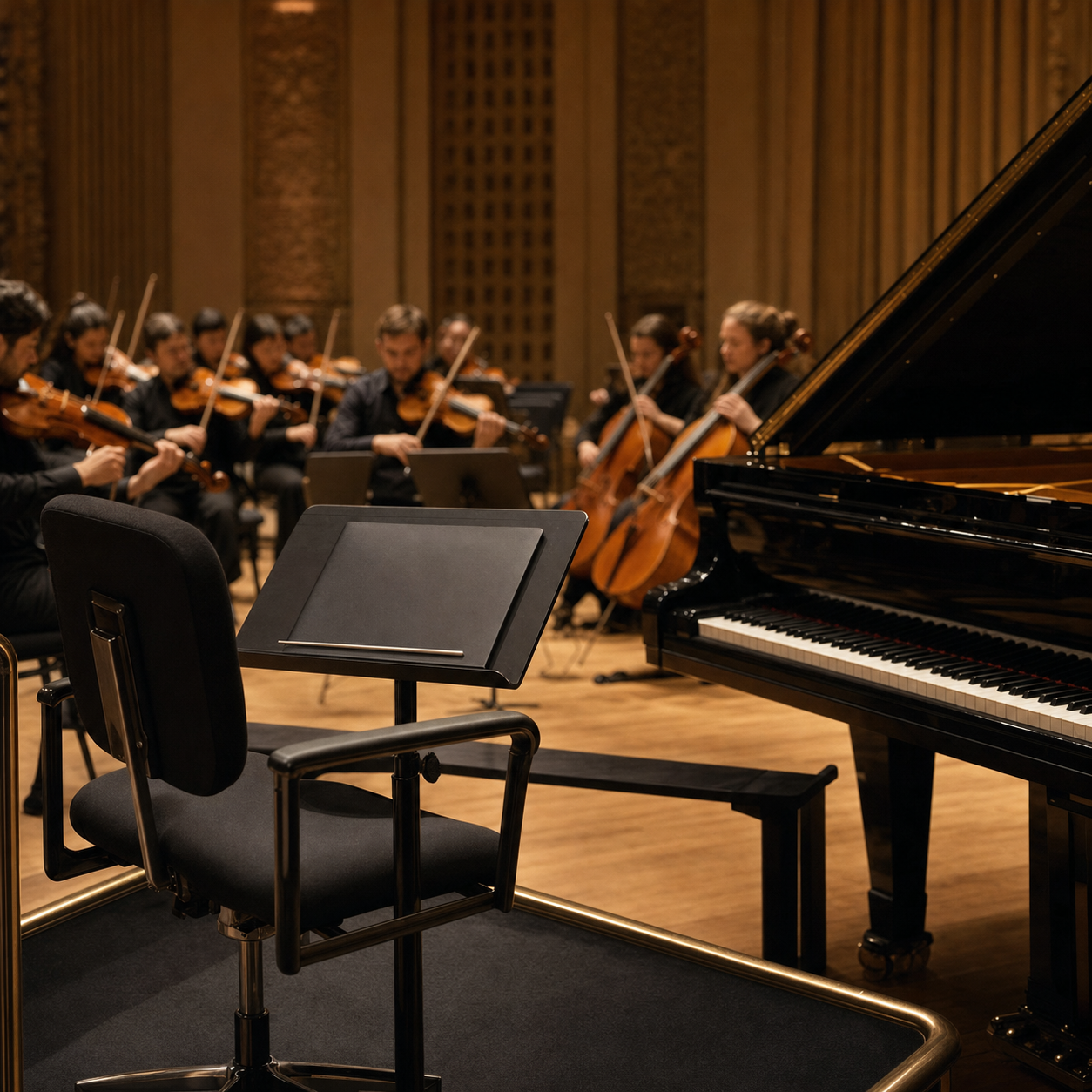
This has direct relevance for pianists. The solo piano is an orchestra of registers. A good Beethoven passage requires the left hand to conduct the right, the inner voice to answer the melody, the pedal to support without flooding the harmony. Barenboim’s conductorly way of thinking helps students imagine the piano as a community of lines rather than a single singing surface.
The West-Eastern Divan Orchestra adds another layer. Its own site describes an ensemble guided by principles of peaceful coexistence and collaborative creativity, and in 2026 it lists Barenboim conducting summer concerts. One should avoid turning music into easy symbolism, but the orchestra’s existence sharpens an important musical fact: ensemble requires listening before agreement. Players do not have to be identical to share time. That lesson belongs in chamber music, duo work, accompaniment and every serious piano lesson.
A Barenboim listening framework
Listen for how a movement’s early material prepares its later weight.
Ask whether breadth clarifies the music or merely slows it down.
Notice which line governs the harmony, especially in quiet transitions.
Hear the pianist as conductor: every register must know its role.
Serious piano listening: curated recordings and chamber work
A good Barenboim listening path should not try to be exhaustive. It should give the ear a few strong doors into his art. Deutsche Grammophon’s A-Z overview is useful because it frames a career across more than seventy years of recordings, including early solo material and later Beethoven sonatas. His official catalogue also connects recordings and books, making it clear that Barenboim has treated music as thought as well as performance.
Key listening point
In Barenboim’s best Beethoven, the listener should feel that tempo has been chosen for the whole argument. If the opening sounds broad, wait for the later return: the reason often becomes clear only in retrospect.
Chamber music, collaborations and where to hear the legacy in London
Barenboim’s chamber music is essential because it prevents the heroic conductor image from taking over. His London years with Jacqueline du Pre belong to a tradition of intense collaboration in which the piano is never merely accompaniment. It must breathe, argue, support and listen. That is why the best way for a pianist to learn from Barenboim may be to listen to chamber music before returning to solo Beethoven.
London gives this kind of listening practical form. Students can hear orchestral concerts, chamber recitals, lecture-style events and London music events, then bring those impressions into lessons. They can study piano masterclasses in London and compare how a teacher describes the same problem that a conductor solves on stage: balance, timing, character and direction.
For adult learners, there is also a useful route through adult piano lessons at WKMT. Barenboim’s example does not demand professional ambition. It demands a more precise ear. A returning pianist can learn to hear a bass line as an orchestral foundation; a serious amateur can learn to record practice and ask whether an intended phrase is actually audible. These are modest habits with large musical consequences.
Study classical piano with a more serious ear
WKMT’s London teaching connects technical work with musical culture: score reading, tone, interpretation, performance confidence and the habit of listening deeply. Barenboim’s career is a reminder that serious piano study begins when the ear starts asking better questions.
FAQs
Why is Daniel Barenboim important as both pianist and conductor?
Because his playing and conducting share the same priorities: structure, tempo, voicing and long-range musical argument. Pianists can learn from the way his conductor’s ear shapes the keyboard.
What should a London listener hear first?
Begin with Beethoven: sonatas for structure, concertos for dialogue, and recent West-Eastern Divan Orchestra performances for the conductor’s late style and ensemble control.
Can adult learners use Barenboim’s recordings in practice?
Yes, if they listen actively. Choose one phrase, identify the bass direction, compare voicing, and ask whether the performance makes the structure clearer rather than merely more impressive.
Sources, further reading and WKMT connection on Daniel Barenboim in London
Sources
- Daniel Barenboim official biography and timeline.
- Deutsche Grammophon biography: Daniel Barenboim.
- Deutsche Grammophon: Daniel Barenboim A-Z solo recordings.
- Royal Albert Hall: BBC Proms 2024 Prom 31 listing.
- The Guardian review: West-Eastern Divan Orchestra and Barenboim at the Proms, 2024.
- The Guardian review: West-Eastern Divan Orchestra and Barenboim at Royal Festival Hall, 2024.
- West-Eastern Divan Orchestra official site.
- Chicago Symphony Orchestra archive: Daniel Barenboim.
For WKMT students, the practical connection is clear: Barenboim’s career joins interpretation, keyboard discipline, chamber listening and orchestral imagination. That is the culture serious piano lessons should develop, whether the pupil is preparing Beethoven for a diploma, returning to the piano after years away, or learning how to hear a phrase with greater patience.